
Voronoi Bubbles
Informal use of Voronoi diagrams can be traced back to Descartes in 1644 Peter Gustav Lejeune Dirichlet used two-dimensional and three-dimensional Voronoi diagrams in his study of quadratic forms in 1850. British physician John Snow used a Voronoi-like diagram in 1854 to illustrate how the majority of people who died in the Broad Street cholera outbreak lived closer to the infected Broad Street pump than to any other water pump. Voronoi diagrams are named after Georgy Feodosievych Voronoy who defined and studied the general n-dimensional case in 1908. -Wikipedia.
The dual of this subdivision is the Delaunay triangulation. Although the name Voronoi comes from a specific mathematician, as seen in the brief history above, it actually has numerous predecessors.
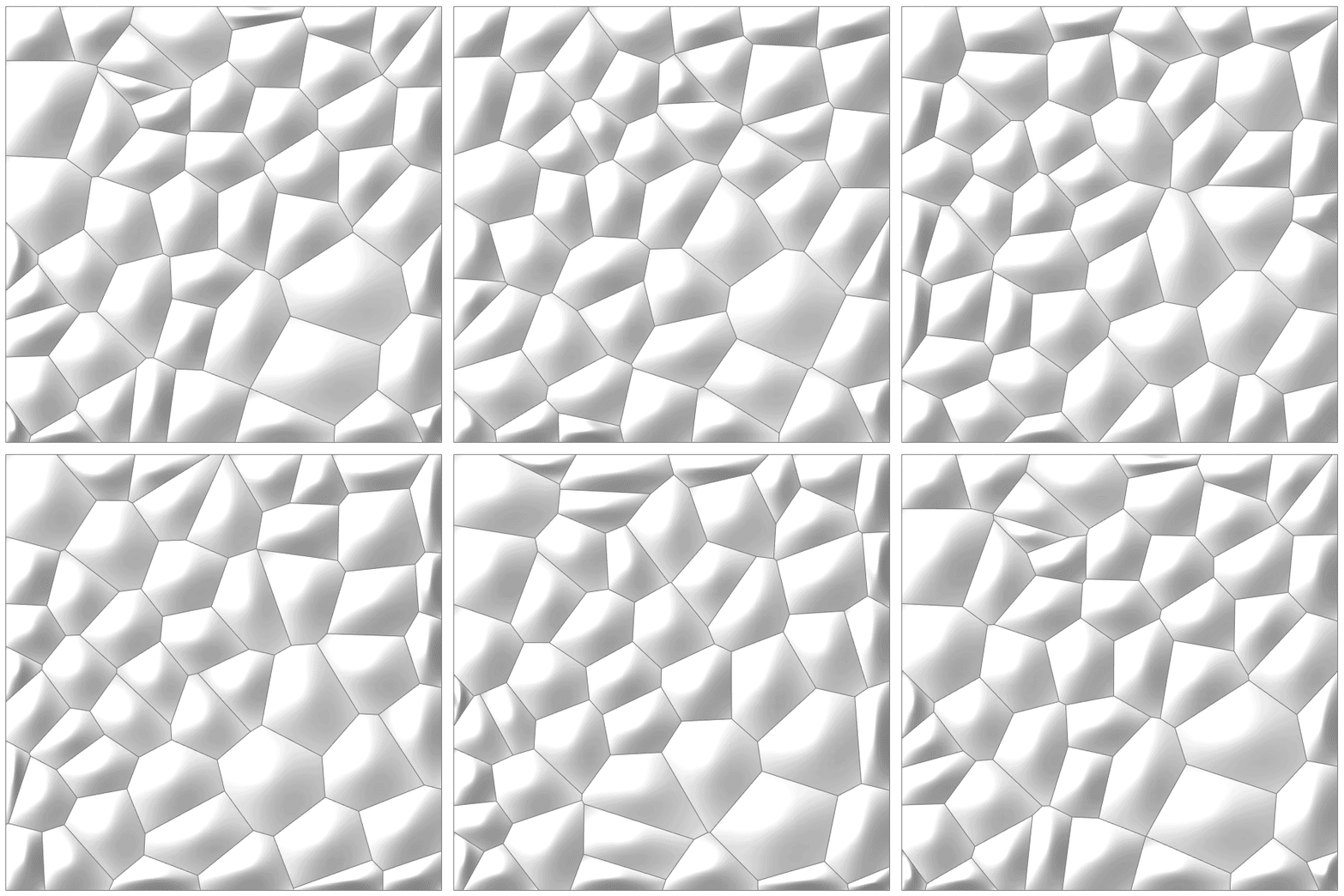
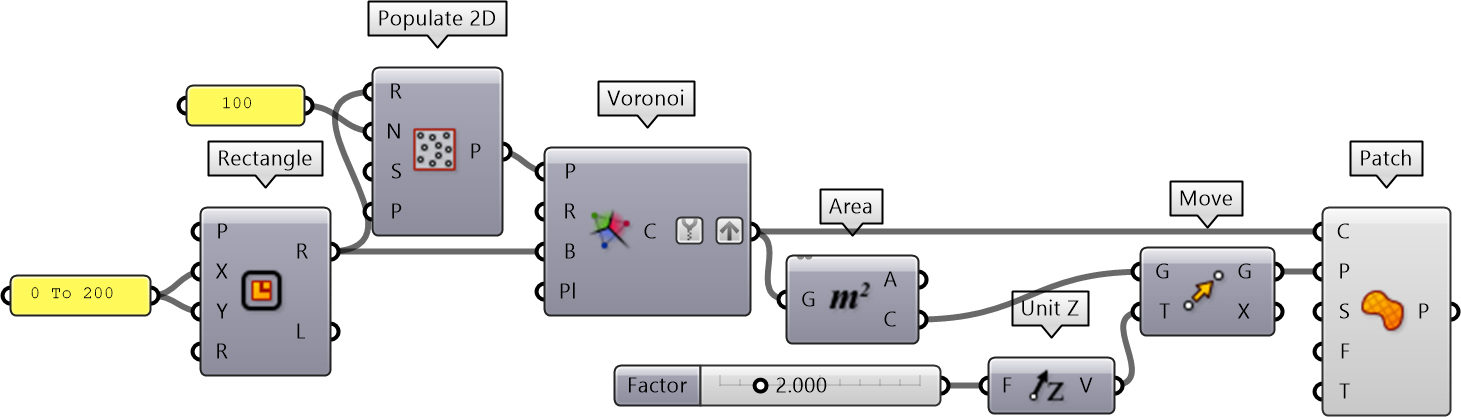
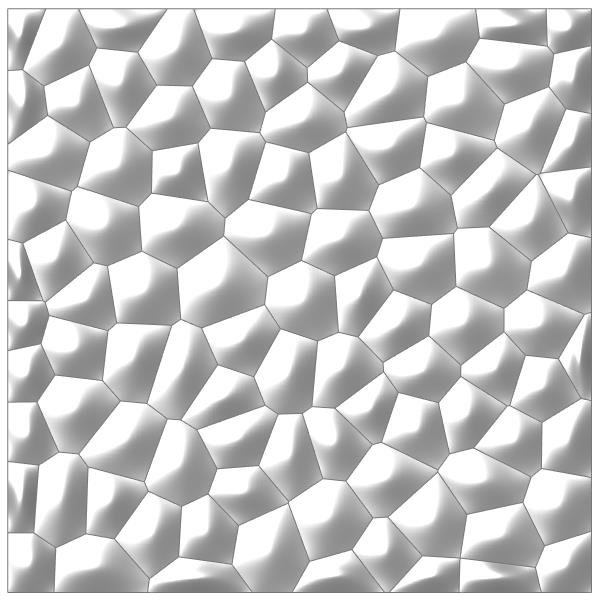
Dirichlet’s Age of Mathematics
Dirichlet Tessellation is essentially the exact same solution as Voronoi, and was defined for 2- and 3-dimensional spaces by the German mathematician Gustav Dirichlet about 50 years before Voronoi. Even though these systems are referred to as Voronoi in our field, the name Voronoi actually belongs to the n-dimensional generalization of this structure, whereas Dirichlet formulated the 2-dimensional definition in 1850, precisely the format used by Grasshopper. Because of this, I decided to gather some information about Dirichlet. As I mentioned on this site as well, he made contributions to Fourier Series. Beyond that, he has countless other contributions. As I looked closer, I noticed that he mentored some very interesting names (Dedekind, Riemann, Cantor, and Enneper). Each of them holds a unique place in geometry and mathematics. Dedekind surprised me in particular because, alongside Frege, he is the founder of Logicism. Riemann probably doesn’t even need to be mentioned. Cantor is the founder of set theory, and Enneper gave his name to a special surface I have used.
The relationship between Gauss and Dirichlet is a deep intellectual bond between the master who laid the foundations of number theory and his most loyal apprentice who carried that legacy to its peak. Gauss summarized his admiration for Dirichlet’s genius with the phrase, “Jewels are not weighed on a grocer’s scale,” and following Gauss’s death, Dirichlet took over his legendary chair in Göttingen, becoming the natural successor to this great mathematical heritage. Unfortunately, Dirichlet passed away only at the age of 54.
Cite this post
Related Posts
Frege and Logicism
November 7, 2026
Today’s Digital Culture reading was on Frege. After the historical process shaped by thinkers like Hobbes and Leibniz, and by the effects of capitalism, I thought reading Frege would provide a good foundation before moving on to Wittgenstein. Gottlob Frege (1848-1925) was a German mathematician and logician. He spent most of his academic life at the University of Jena. Regarded as one of the founders of modern logic and analytic philosophy, Frege argued that the foundations of mathematics should be…
Fourier Series
November 14, 2022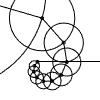
This is my first experiment with the Fourier Series in Grasshopper using Python. This is a technique to decompose functions into their frequency components. Fourier series have a wide range of applications in physics and engineering. What makes it especially fascinating, however, is the visual intuition it offers. It looks like a kind of mathematical “magic” that emerges from the geometry of frequency. I explored several excellent visual explanations online, including those by Coding Train, 3Blue1Brown, and Mathologer, each offering…
Fermat’s Nightmare
October 14, 2026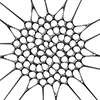
Revisiting a specific mathematical phenomenon that I previously explored twice, here (in 2017) and here (in 2011), from a different angle in 2026 now. This was the final video (from 2023) that I found in my junk folder during the blog’s resurrection. Today, designers mostly know Fermat through the famous 137.5-degree angle of rotation, which is the mathematical formula used to describe the arrangement of sunflower seeds. However, today I will speculate on a nightmare of Fermat’s. Because Fermat, in…
Karyokinesis
November 2, 2013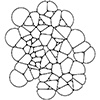
While searching for a way to work with random points and growing populations, this idea appeared accidentally. I wasn’t trying to mimic the behavior of Karyokinesis of biological cells (in fact I’m in serious doubt about biomimicry in general). The trick is to use a timer + data recorder + a knob for the arbitrary user input. It starts to breed when you start the timer, but to change the evolution speed, just roll the knob! Of course, the knob…
Points by Curvature
April 26, 2012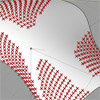
This is the basic form of a surface division, based on curvature. As each point on the surface has a curvature value, this might be used to dispatch those values and see the points at flat and curved parts of the surface. I used my favourite surface equation definition (here) as implemented equation of cos(x)+cos(y) in the animation below.