
Fourier Series
This is my first experiment with the Fourier Series in Grasshopper using Python. This is a technique to decompose functions into their frequency components. Fourier series have a wide range of applications in physics and engineering. What makes it especially fascinating, however, is the visual intuition it offers. It looks like a kind of mathematical “magic” that emerges from the geometry of frequency. I explored several excellent visual explanations online, including those by Coding Train, 3Blue1Brown, and Mathologer, each offering a unique perspective.
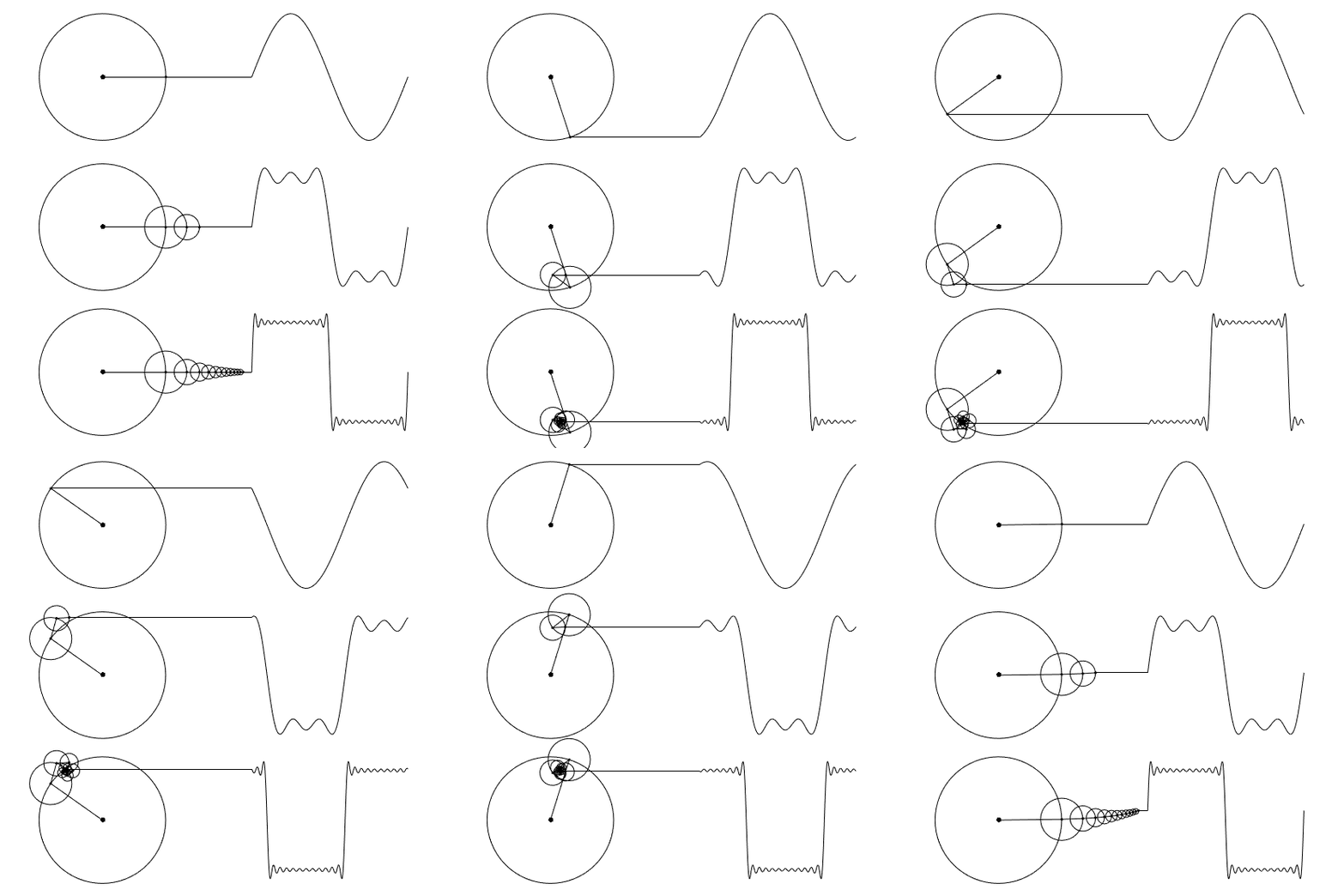
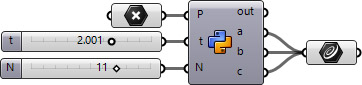
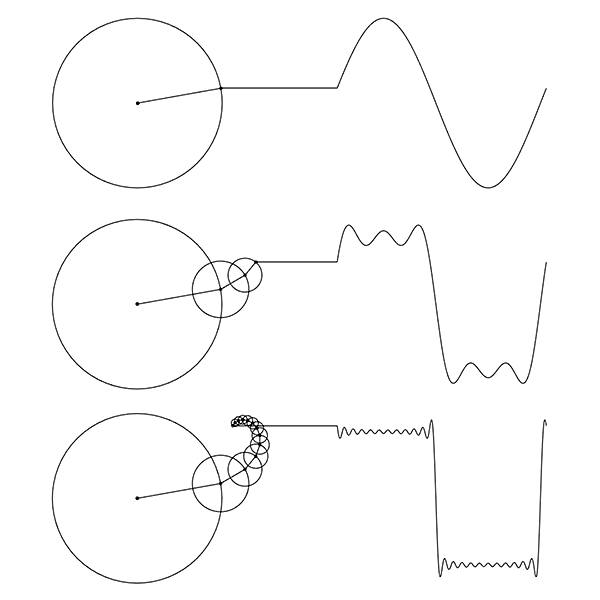
This Grasshopper definition includes a Python component that animates a set of rotating circles and the resulting wave. It serves as an introduction to more complex explorations. The N input controls the number of circles (harmonics), allowing you to observe how increasing complexity affects the wave. The t input advances the rotation, enabling animation. This is an early-stage experiment. I aimed at understanding the fundamentals of the technique. The more intriguing direction would be to reverse the process: given a waveform, the circle parameters that reconstruct it would be determined. This can be the core purpose of the Discrete Fourier Transform. I studied that topic here.
import rhinoscriptsyntax as rs
import math
a, b, c, wave_pts = [], [], [], []
dt, t = math.pi / 200, -2 * t * math.pi
x, y = P[0], P[1]
for i in range(N):
    n = i * 2 + 1
    r = 4 / (n * math.pi)
    prev = [x, y, 0]
    x += r * math.cos(n * t)
    y += r * math.sin(n * t)
    a += [rs.AddCircle(prev, r), rs.AddCircle([x, y, 0], 0.02)]
    b.append(rs.AddLine([x, y, 0], prev))
tw = 2 * math.pi
while tw > 0:
    wy = P[1] + sum(4 / ((i * 2 + 1) * math.pi) * math.sin((i * 2 + 1) * (t + tw)) for i in range(N))
    wave_pts.append([3.6 + tw / 2, wy, 0])
    tw -= dt
c.append(rs.AddInterpCurve(wave_pts))
b.append(rs.AddLine([x, y, 0], [3.6, y, 0]))
Above is the Fourier Series code I wrote in the Python component. So, it should work in Rhino 6, 7, and 8 without problems. However, you can rebuild the component by copying the code above.
Cite this post
Related Posts
Generating Harmonic Motion
September 21, 2026
While trying to program the curves produced by Spirograph toys in Grasshopper, I took a slightly different path. The topic eventually led to a broader heading: harmonic motion, and from there, to the Fourier Series we looked at previously. This simple Python code models Fourier Synthesis, driven by circles of different radii in a very straightforward way. The Python component sets up a loop that calculates the effect of each circle to the x and y values, individually. In this…
Discrete Fourier Transform
May 8, 2025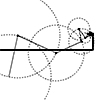
The Fourier Transform is a powerful mathematical technique that allows us to analyze the different frequency components within a signal or shape. Its discrete version, the Discrete Fourier Transform (DFT), is used when working with numerical data. I studied the Fourier Series here before. One of the most fascinating aspects of the DFT is that it can represent a signal or shape using rotating circles (or vectors). Each circle corresponds to a specific frequency, amplitude, and phase. When connected in…
Fermat’s Nightmare
October 14, 2026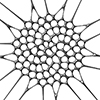
Revisiting a specific mathematical phenomenon that I previously explored twice, here (in 2017) and here (in 2011), from a different angle in 2026 now. This was the final video (from 2023) that I found in my junk folder during the blog’s resurrection. Today, designers mostly know Fermat through the famous 137.5-degree angle of rotation, which is the mathematical formula used to describe the arrangement of sunflower seeds. However, today I will speculate on a nightmare of Fermat’s. Because Fermat, in…
Flow Map on Terrains
September 11, 2026
We previously looked at the terrain generator script we used in midterm projects with first-year architecture students over here. Later on, we added a few analysis modules to this tool. You might remember the slope analysis tool from this link. Today’s topic is another type of analysis: flow. The idea for this code wasn’t actually mine; I developed it by looking at an existing script based on Serkan Uysal’s suggestion. Unfortunately, I don’t know who originally wrote it. Keeping track…
Dual Polyhedra in Grasshopper
October 7, 2025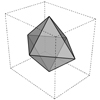
Exploring dual polyhedra in Grasshopper is an interesting topic. In this post, I try to generate the dual of any polyhedron using Rhino Python and possibly Grasshopper. I developed this code for Rhino Python earlier here, and now I have converted it into a Grasshopper-Python component for better usability. I start the process by breaking the polyhedron into individual faces and gathering the corner points of each face. These points become the vertices of the dual polyhedron. Then, for each…