
Islamic Patterns of Semi-Regular Tessellations
The intricate harmony of the Islamic Patterns is amazing. The geometry of this and other Islamic pattern designs are explained in the 3rd chapter of Craig S. Kaplan’s Ph.D. dissertation. I constructed a semi-regular tessellation, particularly the 4.8 because it seems to open interesting explorations that mostly emerge from truncated squares. We know equilateral triangles and hexagons are also fundamental shapes for this task. However, the dual nature of the semi-regular tessellations makes a difference in most compositions. First, I focused on developing a truncated square tiling. It was easy to divide and rebuild the grid cells in octagons. However, it was also necessary to tell Grasshopper that there are emergent small squares. The rest was easy, offset the square and octagon, then re-build with the proper vertex IDs. Overall, it is a good exercise for pattern studies in Grasshopper.
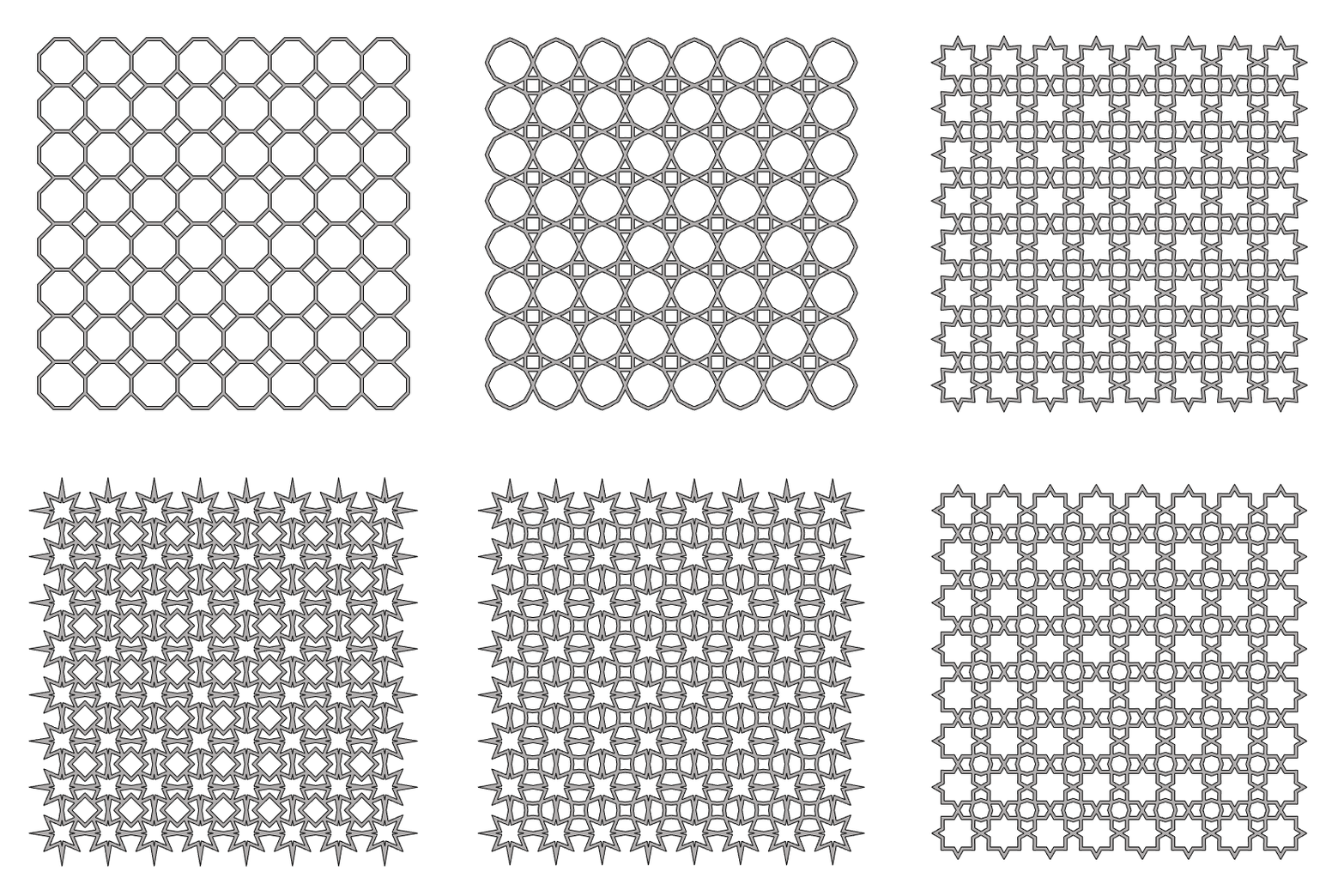
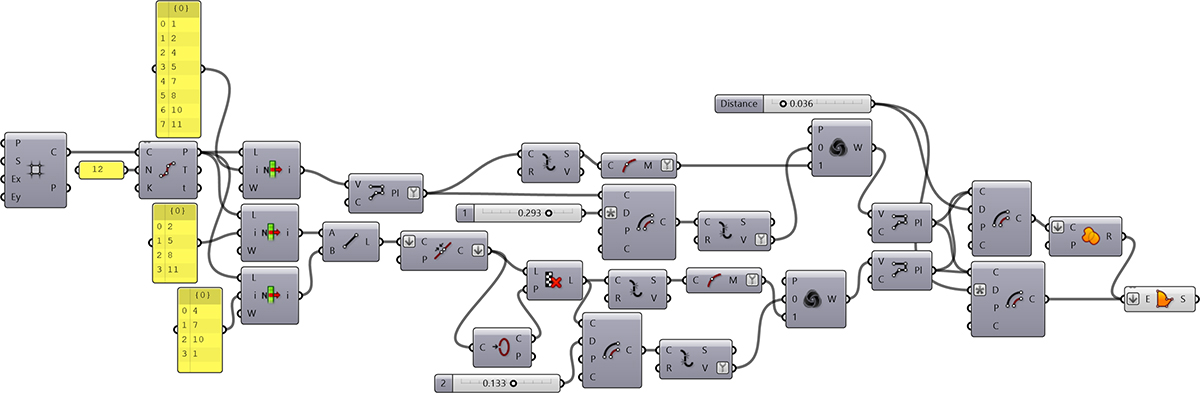
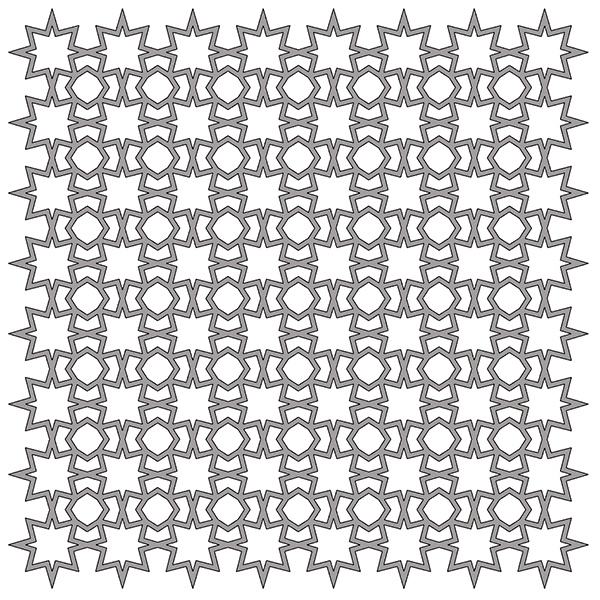
This Grasshopper definition generates Islamic Patterns based on the semi-regular tessellation of 4.8. The input parameters are the number of the grid cells, the parameters of both octagonal and quadrangular stars, and the offset value of the lattice. The code is using native Grasshopper components. Thus, no add-ons are necessary for it to work. However, you can implement the Clipper add-on for faster lattice calculation.
Cite this post
Related Posts
Snub Square Tiling
October 22, 2012
Here is the step-by-step generation of the old Snub Square Tiling. Frankly, this is the first step in the generation of Cairo Pentagonal Tiling I generated with Grasshopper earlier. Because Cairo pentagonal is the dual of a snub square. The first step was easy. Just dispatch cells of a square grid, then evaluate them according to the ratio of 0.366 approx. which is derived from the bisector of an equilateral triangle. Now, we have a snub square tiling, composed of…
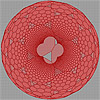
Truncated hexagonal tessellation (or named 3-12-12) is represented in hyperbolic space (as far as I understood it). The idea is simple if you don’t mix it with complex equations. Below is the 2-dimensional representation of hyperbolic projection. Paper space is defined by the thick line there. Projection is based on a two-sheet hyperboloid surface. Euclidean version of this tessellation is described here.
Semi-regular Tessellations
May 24, 2012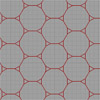
Creating and handling new types of grid configurations might be an important topic, as Grasshopper is not supporting them natively (yet). I tried to create some semi-regular tessellations based on regular grids. It is actually truncated versions of regular grids, but it slowly becomes interesting as I realized that I may further truncate emerging grids to create Level 2 and Level 3 grids with more complex tessellations. Here are two examples of Level 1, truncating regular tessellations of squares and…
Semi-regular Surface Tessellation
December 20, 2011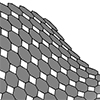
Back in 2011, one of the first posts on designcoding explored how to divide a surface in alternative ways. I called this Grasshopper definition a semi-regular surface tessellation. Although the term isn’t entirely accurate -since the pattern is neither planar nor made of equilateral shapes- it still reflects what I had in mind. Dividing surfaces into fabricable parts remains a key concept in learning parametric modeling, so I decided to revisit and update this old definition. There must be many…
Hexagonal Star Lattice
December 18, 2023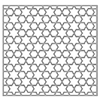
Here are the variations of classical six-pointed star patterns generated by Grasshopper. Generally, you can see these patterns under the title “Islamic patterns” because they are frequent in the decorations of mosques and palaces. I studied these patterns in Grasshopper earlier in these posts. I always find this an interesting geometry exercise. This time, my main goal was to develop a useful code only with the native Grasshopper components that create laser-cut-ready products of hexagonal star lattice. Thus, I made…