
Star Lattice
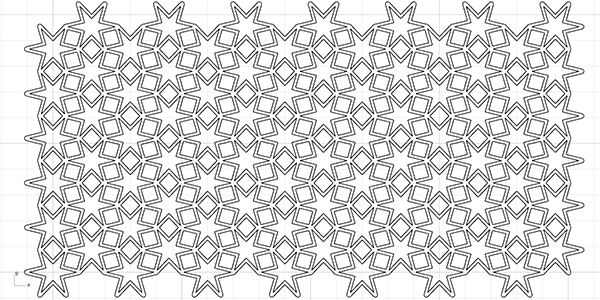
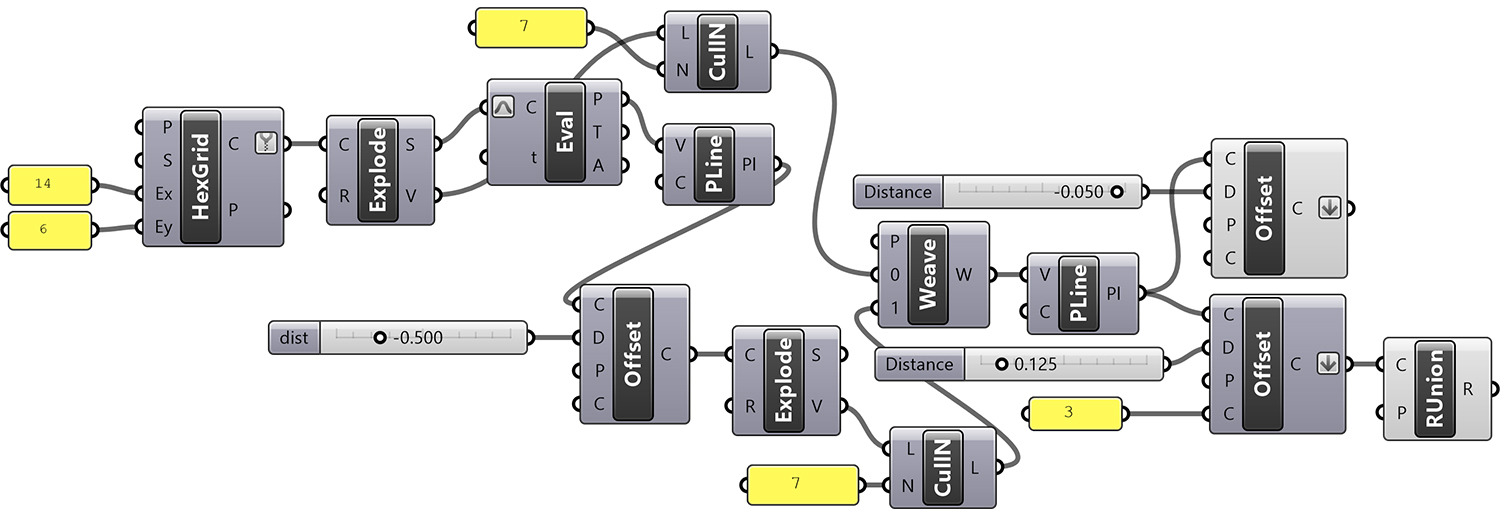
This is the six-pointed star lattice definition in Grasshopper. The definition is generating CNC or laser-ready results as seen below. In this code, first, I developed a common star pattern by exploding a hexagonal grid. The tricky part of this definition is the last part. There, you can see how you can use the Region Union (RUnion) component to add thickness to a pattern we have drawn before. The operation here will require trimming and extending commands under normal conditions. However, closed curves that are shifted outward from star shapes can be combined with the help of Region Union (RUnion). So that you can delete the overlapping parts between them. I used a second Offset component for the inner stars.
I recommend that you can try the same process in different patterns that are irregular. Although the Region Union component is problematic sometimes, this definition runs smoothly in most cases. One thing to note is when we explode closed polylines like here. The code repeats the first and last element of the list of points from the V output. Therefore, before knitting the points forming the star with Weave, I deleted one point from each list. I did this with the help of a Cull component and corrected that issue.
Cite this post
Related Posts
Lace Experiments
September 15, 2026
For a research project with Avşar Gürpınar in 2024, we studied lace patterns. During this process, I had the opportunity to try out two Grasshopper plugins: Parakeet and Clipper. When combined, they allow you to obtain laser-cutting patterns. Parakeet is a very good plugin that generates tessellations. This was something I always dreamed of developing back in my youth. 2-Uniform Tiling In this design, I used the Parakeet component named 2-Uniform Tiling. In geometry and tiling theory, a 2-uniform tiling…
Hexagonal Star Lattice
December 18, 2023
Here are the variations of classical six-pointed star patterns generated by Grasshopper. Generally, you can see these patterns under the title “Islamic patterns” because they are frequent in the decorations of mosques and palaces. I studied these patterns in Grasshopper earlier in these posts. I always find this an interesting geometry exercise. This time, my main goal was to develop a useful code only with the native Grasshopper components that create laser-cut-ready products of hexagonal star lattice. Thus, I made…
Islamic Patterns of Semi-Regular Tessellations
October 22, 2012
The intricate harmony of the Islamic Patterns is amazing. The geometry of this and other Islamic pattern designs are explained in the 3rd chapter of Craig S. Kaplan’s Ph.D. dissertation. I constructed a semi-regular tessellation, particularly the 4.8 because it seems to open interesting explorations that mostly emerge from truncated squares. We know equilateral triangles and hexagons are also fundamental shapes for this task. However, the dual nature of the semi-regular tessellations makes a difference in most compositions. First, I…
Parquet Deformation of Star Patterns
February 3, 2012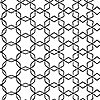
This is another starting point for pattern generation study in a dataflow environment. I tried to implement the parquet deformation of Islamic patterns in Grasshopper. I studied Hankin’s method of Islamic Pattern generation. Then I tried to simulate his process beginning with basic regular tiling (regular hexagonal tessellation). Craig S. Kaplan (here) explains this and other methods in his dissertation. A Simple Foundation We have already experienced the result of exploding any hexagonal grid, shifting its points with the help…
Deformation of Islamic Patterns
March 2, 2024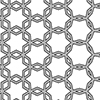
This is the new version of my previous study on the deformation of Islamic Patterns. I love the purity and simplicity of the geometric construction processes of these patterns. It is possible to observe them in many places in many different forms. By continuing this work, I aimed to highlight the pattern deformations that map out all the variation possibilities of these patterns. Unlike previous versions, this time I aimed to achieve results ready for laser-cutting production. As you will…