designcoding
About Table of Contents Keywords Monthly Archive
Support designcoding!

#folding

22 posts

A-Chord Folding Structure

April 12, 2015
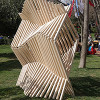
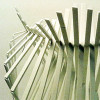
The A-Chord folding structure was developed and constructed for the World Wood Day 2015 event in İstanbul. The structure had fifty wooden struts of 4 cm X 4cm with changing heights from 200 cm to 230 cm. Two struts joined with a hinge enabled the folding motion of the structure. Thus, the nearby unit is folding in the opposite direction. The Grasshopper model generated all construction details and drawings automatically. As a result, these data enabled the revisions needed for structural experiments. In…

Contouring and Folding Together

March 7, 2015

This is a project proposal designed at the workshop organized together with Simge Esin Orhun and Fulya Akipek as part of the International Wood Day Exhibition in İstanbul. This time, the final Grasshopper definition is created “after” some experiments with physical models. Here is the first model showing the idea inspired by the folding chairs studied here. I realized that in order to make a “wall” instead of a chair, it would be a good idea to extend the edges of the…

Design Geometry Final Works

February 2, 2015

Classical folding methods were subjects to be tested and studied in this semester’s design geometry classes. This has been very useful in introducing first-year students to 3d euclidean constructions and using physical objects as references to a digital model. Groups of students studied different folding methods and made both physical and digital models. Two of these methods were dominant in the class however, one of them was the variations of Miura-Ori, and the other one was Ron Resch’s famous folding pattern. Below…

Contour-fold Structure

February 1, 2015

Euclidean constructions, when represented computationally, rely on algorithms and mathematical principles to generate geometric shapes and forms. Through precise calculations and logical operations, a computer program can emulate the actions of a compass and straightedge, constructing lines, circles, and polygons with accuracy and efficiency. These digital incarnations of Euclid’s timeless techniques enable the exploration of geometric concepts and the creation of visually captivating representations. This project is interesting because of the Euclidean construction underneath. Initially, I studied this type of…

Mesh

January 20, 2015

This year’s first semester at Basic Design Studio was full of surprises. Together with Can Sucuoğlu and Birgül Çolakoğlu, we coordinated 9 student groups in their 4-week final project called “Arboriforms“.  “Arbori-” is derived from the Latin word “arbor,” meaning “tree,” and “-form” indicates a shape or form. Therefore, we can understand “arboriform” as an adjective describing something that is tree-like in appearance, structure, or form. For example, one might use the term “arboriform” to describe the branching pattern of…

The Kirigami Fold

May 23, 2014

Third and the final outcome of the Animate Patterning workshop is coordinated by Mehmet Ali. Students tried to develop a kirigami-like surface animation (which is also a good solution to my one-servo question) while they studies numerous variations. They ended up with this panel, ready to be moved by Arduino; The workshop is organized together with Mehmet Ali Altın and Fulya Akipek. Students are, Murat Akırmak, Gizem Ceyhanlıer, Cem Kıyak, Bartu Can, Tuğba Levent, Seda Orhan, Gizem Gümüşkaya, Yunus Emre…

The Miura Fold

May 23, 2014

This is one of the works of the three-day workshop at Eskişehir Anadolu University, called “Animate Patterning“. This project is based on our previous folding experiment posted here, while students advanced it, testing a folding style called “Miura”. They built a 2.5m x 1m folding pattern, explained briefly here. After analyzing, and testing the folding technique, they drew the tessellation composed of a single parallelogram. They joined the structure together with hinges and screws. Finally, an Arduino setting is added including a continuous…

Prototype Cut-Fold

May 12, 2014

Inspired by this cut-fold pattern, we developed a prototype with Fulya Akipek. The first experiments were made from 3mm thick foamboards and they worked very well with 50×70 plates. However, when the project gets bigger and bigger, we needed to add a joint detail and use 5mm thick foamboards to achieve our goal (that is to develop a 1m by 2.5m shutter system). Then, we tried to animate its folding behavior by adding an Arduino setting with one motion sensor and a…

Folded Plates: Basic Design Project

June 21, 2013

Below is one of the fourteen final projects of the freshman year Basic Design studio in İstanbul Bilgi University Faculty of Architecture. The component is made of folded aluminum sheets. Students insist that this is the most optimal solution to the problem of polyhedra in a component-based structure. They experimented with this shape a lot and tried their best to make one that has similar triangular faces on different sides, so the component would drive the macro form in diverse…

Waterbomb Tessellation

January 23, 2013

It all started with my new passion for origami tessellations, not much of origami, but the tessellation part. I was too lazy to fold it physically, nor model them using an engine such as Kangaroo. That would also be very unnecessary (and yes, very boring) to simulate a folding effort on the computer unless we lose our connection with the real world. Instead, I tried to look at a much more abstract, silly, and basic part of it; the creasing…

« 1 2 3 »
  • Chapters

    • Algorithms
    • Discourses
    • Fabrications
    • Studios
  • Explore

    • All Keywords
    • Table of Contents
    • Monthly Archive
    • #aluminium
    • #tetrahedron
    • #noise
    • #cnc-milling
    • #firefly
    • #muqarnas
    • #chaos
    • #permaculture
    • #ice-ray
    • #gyroid
    • #hotwire-cutting
    • #gosper-curve
    • #archimedean-solid
    • #stone
    • #phyllotaxis
    • #simulation
    • #complex-number
    • #rhombus
    • #hyperbolic-paraboloid
    • #kuka-prc
  • Search

  • Support designcoding!

  • Enjoying designcoding? Support me on Patreon to keep it growing. Thank you!

  • copyright 2026 designcoding.net | about | privacy policy | end user license agreement