
Sierpinski Triangle
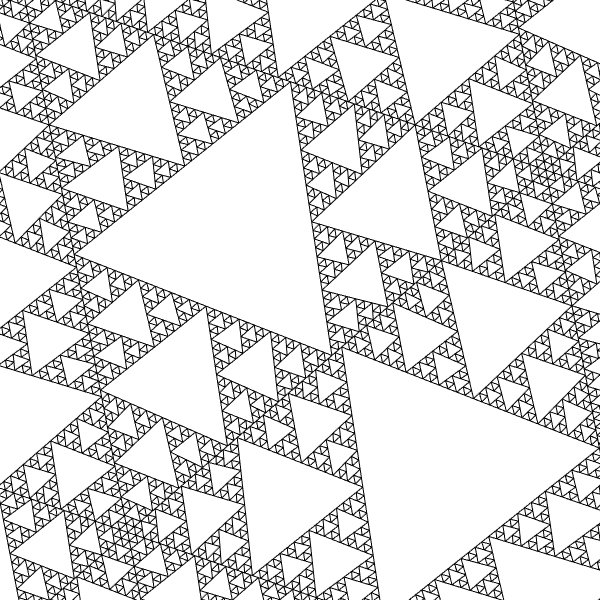
Today’s computational curve is the beautiful Sierpinski Triangle. It is a fractal named after the Polish mathematician Waclaw Sierpinski, who described it in 1915, though it had been previously described by other mathematicians. It is a self-replicating pattern that arises from a simple recursive process. To construct the fractal, you start with an equilateral triangle and then repeatedly remove smaller equilateral triangles from its interior, leaving holes. Each iteration involves dividing each triangle into four smaller triangles and removing the middle triangle. Then, you repeat this infinitely. The Sierpinski triangle exhibits self-similarity, meaning that it looks the same at any magnification or scale. It is a fascinating example of how simple rules can lead to complex and beautiful patterns in mathematics.

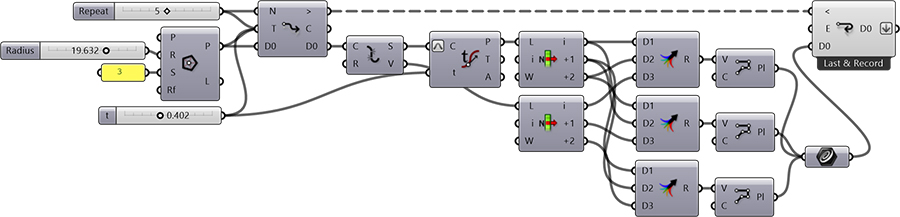
This Grasshopper definition generates the Sierpinski Triangle and its improvizations with several input parameters. The number of iterations, initial radius, thickness of the lattice, and evaluation parameters are the user-controlled inputs. So, you can generate the original Sierpinski Triangle and several deformed variations of them by playing with the inputs. The outputs are a planar surface and closed polylines of the resulting lattice. Therefore, it is ready to be laser-cut. I made the definition with the help of the Anemone iteration components. So, you need to install it to be able to use the definition.
Cite this post
Related Posts
Polygon Fractals with Rhino Python
August 2, 2017
We will see a simple Rhino Python exercise here. I called these Polygon Fractals (or Pentaflakes sometimes). It is both educational and fun to play with them. In Rhino, it can be a good exercise for basic CAD commands and transformations such as move, copy, and scale, and precision drawing operations such as object snapping. Also, in Grasshopper, it can be a good challenge for looping. In Rhino Python, it is already a good exercise for understanding Python and the…
Star Lattice
May 15, 2023
This is the six-pointed star lattice definition in Grasshopper. The definition is generating CNC or laser-ready results as seen below. In this code, first, I developed a common star pattern by exploding a hexagonal grid. The tricky part of this definition is the last part. There, you can see how you can use the Region Union (RUnion) component to add thickness to a pattern we have drawn before. The operation here will require trimming and extending commands under normal conditions….
Drawing Hexaflake
December 11, 2024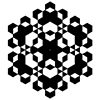
The term “hexa” generally refers to the number six, derived from the Greek word. It is commonly used in mathematics, geometry, and other scientific fields to indicate six-sided shapes or structures. A hexagon is a polygon with six sides and six angles. It is one of the regular polygons, meaning all of its sides and angles are equal. A hexahedron is a polyhedron with six faces. The most well-known example is the cube, which has six square faces, twelve edges,…
Dragon Curve Fractal
December 25, 2023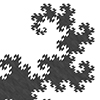
This week’s fractal is the famous Dragon Curve. Dragon Curve exhibits self-similarity, meaning parts of the curve resemble the overall shape, regardless of scale. It’s fascinating because a relatively simple construction process generates a complex and visually captivating fractal pattern. The Dragon Curve is often used to demonstrate fractal properties in mathematics and is popular in recreational mathematics due to its intricate and beautiful patterns. It has applications in computer graphics and is interesting in studying chaos theory, self-similarity, and…
Cesaro Fractal
December 19, 2023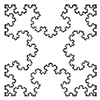
In this study, I explore Cesaro Fractal, generated by Grasshopper. Usually, it is not possible to code recursive algorithms in Grasshopper. With the help of the Anemone add-on, these fractal curves are easy to model. I studied similar fractal algorithms here before. This one is very similar to the Koch’s snowflake. The only difference (as far as I understood) is the side of the spikes. Koch’s Snowflake generates triangular spikes pointing to the outside of the polygon. Cesaro Fractal does…