
Landscape Extensions Final: Digital Sketch
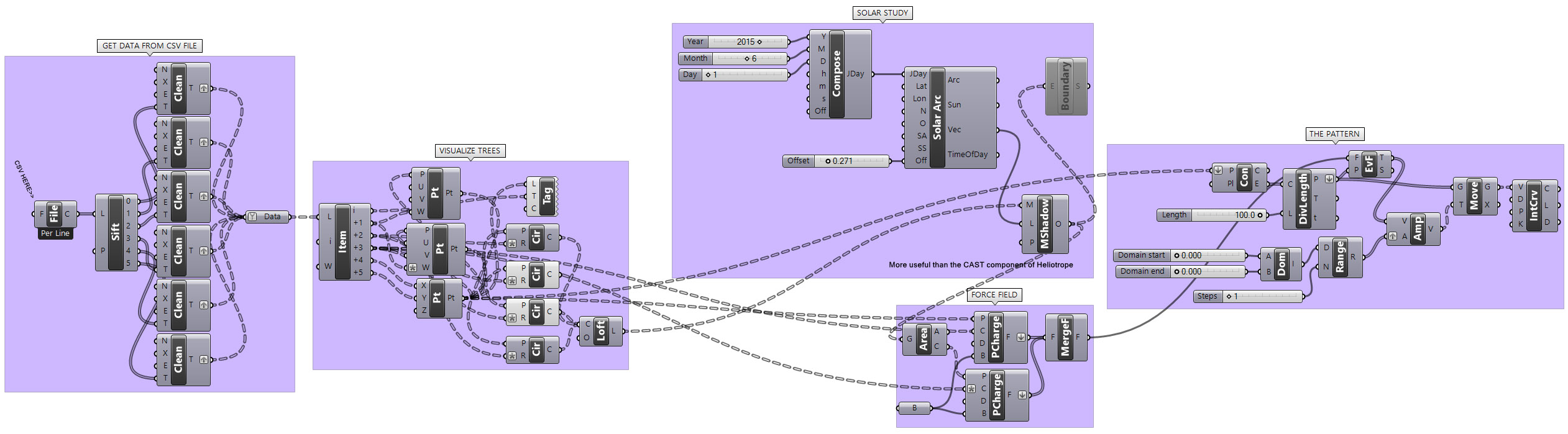
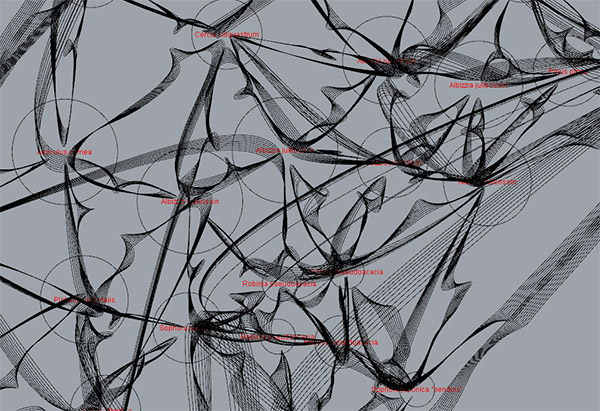
This is the final Grasshopper sketch of our graduate studio conducted together with Fulya Akipek at Yıldız Technical University Computational Design Unit. The project was about designing parametric “Landscape Extensions” at Kabataş Park in İstanbul. I hope I’ll be able to post the actual student works and the material system, but now; only the final result of the digital sketch we’ve developed together with students is presented here. This was a kind of “sketchy” definition that came up as an investigation about how can we construct a system on the selected area that can help us formalize our design concepts. The trees were one of the important elements of the park so students obtained all possible data about them. After the first discussions, this design idea slowly evolved into creating a parametric system that helps to produce appropriate surfaces for people to sit, to lay in the park. So that the Grasshopper definition takes this data about the trees from a csv file and creates a diagram that can be used to develop a solar shading study in order to describe the places and the ways of “sitting” there. However, the project finished without creating a solid connection between the material system and this parametric model. Please note the the Grasshopper definition requires Heliotrope components. Here is a video explaining the Grasshopper definition:
Cite this post
Related Posts
Ladybug Workflow
January 11, 2018
Here is a short series of videos showing the basic usage of Ladybug tools in a canopy design. So, I prepared this for my Parametric Design Systems elective course. Then, I encouraged my students to design their own canopies utilizing a similar Ladybug workflow in Grasshopper. In this first video, I am building a test surface in Grasshopper. I use the Graph Mapper component to derive 3D points and Interpolated curves. Finally, the EdgeSrf component is used to model the…
Flow Map on Terrains
September 11, 2026
We previously looked at the terrain generator script we used in midterm projects with first-year architecture students over here. Later on, we added a few analysis modules to this tool. You might remember the slope analysis tool from this link. Today’s topic is another type of analysis: flow. The idea for this code wasn’t actually mine; I developed it by looking at an existing script based on Serkan Uysal’s suggestion. Unfortunately, I don’t know who originally wrote it. Keeping track…
Vector Fields Exercise
April 4, 2023
Fields is a native group of components available since the very early version of Grasshopper. In today’s Design Computing class, we studied it again with the first-year design students. I studied these interesting and beautiful shapes earlier here, here, here, and here. The one you see below is a short in-class exercise about vector fields. The exercise aims to show the Grasshopper’s capabilities in form-finding studies via Field Lines. The definition starts with the generation of a set of random…
Delaunay Triangulation on Surface
March 26, 2015
This is a useful tip both to solve some of the problems with custom surface subdivisions, and to explain the uses of parametric surface evaluations (the U, V, W thing) and the practical use of data lists. Step 1: Put your points inside 0,0,0 and 1,1,0 so that the resulting coordinates can easily be converted to U and Vs. In the example, we are putting some random points between 0,0 and 1,1 using the Populate2d component. Step 2: Then make whatever you…
Delaunay Exercise
June 28, 2013
After becoming a ready-made component in Grasshopper, the Delaunay triangulation lost its popularity quickly. It used to be a nice problem of computational geometry for designers obsessed with scripting. Last month, Benay reminded me of the method of circle checking. She showed her Rhinoscript that creates circles from point triplets and checks if a point is inside or not. Today I studied this in Grasshopper to see if I can handle the required point combinations quickly. However, my first attempt…