
Delaunay Exercise
After becoming a ready-made component in Grasshopper, the Delaunay triangulation lost its popularity quickly. It used to be a nice problem of computational geometry for designers obsessed with scripting. Last month, Benay reminded me of the method of circle checking. She showed her Rhinoscript that creates circles from point triplets and checks if a point is inside or not. Today I studied this in Grasshopper to see if I can handle the required point combinations quickly. However, my first attempt was terrible.
Wikipedia has a clean-quick explanation of the term:
In mathematics and computational geometry, a Delaunay triangulation for a set P of points in a plane is a triangulation DT(P) such that no point in P is inside the circumcircle of any triangle in DT(P). Delaunay triangulations maximize the minimum angle of all the angles of the triangles in the triangulation; they tend to avoid skinny triangles. The triangulation is named after Boris Delaunay for his work on this topic from 1934.
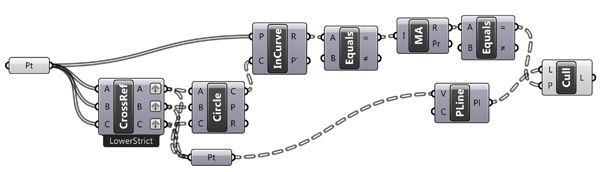
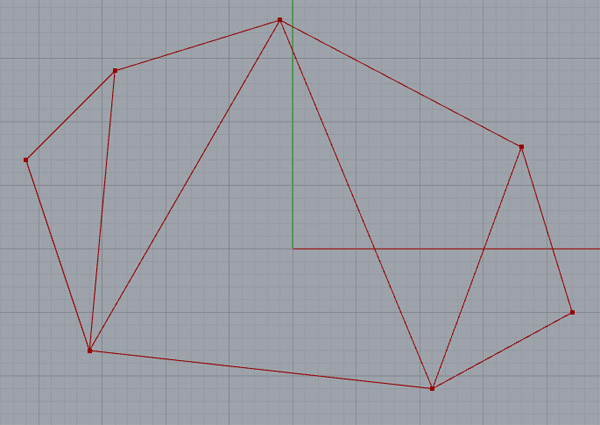
After a couple of dead ends, I solved it. The best part was understanding the “cross reference” component. It is a brute-force approach, creating all possible triangles from a given list of points. By using the combination formula I calculated the correct number of triangles. However, the different modes of the “cross reference” component give different results. “Lower strict” mode was the one I want, which calculates every combination of point triplets without caring about their order. I studied it with other native Grasshopper components but it became too complicated. After finding all of the circles. I checked if any point is inside these circles. If there is no point inside the circle, then these three points create a cell of the Delaunay triangulation. I checked with the ready-made component and it works correctly. But in some conditions, the circle component gives an error as three linear points cannot create a circle.
Cite this post
Related Posts
Delaunay Triangulation on Surface
March 26, 2015
This is a useful tip both to solve some of the problems with custom surface subdivisions, and to explain the uses of parametric surface evaluations (the U, V, W thing) and the practical use of data lists. Step 1: Put your points inside 0,0,0 and 1,1,0 so that the resulting coordinates can easily be converted to U and Vs. In the example, we are putting some random points between 0,0 and 1,1 using the Populate2d component. Step 2: Then make whatever you…
Landscape Extensions Final: Digital Sketch
February 1, 2015
This is the final Grasshopper sketch of our graduate studio conducted together with Fulya Akipek at Yıldız Technical University Computational Design Unit. The project was about designing parametric “Landscape Extensions” at Kabataş Park in İstanbul. I hope I’ll be able to post the actual student works and the material system, but now; only the final result of the digital sketch we’ve developed together with students is presented here. This was a kind of “sketchy” definition that came up as an…
Delaunay Triangulation with Rhino Python
July 27, 2017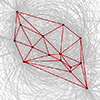
Boris Nikolayevich Delaunay was a Russian mathematician and mountain climber. He developed the Delaunay triangulation, which is a method in computational geometry. It is a triangulation of a set of points such that no point is inside the circumcircle of any triangle formed by the points. It’s widely used in computer graphics and mesh generation. In 2013, I made the brute force code in Rhino Python which is a slow solution to this problem. It used to be a nice…
Fermat’s Nightmare
October 14, 2026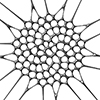
Revisiting a specific mathematical phenomenon that I previously explored twice, here (in 2017) and here (in 2011), from a different angle in 2026 now. This was the final video (from 2023) that I found in my junk folder during the blog’s resurrection. Today, designers mostly know Fermat through the famous 137.5-degree angle of rotation, which is the mathematical formula used to describe the arrangement of sunflower seeds. However, today I will speculate on a nightmare of Fermat’s. Because Fermat, in…
Campanus Sphere
October 9, 2026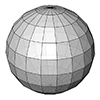
I want to introduce a concept I came across the other day, one I had never heard of before, along with a few fantastic websites. The Campanus Sphere is essentially a rather crude spherical representation, the kind I’m used to seeing in (very old) computer games, and it also makes a nice nod to 80s disco culture. I also recall that in many older CAD software packages, spheres and sphere-related Mesh objects were represented as polyhedra using this method. However,…