
Ladybug Workflow
Here is a short series of videos showing the basic usage of Ladybug tools in a canopy design. So, I prepared this for my Parametric Design Systems elective course. Then, I encouraged my students to design their own canopies utilizing a similar Ladybug workflow in Grasshopper.
In this first video, I am building a test surface in Grasshopper. I use the Graph Mapper component to derive 3D points and Interpolated curves. Finally, the EdgeSrf component is used to model the surface.
In the second video, I obtain the climate data file for Istanbul. The *.epw file will be used in Grasshopper Ladybug components. I use the importEPW component of Ladybug to load the file. Then, sunPath component quickly draws the solar path diagram. Finally, I am showing how to create various charts and print them in Rhino.
In the third video, I am testing and comparing several surfaces generated and baked by the code in the first video. The test is ComfortShadingBenefit. Thus, I am trying to calculate and compare the total heat of the surface geometries over a yearly period.
In the fourth video, I am creating an adaptive surface component. It used the data coming from the analysis results.
In the final video, I am calculating the sunlight hours of the floor surfaces via several canopy forms. So, these are the basic analyses I could test as a Ladybug Workflow in 2018. However, I think I am going to develop this tutorial series better in the future. Because maybe I can shoot more coherent and useful tutorials. Finally, after this and other classes, my students created their canopy designs. Here are some of the example student works:
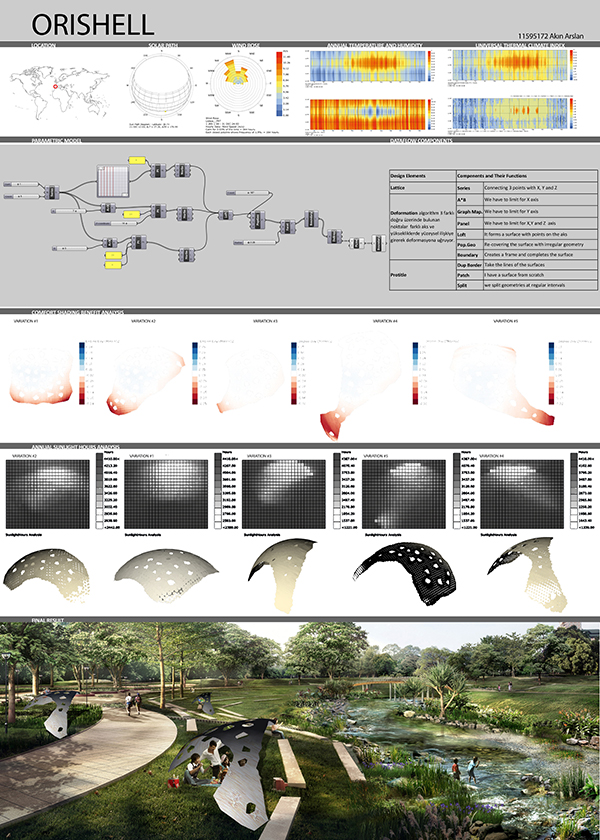
Akın Arslan
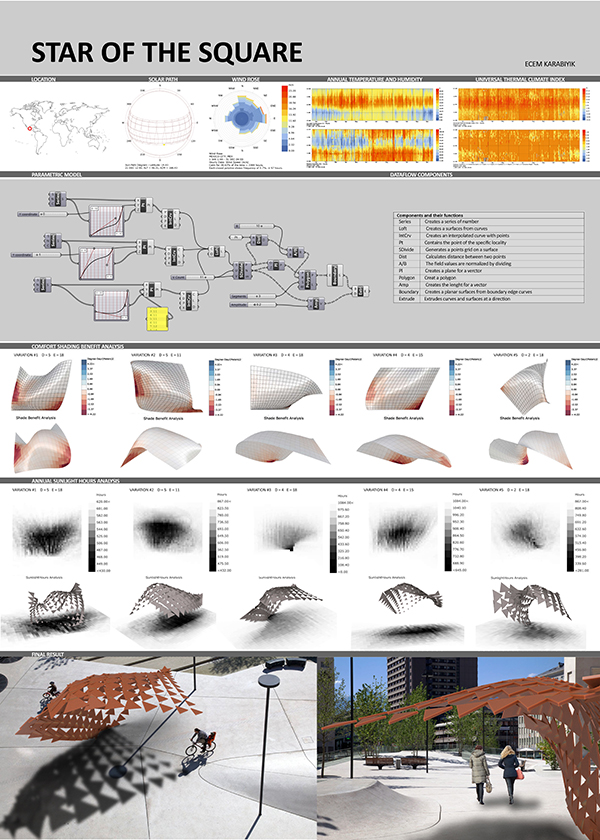
Ecem Karabıyık
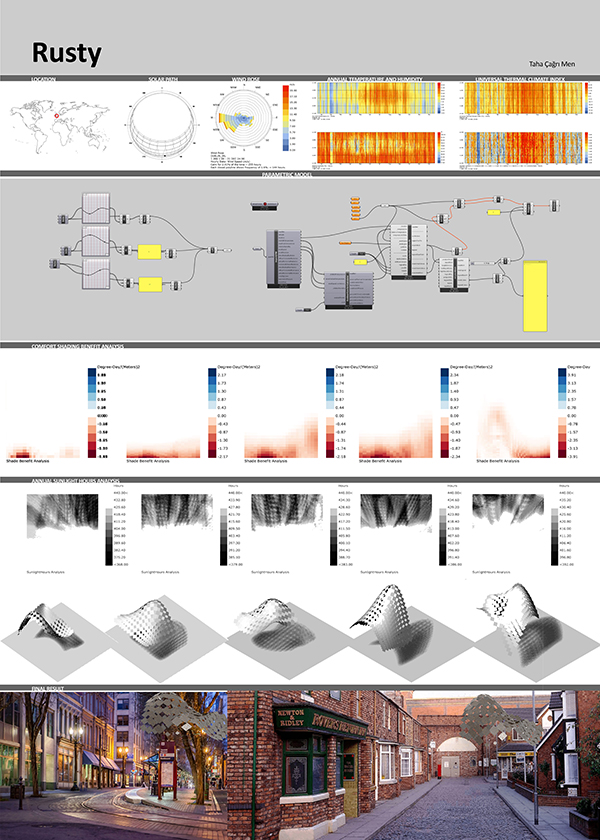
Taha Çağrı Men
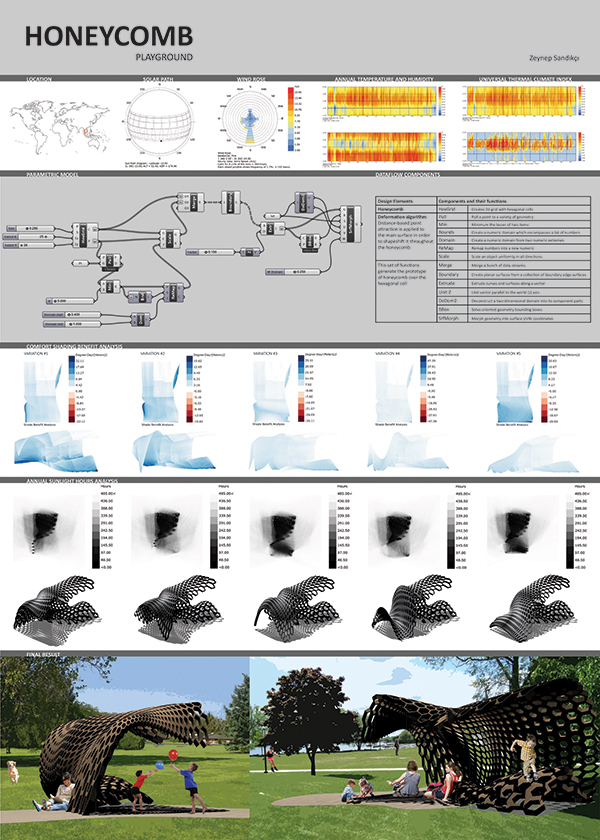
Zeynep Sandıkçı
Cite this post
Related Posts
Landscape Extensions Final: Digital Sketch
February 1, 2015
This is the final Grasshopper sketch of our graduate studio conducted together with Fulya Akipek at Yıldız Technical University Computational Design Unit. The project was about designing parametric “Landscape Extensions” at Kabataş Park in İstanbul. I hope I’ll be able to post the actual student works and the material system, but now; only the final result of the digital sketch we’ve developed together with students is presented here. This was a kind of “sketchy” definition that came up as an…
Solar Analysis including Occlusion
May 31, 2012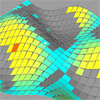
I’ve worked a little more about the Solar Position definition I’ve started here. The definition uses Danel da Rocha’s beautiful solar position script and utilizes it with other components. It creates visual output for any given surface, divided into quads (with side faces of course) and coloring according to their orientation to the sun. This time I added an occlusion part to calculate the surface’s own shadow. Now, the solar calculation takes surfaces as obstacles and dispatches the occluded faces…
Solar Position
May 6, 2012
Experimenting with various plug-ins for solar calculations, I found Daniel Da Rocha’s robust implementation of the solar position algorithm in vb.net. It calculates the solar angle of any place and time. Although it’s written in the old vb.net component, it still works great. I’m trying to create a fast and easy workflow to optimize Grasshopper models based on solar directions. This is done by projecting faces to the solar planes and checking how much of their area is included in…
Canopy of Vector Fields
April 26, 2015
Utilizing “Force Field” components of Grasshopper to show my students how it is easy to develop flexible surfaces in design. The classical parametric canopy design is introduced in this video: In vector calculus, a vector field is an assignment of a vector to each point in a subset of space. A vector field in the plane, for instance, can be visualized as a collection of arrows with a given magnitude and direction each attached to a point in the plane….
Cellular Canopy
January 8, 2012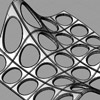
Here, we plan and develop a 3d model that uses regular flow on surface command. However, while we are doing this, we also start to create a pseudo-parametric definition (or diagram) of the modeling process. In the end, this gives us the complete dataflow diagram of the 3d model. Students are expected to start understanding both the differences between geometric modeling and parametric modeling and also between procedural computing and dataflow computing. Below is an example of such diagrams students…