
Vector Fields Exercise
Fields is a native group of components available since the very early version of Grasshopper. In today’s Design Computing class, we studied it again with the first-year design students. I studied these interesting and beautiful shapes earlier here, here, here, and here. The one you see below is a short in-class exercise about vector fields. The exercise aims to show the Grasshopper’s capabilities in form-finding studies via Field Lines.
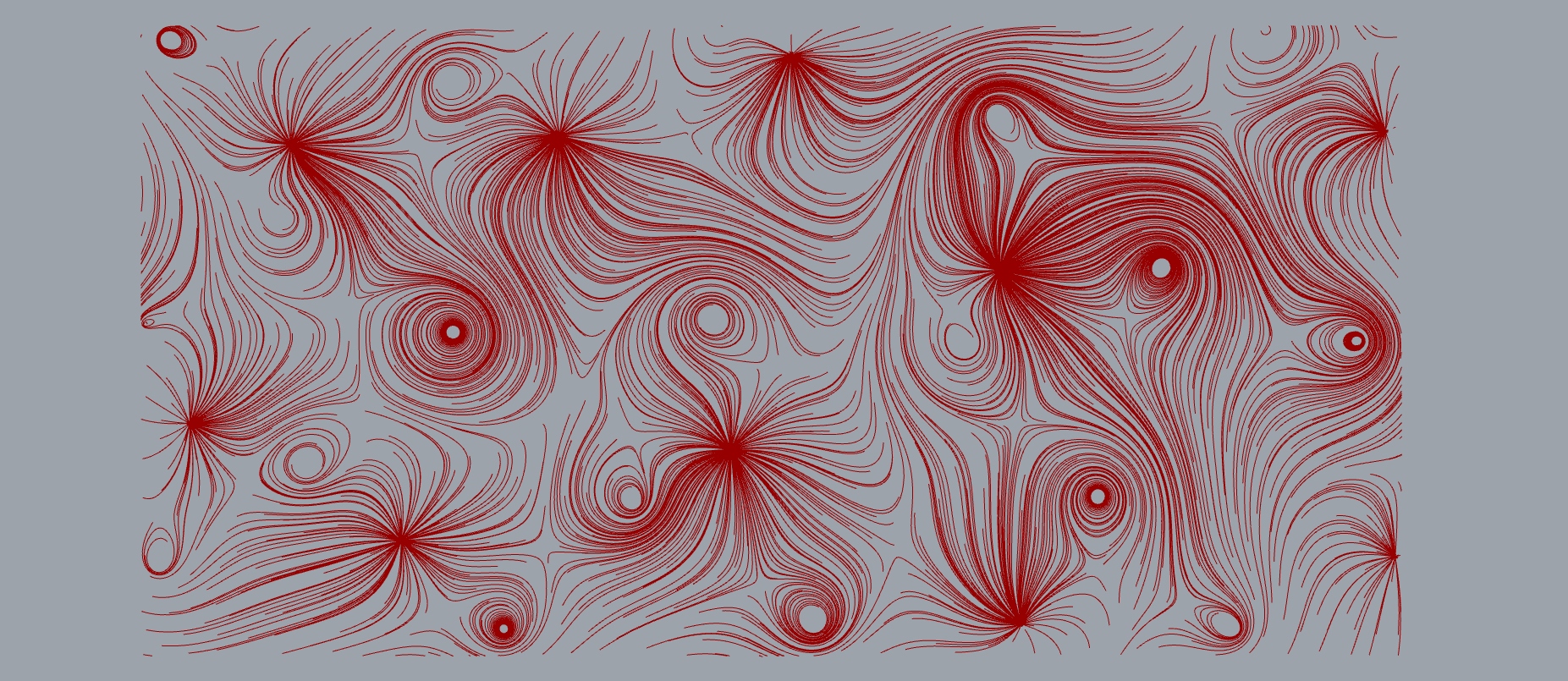
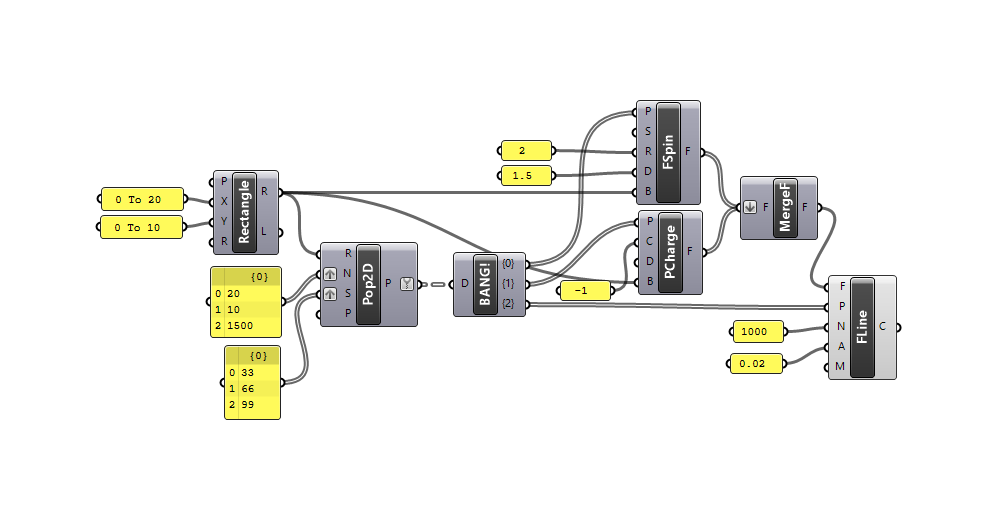
The definition starts with the generation of a set of random points in a 2D rectangular region. Then, in other random point sets, Point Charge and Spin Force charges are defined. Then, I merge these charges into a single field. Finally, I create Field Lines from a set of 1000-1500 random points. The vector fields exercise is a good start in understanding grafted lists and their usage. The grafted list of three numbers, fed to the Pop2D component allows the creation of three different sets of random points. Then, the Explode Tree component (BANG!) makes it possible to use these three point sets in their correct operations. The first point set goes to the Spin Force component and the second set to the Point Charge. Finally, the third point set is used in the generation of the field lines. The field lines are graphical representations of the vector field.
I guess that this advanced feature of native Grasshopper is still interesting and worth studying. Our students are learning the intermediate concepts of Grasshopper’s inner mechanics through this and similar exercises.
Cite this post
Related Posts
Flow Map on Terrains
September 11, 2026
We previously looked at the terrain generator script we used in midterm projects with first-year architecture students over here. Later on, we added a few analysis modules to this tool. You might remember the slope analysis tool from this link. Today’s topic is another type of analysis: flow. The idea for this code wasn’t actually mine; I developed it by looking at an existing script based on Serkan Uysal’s suggestion. Unfortunately, I don’t know who originally wrote it. Keeping track…
Landscape Extensions Final: Digital Sketch
February 1, 2015
This is the final Grasshopper sketch of our graduate studio conducted together with Fulya Akipek at Yıldız Technical University Computational Design Unit. The project was about designing parametric “Landscape Extensions” at Kabataş Park in İstanbul. I hope I’ll be able to post the actual student works and the material system, but now; only the final result of the digital sketch we’ve developed together with students is presented here. This was a kind of “sketchy” definition that came up as an…
Force Fields in ARCH362
March 17, 2015
This year’s Parametric Modeling class starts with some of the very basic use of Grasshopper concepts. This definition is a practical start-up of using force fields in the architectural design process. However it does not compute any physical phenomena (such as circulation of people, wind, or anything else), but shows a simple way to tell Grasshopper about walls that push the field, and points that pull the field. I’ll post more of this kind of basics, hopefully along with some student…
Field Deformation
October 8, 2026
Ever since I restructured designcoding, I’m still sorting through the trash folder. All 580 posts published on the blog have been reviewed, and their files have been uploaded as open source. The mysterious trash folder, where I couldn’t even tell where things belonged, is shrinking fast. While checking this folder yesterday, I found a video. This is probably a simple tutorial I prepared about 10 years ago for the parametric modeling elective course (probably related to this 2012 post). The…
Differential Growth
June 16, 2025
Differential growth is a process where different parts of a structure grow at different rates, leading to complex forms. After watching this, I decided to try it in Grasshopper. Here, differential growth mimics this behavior by applying rules such as Repulsion to avoid crowding or overlapping, Cohesion to keep parts connected or within a range, and Insertion to add new elements when a part stretches too far. The algorithm I present here simulates a differential growth process starting from a…