
Force Fields
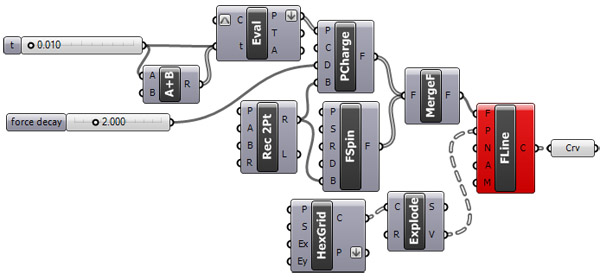
I’ve seen beautiful examples of similar compositions made using vector field components in Grasshopper. I just tried to make my own animate field lines to see how they float over force dynamics. In essence, these compositions could also be done using regular vector components but the field components make life much easier by merging different forces together rather quickly. As you see below, it is a quite small definition that creates beautiful complexity.
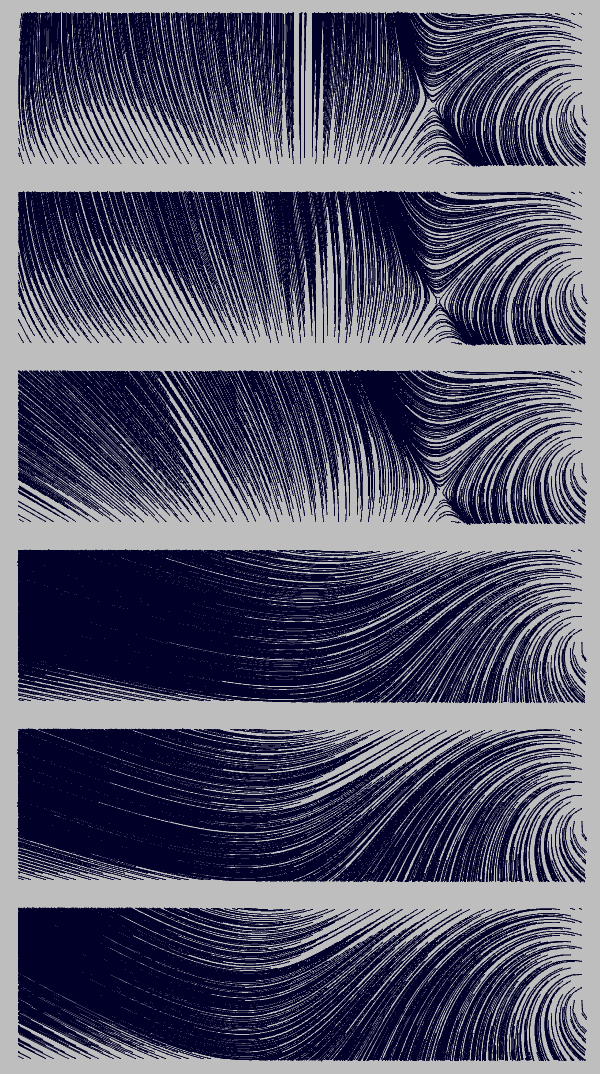
Although we know every single parameter of a system, it could still behave as unexpectedly. It is the exploratory nature of chaos, where I see some parts in such definitions. However there is nothing chaotic in this study as the same things happen when I hit the animate button, but it just reminds me what it could have been. Maybe in a broader sense, it reminds me of how the nature of “designing” happens. Here are some quick explanations of the term;
Chaos is aperiodic time-asymptotic behaviour in a deterministic system which exhibits sensitive dependence on initial conditions.
Chaos: When the present determines the future, but the approximate present does not approximately determine the future.
Cite this post
Related Posts
Field Deformation
October 8, 2026
Ever since I restructured designcoding, I’m still sorting through the trash folder. All 580 posts published on the blog have been reviewed, and their files have been uploaded as open source. The mysterious trash folder, where I couldn’t even tell where things belonged, is shrinking fast. While checking this folder yesterday, I found a video. This is probably a simple tutorial I prepared about 10 years ago for the parametric modeling elective course (probably related to this 2012 post). The…
Flow Map on Terrains
September 11, 2026
We previously looked at the terrain generator script we used in midterm projects with first-year architecture students over here. Later on, we added a few analysis modules to this tool. You might remember the slope analysis tool from this link. Today’s topic is another type of analysis: flow. The idea for this code wasn’t actually mine; I developed it by looking at an existing script based on Serkan Uysal’s suggestion. Unfortunately, I don’t know who originally wrote it. Keeping track…
Differential Growth
June 16, 2025
Differential growth is a process where different parts of a structure grow at different rates, leading to complex forms. After watching this, I decided to try it in Grasshopper. Here, differential growth mimics this behavior by applying rules such as Repulsion to avoid crowding or overlapping, Cohesion to keep parts connected or within a range, and Insertion to add new elements when a part stretches too far. The algorithm I present here simulates a differential growth process starting from a…
Parametric Bricks
January 17, 2024
In 2016, archi-union architects and fab-union intelligent engineering completed the renovation of the art gallery in Shanghai, China. The distinctive feature of the building was the robotic masonry fabrication of the brick facades. The undulating and waving parametric bricks were increasingly becoming popular after the introduction of parametric design tools such as Grasshopper and the works of Gramazio & Kohler at ETH Zurich since 2008, I guess. I made two Grasshopper experiments in 2012 and 2013 to generate such structures….
Vector Fields Exercise
April 4, 2023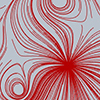
Fields is a native group of components available since the very early version of Grasshopper. In today’s Design Computing class, we studied it again with the first-year design students. I studied these interesting and beautiful shapes earlier here, here, here, and here. The one you see below is a short in-class exercise about vector fields. The exercise aims to show the Grasshopper’s capabilities in form-finding studies via Field Lines. The definition starts with the generation of a set of random…