
Vector Fields
Back to the basics. I finally had time to test the vector fields components in Grasshopper. It was a couple of updates ago, a new tool group emerged in the vector tab, introducing different types of vector fields to users. Then, these fields could be merged to form more complex effects. However, I created a very simple example of how we can use those components to distort a system (such as a regular tessellation). Using attractor forces (usually in geometric forms) is one of the fundamental concepts of parametric modeling today. A regular implementation requires reasoning on the distances between objects and manipulating them according to this reasoning. That works well if there is only one attracting force for every object. However, creating more complex effects by merging various attractors is more difficult, whereas vector fields might seem to represent a faster solution.
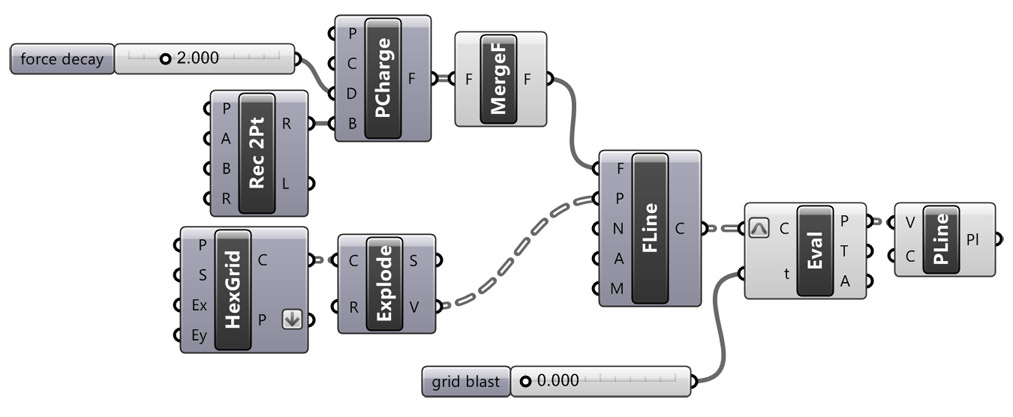
Just put some points as charges, with a rectangular boundary. Then, combine them using the merge component, and create field lines of regular hexagonal grid vertices using this combined vector field.
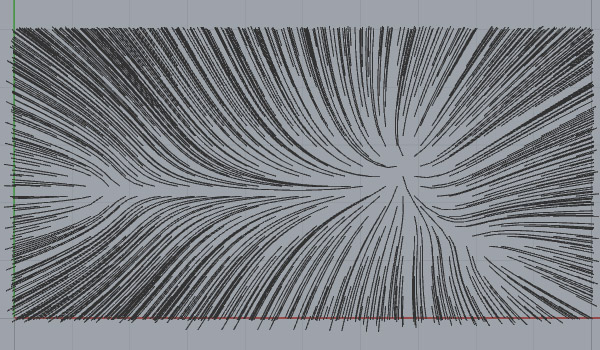
This is the field line of the grid. Every point of the grid is represented as an “escaping” curve here. However, they keep the data tree structure for us to play with. I needed to create a controlled distortion according to these field lines. So, I evaluated them and played with the t parameter value. I rejoined these points in the data tree order and creating closed polylines again.
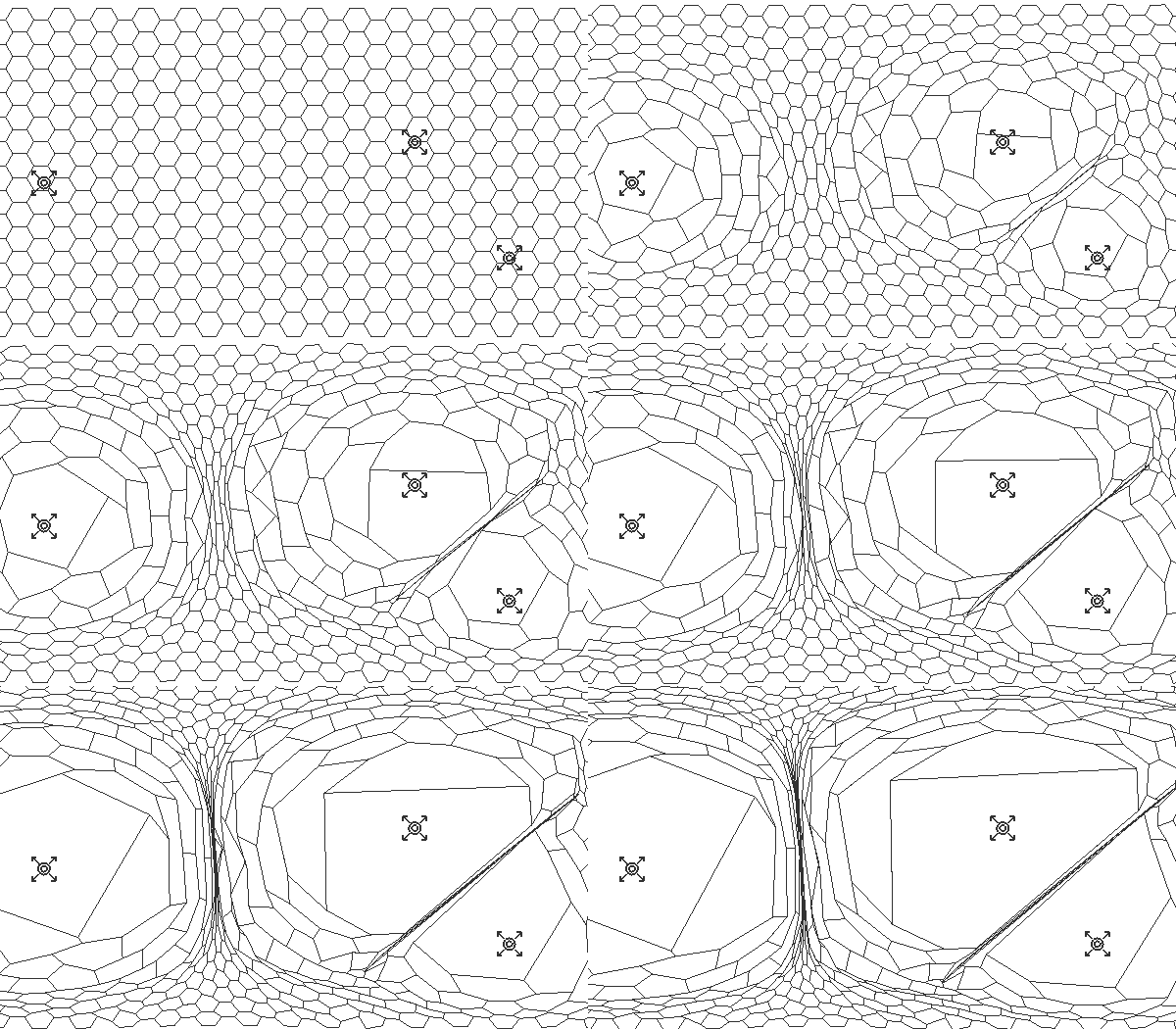
This is the animation of the t value, creating a tearing effect determined by the combined distances to the point charges.
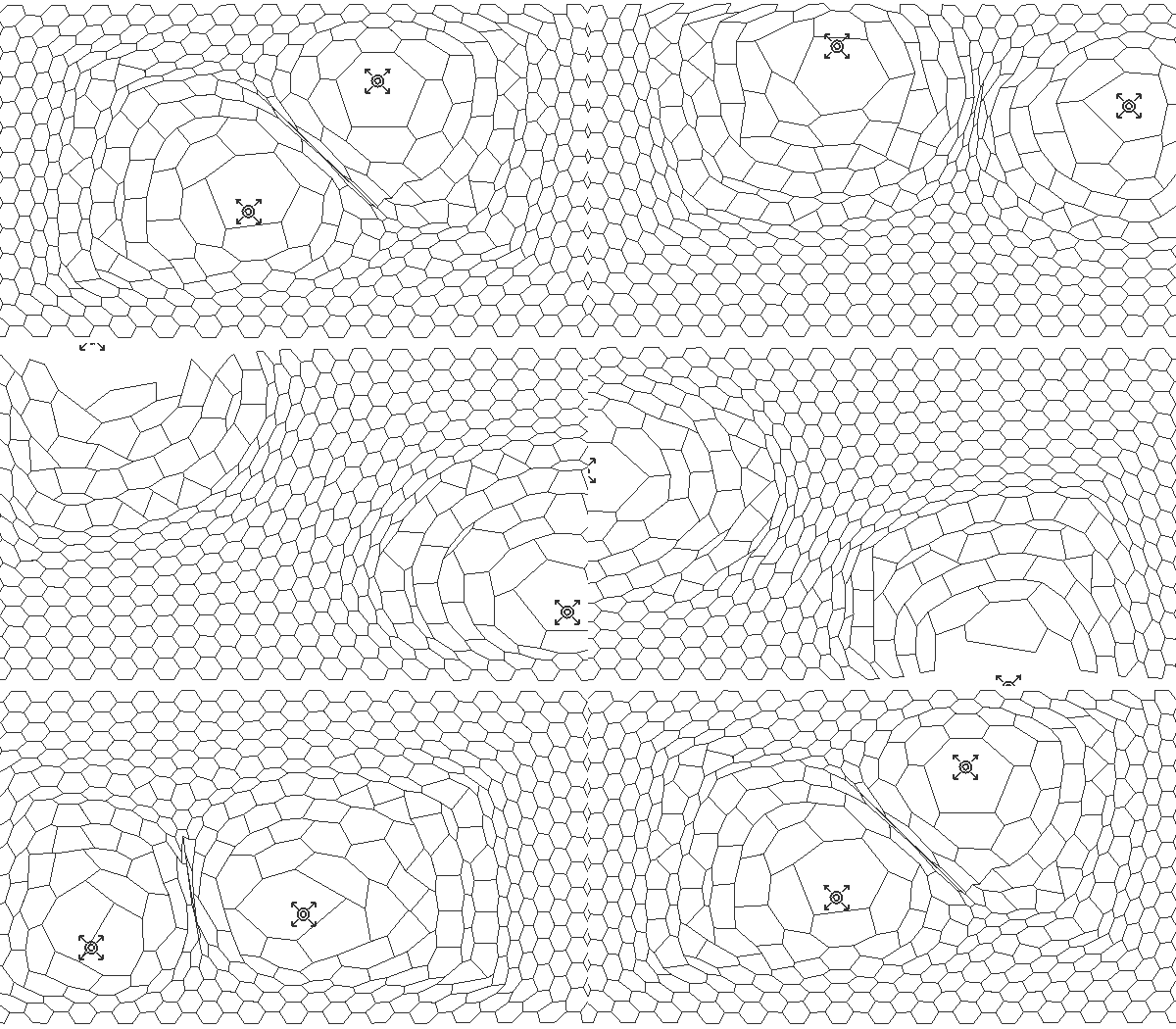
Of course, point locations are another subject of exploration.
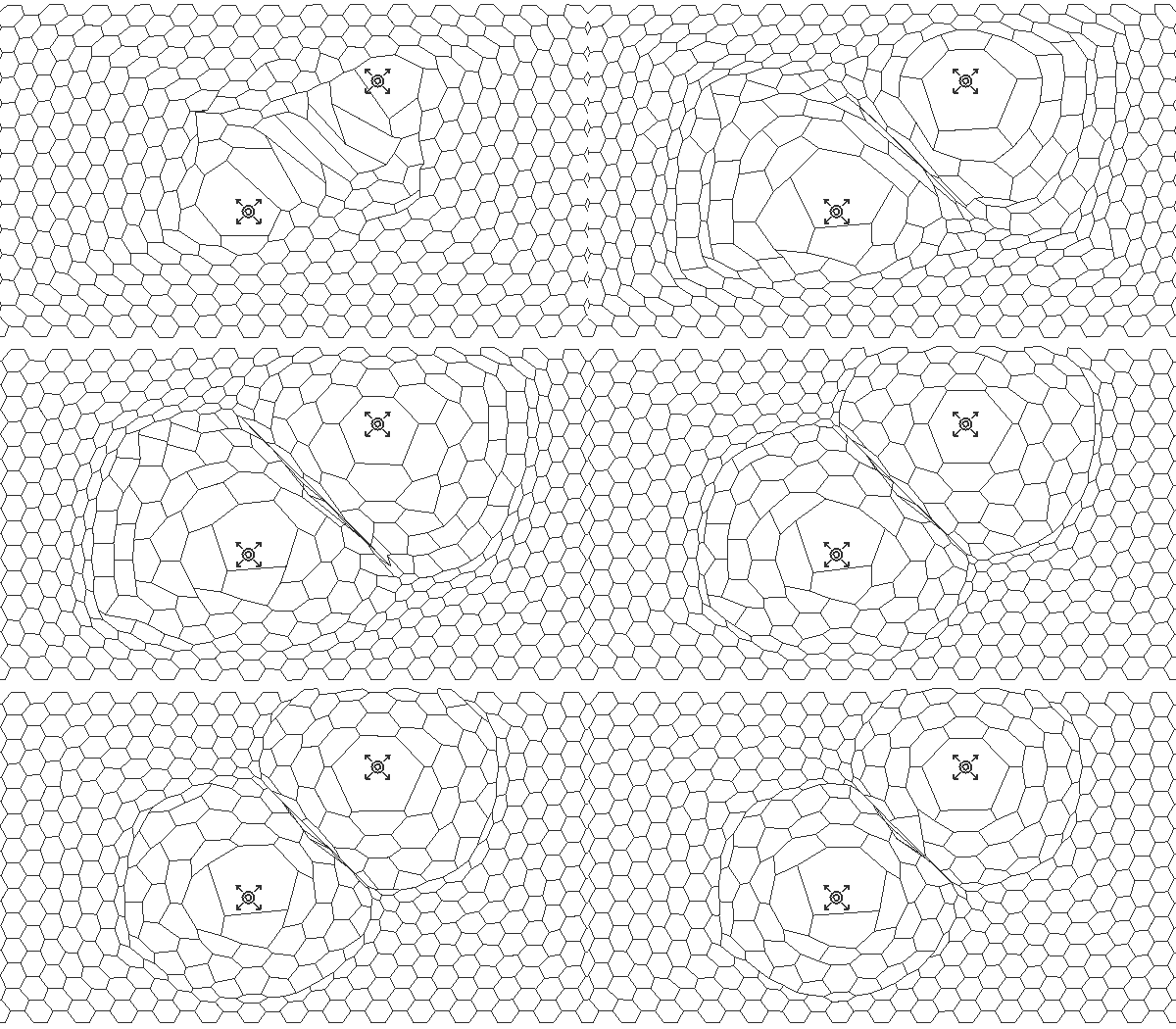
And the decay value of point charges introduces another effect. You can download the Grasshopper file below:
Cite this post
Related Posts
Inflating Grids
December 28, 2012
After playing with vector fields in 2d (here) it was quite easy to create a 3d surface deformation. Here is my first experiment on a regular triangular grid’s three-dimensional behavior within a vector space, that includes a point charge of varying z coordinates. That makes field lines escape to a bounding box, instead of a bounding rectangle. Again, you may play with force decay, the number of samples, and the “grid blast” parameter, which is just a t-value evaluation of…
Hexagonal grid with Rhino Python
July 25, 2017
This python code proves how much effort it takes to create a simple hexagonal tessellation. There are, of course, much easier and faster methods than this. But here you see a code that introduces students to Rhino Python. Using this code, a new Rhino command can be generated, and for the first time in Rhino, we can have a command that creates a hexagonal grid. I followed this tutorial to turn this Python script into a Rhino command. This is…
Waterbomb Tessellation
January 23, 2013
It all started with my new passion for origami tessellations, not much of origami, but the tessellation part. I was too lazy to fold it physically, nor model them using an engine such as Kangaroo. That would also be very unnecessary (and yes, very boring) to simulate a folding effort on the computer unless we lose our connection with the real world. Instead, I tried to look at a much more abstract, silly, and basic part of it; the creasing…
Hexagonal Star Lattice
December 18, 2023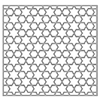
Here are the variations of classical six-pointed star patterns generated by Grasshopper. Generally, you can see these patterns under the title “Islamic patterns” because they are frequent in the decorations of mosques and palaces. I studied these patterns in Grasshopper earlier in these posts. I always find this an interesting geometry exercise. This time, my main goal was to develop a useful code only with the native Grasshopper components that create laser-cut-ready products of hexagonal star lattice. Thus, I made…
Parquet Deformation of Star Patterns
February 3, 2012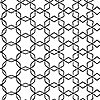
This is another starting point for pattern generation study in a dataflow environment. I tried to implement the parquet deformation of Islamic patterns in Grasshopper. I studied Hankin’s method of Islamic Pattern generation. Then I tried to simulate his process beginning with basic regular tiling (regular hexagonal tessellation). Craig S. Kaplan (here) explains this and other methods in his dissertation. A Simple Foundation We have already experienced the result of exploding any hexagonal grid, shifting its points with the help…