designcoding
About Table of Contents Keywords Monthly Archive
Support designcoding!

#space-filling

6 posts

Space-filling Elongated Dodecahedra

February 22, 2024
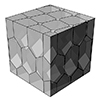
The regular dodecahedron is one of the five Platonic solids, characterized by having 12 regular pentagonal faces, 20 vertices, and 30 edges. When you elongate it, you extend its structure in one or more directions, resulting in a shape that retains the basic properties of the dodecahedron but is stretched out. The elongated dodecahedron might not catch your eye at first—it’s just a long version of a shape you’ve probably seen before, and it seems pretty basic. But don’t be…
Space-filling Rhombic Dodecahedra

February 10, 2024

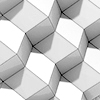
The rhombic dodecahedron is a polyhedron with twelve rhombus-shaped faces, where each face has four sides of equal length. It is possible to construct the space-filling variant of the rhombic dodecahedron by arranging multiple such rhombic dodecahedra in a regular pattern so that they fill space without leaving any gaps. In his 1611 work on snowflakes titled “Strena seu de Nive Sexangula,” Johannes Kepler observed that honey bees utilize the geometric structure of rhombic dodecahedra to construct honeycombs. These honeycombs…

Hilbert Curve

January 16, 2024

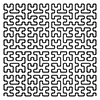
The Hilbert Curve, also referred to as the Hilbert space-filling curve, was initially introduced by the German mathematician David Hilbert in 1891. It is a continuous fractal curve, presenting a variation of the space-filling Peano curves uncovered by Giuseppe Peano in 1890. After a study on the mathematical background of this curve, I implemented a Python code into Grasshopper Python. However, I wanted to explore more variations by playing with the algorithm. This is why, the resulting Grasshopper definition can…

Weaire-Phelan Space-filling Structure

December 20, 2023

The Weaire-Phelan structure is an optimal solution to the problem of partitioning space into equal volumes with the least surface area. Denis Weaire and Robert Phelan discovered it in 1993. This structure gained attention due to its efficiency in filling space, offering a configuration that achieves a more balanced distribution of volume and surface area compared to other known structures at the time. Here is my model for the Weaire-Phelan space-filling structure. The Weaire-Phelan structure consists of two different shapes:…

Urban Polyhedra

October 11, 2018

This is a competition entry on the innovative uses of natural stone. Urban Polyhedra aims to organize the natural stone usage, especially on the shores. In the current implementation of this system, random blocks are placed to prevent landslides on the urban coastal areas, but restrict the interaction of the citizens with the shore, and destroy the spaces for sea creatures, and vegetation. Thus, this random placement makes it difficult to interfere with a design/arrangement. Citizens try to reach the…

Modeling the Weaire-Phelan Structure

May 15, 2013

Becoming popular after the Beijing 2008 Olympics National Aquatics Centre‘s facade (which is believed to be a Voronoi subdivision, as an epic mistake), the Weaire Phelan structure is a solution of equal volumes with minimal surface area. This nice website briefly explains the phenomenon. There is also an implementation on Grasshopper by Jon Mirtschin. Here, I will be modeling the Tetrakaidecahedron of the Weaire-Phelan structure. First, we define the overall size by drawing a 20×10 rhombus. Copy the rhombus by…

  • Chapters

    • Algorithms
    • Discourses
    • Fabrications
    • Studios
  • Explore

    • All Keywords
    • Table of Contents
    • Monthly Archive
    • #sandblasting
    • #data-flow
    • #fibonacci
    • #rhombicosidodecahedron
    • #dodecahedron
    • #visualization
    • #hyperbolic
    • #timer
    • #stone
    • #noise
    • #regulations
    • #vector-field
    • #muqarnas
    • #delaunay-triangulation
    • #moulding
    • #parametric-curve
    • #firefly
    • #dual
    • #octahedron
    • #tetrahedron
  • Search

  • Support designcoding!

  • Enjoying designcoding? Support me on Patreon to keep it growing. Thank you!

  • copyright 2026 designcoding.net | about | privacy policy | end user license agreement