
Space-filling Rhombic Dodecahedra
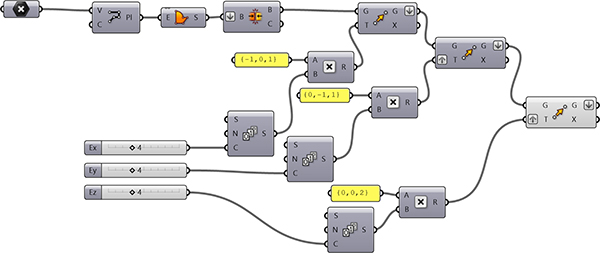
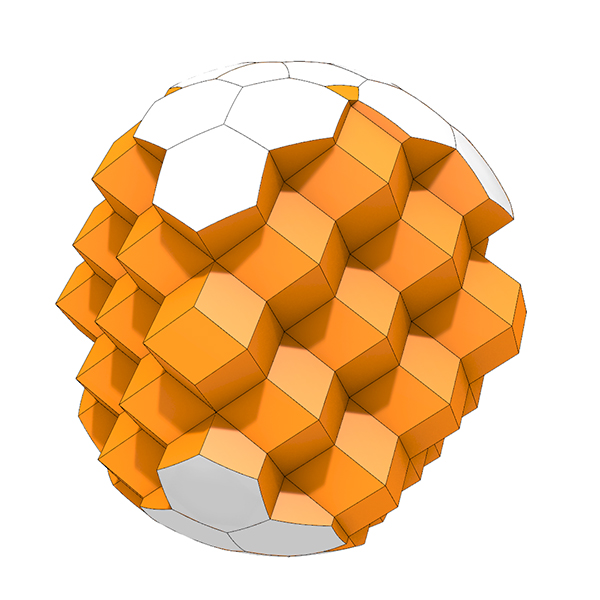
The rhombic dodecahedron is a polyhedron with twelve rhombus-shaped faces, where each face has four sides of equal length. It is possible to construct the space-filling variant of the rhombic dodecahedron by arranging multiple such rhombic dodecahedra in a regular pattern so that they fill space without leaving any gaps. In his 1611 work on snowflakes titled “Strena seu de Nive Sexangula,” Johannes Kepler observed that honey bees utilize the geometric structure of rhombic dodecahedra to construct honeycombs. These honeycombs consist of a tessellation of cells, with each cell being a hexagonal prism topped with half a rhombic dodecahedron. I generated this structure in Grasshopper by utilizing the vertex coordinates of the polyhedron. Then, I defined three vectors to copy it in three directions. You can cut the output of the code and analyze the interior spaces, as seen in the animation.
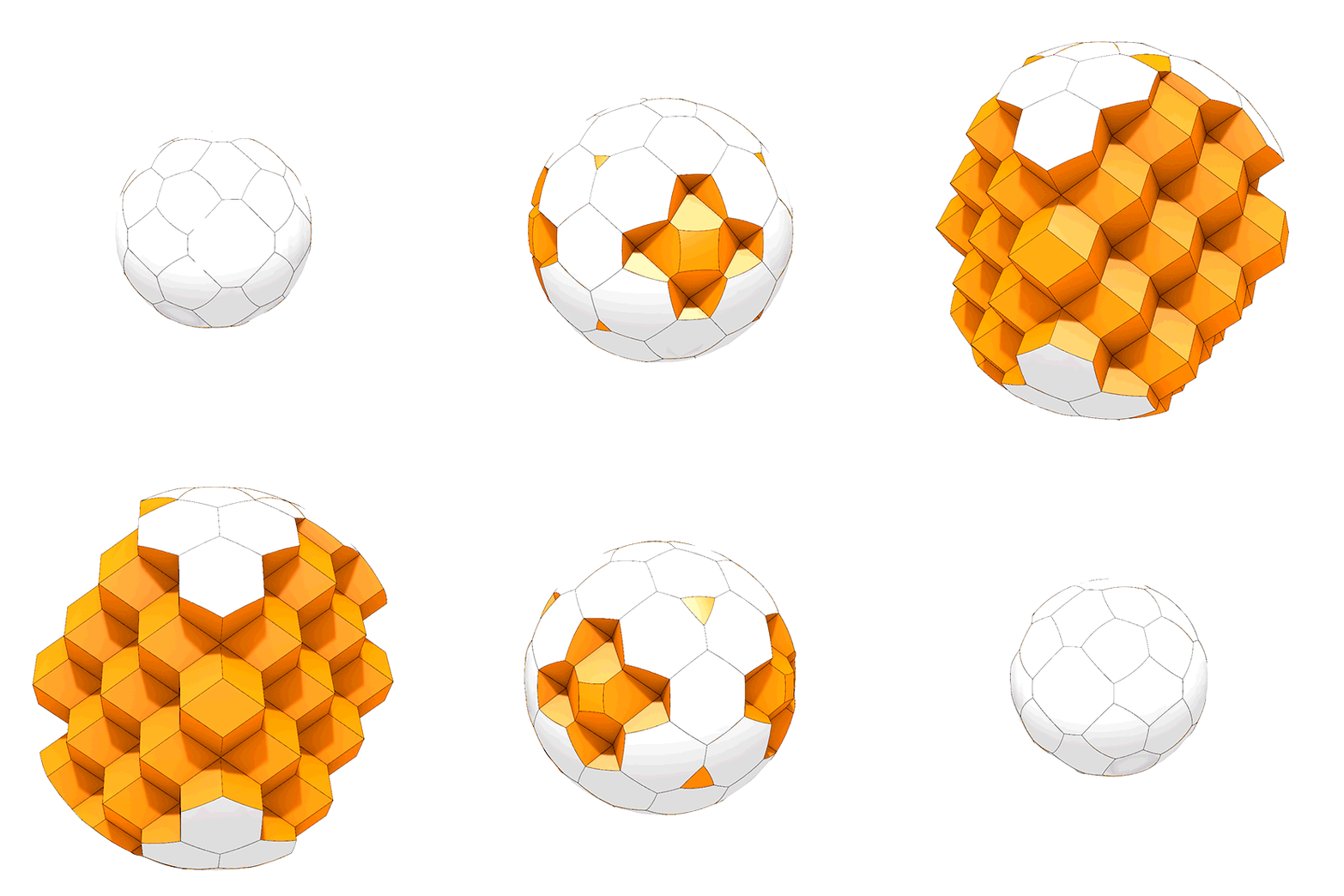
This Grasshopper definition generates the Space-filling Rhombic Dodecahedra structure. The input parameters are the number of cells in three directions. The output of the definition is the solid 3d model. It has a structure with individual cells. Therefore, it is ready for 3d printing. The code is using native Grasshopper components. Thus, no add-ons are necessary for it to work.
Cite this post
Related Posts
Space-filling Elongated Dodecahedra
February 22, 2024
The regular dodecahedron is one of the five Platonic solids, characterized by having 12 regular pentagonal faces, 20 vertices, and 30 edges. When you elongate it, you extend its structure in one or more directions, resulting in a shape that retains the basic properties of the dodecahedron but is stretched out. The elongated dodecahedron might not catch your eye at first—it’s just a long version of a shape you’ve probably seen before, and it seems pretty basic. But don’t be…
Weaire-Phelan Space-filling Structure
December 20, 2023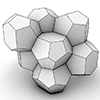
The Weaire-Phelan structure is an optimal solution to the problem of partitioning space into equal volumes with the least surface area. Denis Weaire and Robert Phelan discovered it in 1993. This structure gained attention due to its efficiency in filling space, offering a configuration that achieves a more balanced distribution of volume and surface area compared to other known structures at the time. Here is my model for the Weaire-Phelan space-filling structure. The Weaire-Phelan structure consists of two different shapes:…
Coding the Dodecahedron
March 7, 2024
Here is a method for coding the dodecahedron and all its irregular variants in Grasshopper as quickly as possible. I utilized the golden ratio rectangles, usually used to construct the sister polyhedron, the icosahedron. However, the magic component of the Grasshopper, the Faceted Dome rescued me again to generate the dual of it, the dodecahedron. This is a special platonic solid, which has 12 regular pentagonal faces. There are several techniques that I generally prefer to use in Grasshopper. You…
Modeling the Weaire-Phelan Structure
May 15, 2013
Becoming popular after the Beijing 2008 Olympics National Aquatics Centre‘s facade (which is believed to be a Voronoi subdivision, as an epic mistake), the Weaire Phelan structure is a solution of equal volumes with minimal surface area. This nice website briefly explains the phenomenon. There is also an implementation on Grasshopper by Jon Mirtschin. Here, I will be modeling the Tetrakaidecahedron of the Weaire-Phelan structure. First, we define the overall size by drawing a 20×10 rhombus. Copy the rhombus by…
Modeling Excavated Dodecahedron
December 15, 2024
In geometry, the excavated dodecahedron is a star polyhedron that looks like a dodecahedron with concave pentagonal pyramids in place of its faces. In this short tutorial video, I am modeling an excavated dodecahedron in the Rhinoceros software. I use basic drawing and modeling commands. I aim to introduce this skill to beginner-level architects and designers. As the name suggests, this process includes the construction of the dodecahedron first. Then, the pentagonal faces of this polyhedron were “excavated” to the…