
Modeling Excavated Dodecahedron
In geometry, the excavated dodecahedron is a star polyhedron that looks like a dodecahedron with concave pentagonal pyramids in place of its faces. In this short tutorial video, I am modeling an excavated dodecahedron in the Rhinoceros software. I use basic drawing and modeling commands. I aim to introduce this skill to beginner-level architects and designers. As the name suggests, this process includes the construction of the dodecahedron first. Then, the pentagonal faces of this polyhedron were “excavated” to the interior side. Five regular triangles emerge on every pentagon. Although it looks a bit boring, this polyhedron is useful as an alternative exercise for stellation and stellated polyhedra.
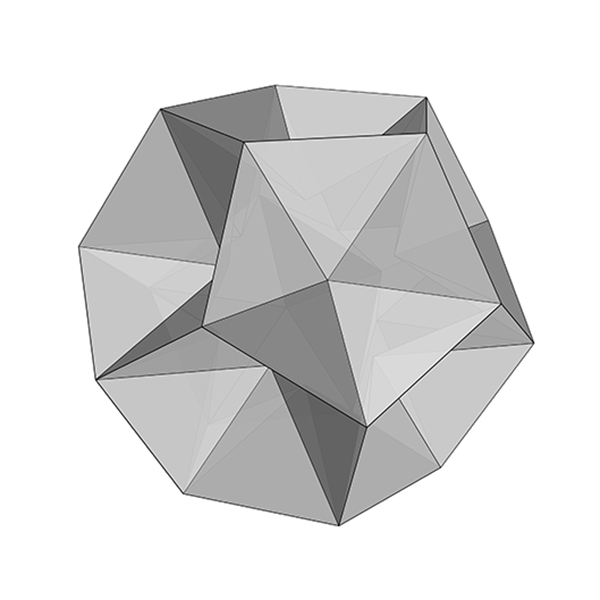
In this video series, I present a variety of in-class exercises from my first-year Architectural Geometry course. We study Euclidean constructions, basic drawing, and transformation commands using Rhinoceros software. In addition to these basics, I study introductory fractals, regular and semi-regular tessellations, patterns, modeling, and unrolling polyhedra. These concise drawing exercises benefit junior architects, interior designers, industrial designers, and enthusiasts from other disciplines. I’ll share exercises and tutorials weekly on my blog and other platforms. So, today’s exercise is modeling an excavated dodecahedron.
The software used in this course is Rhinoceros 3d (www.rhino3d.com). However, if you want to find out more and see the whole list of this video series, you can check my YouTube channel at www.youtube.com/@designcodingnet. The music of this video is ‘Signal to Noise’ by Scott Buckley (CC-BY 4.0). www.scottbuckley.com.au
Cite this post
Related Posts
Modeling and Unrolling Dodecahedron
December 12, 2024
A dodecahedron is a three-dimensional polyhedron with twelve flat, regular pentagonal faces, twenty vertices, and thirty edges. It is one of the Platonic solids and is highly symmetrical, with each face being a regular pentagon. The dodecahedron’s shape is unique among the Platonic solids because its faces are polygons with five sides, unlike the others which have triangular faces. Due to its symmetry, the dodecahedron has been used in various applications, including as a model in geometry and in certain…
Modeling a Dodecahedron
February 14, 2024
This is a 3d modeling tutorial for the platonic solid of dodecahedron. Modeling a dodecahedron is a good exercise for the basic transformation commands such as Rotate3D in Rhinoceros. You will see that it is possible to calculate the rotation angle by using sphere intersections. I learned this elegant method while teaching Architectural Geometry classes 12 years ago. It is based on the fact that, given a rotation axis and the rotation point, you can draw the path traced by…
Dodecahedron: Drawing and Unrolling
December 23, 2011
The dodecahedron is a Platonic Solid with 12 equilateral pentagonal faces. It has a close relationship with its 20-sided dual, Icosahedron. Mete Tüneri showed the following method of Dodecahedron construction, using only distances, corners of the pentagon, and a visionary equilateral triangle underneath. We’ll construct Dodecahedron, assuming that we’ve drawn an initial equilateral pentagon. We need to find out the pentagon’s angle of 3d rotation. First, put spheres at points a and c, with a radius of a to c. The…
Modeling Stellated Icosahedron
December 14, 2024
Stellation of polyhedra refers to the process of extending the faces (or edges) of a polyhedron outward to form new, more complex shapes. These new shapes, called stellations, are created by adding extra vertices, edges, and faces that “project” outward from the original polyhedron’s structure. You can create an infinite number of new polyhedral forms, depending on how you extend the faces and edges. In this short tutorial video, I am modeling a stellated icosahedron. I use basic modeling commands…
Coding the Dodecahedron
March 7, 2024
Here is a method for coding the dodecahedron and all its irregular variants in Grasshopper as quickly as possible. I utilized the golden ratio rectangles, usually used to construct the sister polyhedron, the icosahedron. However, the magic component of the Grasshopper, the Faceted Dome rescued me again to generate the dual of it, the dodecahedron. This is a special platonic solid, which has 12 regular pentagonal faces. There are several techniques that I generally prefer to use in Grasshopper. You…