
Weaire-Phelan Space-filling Structure
The Weaire-Phelan structure is an optimal solution to the problem of partitioning space into equal volumes with the least surface area. Denis Weaire and Robert Phelan discovered it in 1993. This structure gained attention due to its efficiency in filling space, offering a configuration that achieves a more balanced distribution of volume and surface area compared to other known structures at the time. Here is my model for the Weaire-Phelan space-filling structure.
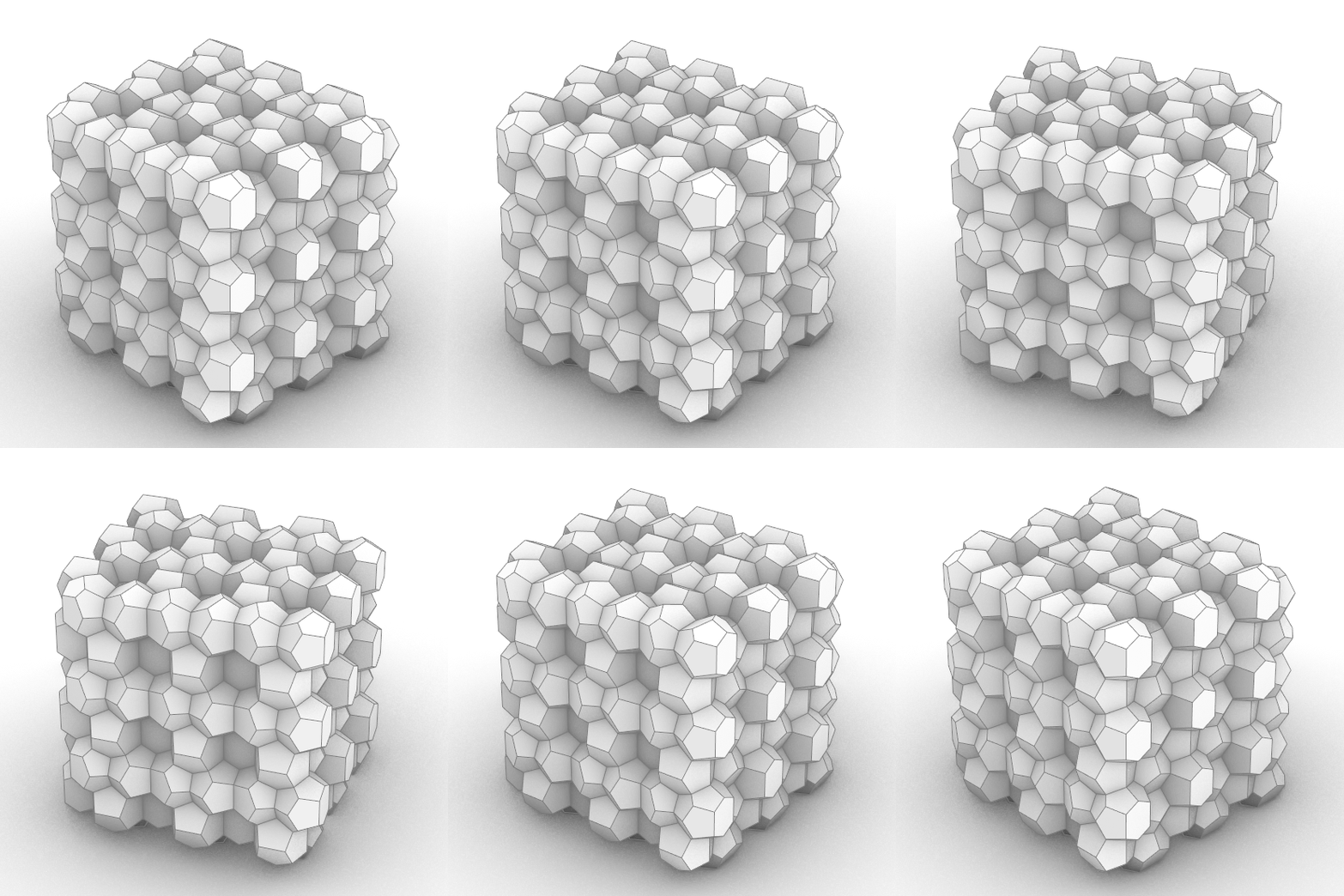
The Weaire-Phelan structure consists of two different shapes: an irregular dodecahedron and a tetrakaidecahedron (14-sided polyhedra). These polyhedra fit together to form a foam-like structure with minimal surface area. Thus, this makes it a subject of interest in various fields, including materials science, physics, and mathematics. Additionally, architects and artists used it as a source of inspiration due to its aesthetically pleasing and unique geometric properties. The Weaire-Phelan structure gained notable attention in the architectural realm with the design of the Beijing National Aquatics Center for the 2008 Summer Olympics in Beijing, China. This building is commonly known as the “Water Cube” (PTW Architects, CSCEC, CCDI, and Arup). It features an innovative bubble-like facade, similar to the Weaire-Phelan structure. The building’s exterior mimics the cellular structure made of a lightweight, translucent material called ETFE (ethylene tetrafluoroethylene).

You can rebuild the Weaire-Phelan space-filling structure by following this link for the construction of the tetrakaidecahedron. You will need to create an array of them to finish the structure.
Cite this post
Related Posts
Modeling the Weaire-Phelan Structure
May 15, 2013
Becoming popular after the Beijing 2008 Olympics National Aquatics Centre‘s facade (which is believed to be a Voronoi subdivision, as an epic mistake), the Weaire Phelan structure is a solution of equal volumes with minimal surface area. This nice website briefly explains the phenomenon. There is also an implementation on Grasshopper by Jon Mirtschin. Here, I will be modeling the Tetrakaidecahedron of the Weaire-Phelan structure. First, we define the overall size by drawing a 20×10 rhombus. Copy the rhombus by…
Space-filling Elongated Dodecahedra
February 22, 2024
The regular dodecahedron is one of the five Platonic solids, characterized by having 12 regular pentagonal faces, 20 vertices, and 30 edges. When you elongate it, you extend its structure in one or more directions, resulting in a shape that retains the basic properties of the dodecahedron but is stretched out. The elongated dodecahedron might not catch your eye at first—it’s just a long version of a shape you’ve probably seen before, and it seems pretty basic. But don’t be…
Space-filling Rhombic Dodecahedra
February 10, 2024
The rhombic dodecahedron is a polyhedron with twelve rhombus-shaped faces, where each face has four sides of equal length. It is possible to construct the space-filling variant of the rhombic dodecahedron by arranging multiple such rhombic dodecahedra in a regular pattern so that they fill space without leaving any gaps. In his 1611 work on snowflakes titled “Strena seu de Nive Sexangula,” Johannes Kepler observed that honey bees utilize the geometric structure of rhombic dodecahedra to construct honeycombs. These honeycombs…
Urban Polyhedra
October 11, 2018
This is a competition entry on the innovative uses of natural stone. Urban Polyhedra aims to organize the natural stone usage, especially on the shores. In the current implementation of this system, random blocks are placed to prevent landslides on the urban coastal areas, but restrict the interaction of the citizens with the shore, and destroy the spaces for sea creatures, and vegetation. Thus, this random placement makes it difficult to interfere with a design/arrangement. Citizens try to reach the…
Chamfered Polyhedra
April 2, 2025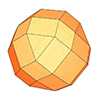
I had been researching Goldberg Polyhedra for a while. While exploring how to perform chamfer operations in Grasshopper, I found some interesting results. I want to share them with you. In this Grasshopper project, I reused my previous work, where I built a dodecahedron using the golden ratio. Essentially, all I did was add the Fillet Edge component. I don’t use this component much, so I learned it through this process. At one point, I realized I had created a…