
Spacebound
Let’s take a closer look at the midterm jury assignment for our “Field & Matter”- themed Computation-based Basic Design 2 studio, which I conducted last year alongside Serkan Uysal, İpek Kuran, and Sinan Logie. I shared the studio’s final project, Earthbound, in a previous post. In this post, we will focus on our process-oriented midterm project named Spacebound.
Topography as a Data Field
In this first major phase of the “Field & Matter” studio, we examined how moving and stationary objects are positioned on a topography. In this context, topography is not just a passive surface to walk on; it is treated as a continuous data field characterized by variables such as slope, flow, and curvature. Here, architecture went beyond random placement, becoming a strategic intervention that manages surrounding conditions and possibilities.
Space Production Through Games
The primary objective of the project was to design an innovative children’s playground that would allow various age groups to engage in different games. The process started with generating a digital topography and analyzing its geometric features. I shared the Grasshopper code that generates and analyzes this topography in previous posts. Our main analysis layers guiding the design included:
- Slope: Used to distinguish between accessible and steep areas.
- Curvature: Served to identify concave (hidden/enclosed) and convex (exposed/open) regions.
- Occlusion: Helpful in mapping visual privacy and blind spots.
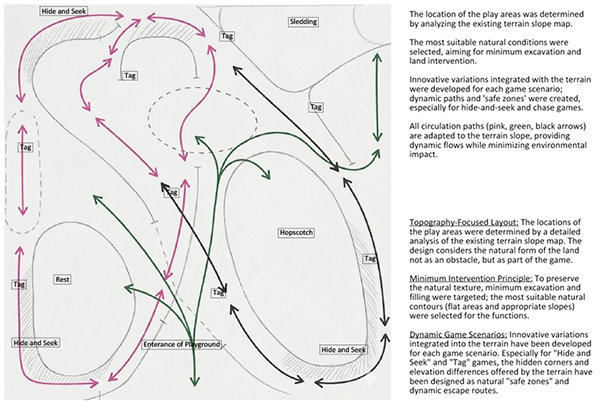
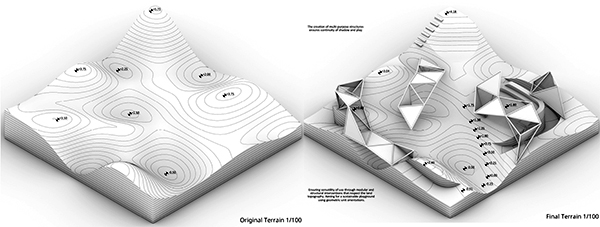
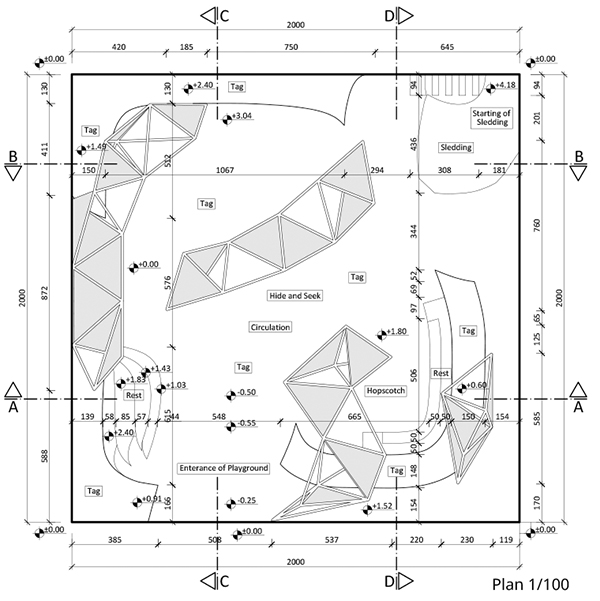
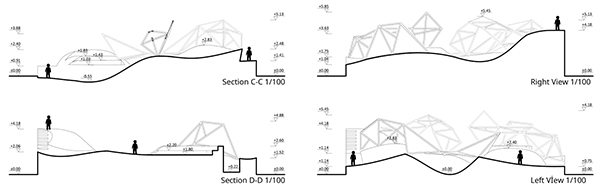
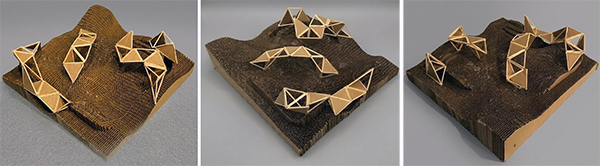
Once the analyses were completed, the studio held collective discussions to decide which parts of the land would host which games. Afterward, each student worked individually on their own terrain, intervening in the topography with minimal additions (sticks and thin walls). Our core approach here was not to force functions arbitrarily, but to let the function emerge organically by creating the right geometric and physical conditions. Games like sledding, hide-and-seek, hopscotch, leapfrog, and tag served as powerful catalysts for reading the data offered by the terrain and translating it into design.
With this project, first-year architecture students were introduced to numerous architectural concepts for the first time. Topics such as scale, dimensions, vista, topography, and even some fundamental structural and functional decisions were introduced. We included basic architectural drawing and modeling skills into the process as well. This project became an unforgettable initial experience for the students. This was also their first experience in an architectural design jury.
The 40-year-old Field Conditions (after Stan Allen and his contemporaries) are surprisingly fresh in today’s digital design education. Below is an example of student work (Muhammed Demir):
Cite this post
Related Posts
Curvature Map on Terrains
September 17, 2026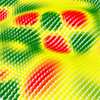
This is the last of the site analysis tools we previously used in the midterm project of first-year architecture education. As you may recall, we previously introduced a tool that generates topographies based on specific parameters. Afterward, we examined two tools that perform slope and flow analyses on these topographies. Today, we are presenting a tool that analyzes curvature. This topic actually constitutes one of the interesting intersection points between architectural design and differential geometry. Curvature is not something architects…
Flow Map on Terrains
September 11, 2026
We previously looked at the terrain generator script we used in midterm projects with first-year architecture students over here. Later on, we added a few analysis modules to this tool. You might remember the slope analysis tool from this link. Today’s topic is another type of analysis: flow. The idea for this code wasn’t actually mine; I developed it by looking at an existing script based on Serkan Uysal’s suggestion. Unfortunately, I don’t know who originally wrote it. Keeping track…
Terrain Generator
August 13, 2026
Last year, for the midterm assignment in our first-year basic design studio, we gave our students a range of different, randomly generated contexts to work with. For this purpose, I developed a small Grasshopper tool that makes the graph of a function look as much like a terrain model as possible. This tool is not really a procedural terrain generator. I would genuinely like to build one, someday. What we have here is simply a function surface. At the inputs,…
Isovist Component
May 26, 2012
Yesterday, Kağan asked me about the isovist component in Grasshopper and how it works. In fact, it is a long story, I said because once upon a time, I was curious about Space Syntax theory as my old friend Ela Çil introduced it. So, here is an original definition of Michael Benedikt: “The environment is defined as a collection of visible actual surfaces in space. An isovist is the set of all points visible from a given vantage point in…
Force Fields in ARCH362
March 17, 2015
This year’s Parametric Modeling class starts with some of the very basic use of Grasshopper concepts. This definition is a practical start-up of using force fields in the architectural design process. However it does not compute any physical phenomena (such as circulation of people, wind, or anything else), but shows a simple way to tell Grasshopper about walls that push the field, and points that pull the field. I’ll post more of this kind of basics, hopefully along with some student…