
Geodesic Dome
Geodesic refers to the shortest path between two points on a curved surface. It is based on the principles of geodesy, which is the science of measuring the Earth’s shape. On the other hand, in architecture and design, a geodesic dome is a spherical or hemispherical structure consisting of a network of geodesic lines (great-circle arcs) forming triangles. Therefore, the dome’s framework provides strength and stability, distributing stress throughout its structure. Buckminster Fuller popularized and developed the concept of the geodesic dome. He designed the dome based on tensegrity (tensional integrity) principles and the geodesic sphere. Fuller’s design and promotion of geodesic domes brought attention to their structural efficiency and versatility. In this short study, I developed a Grasshopper code to design thin-shell Geodesic Dome structures.
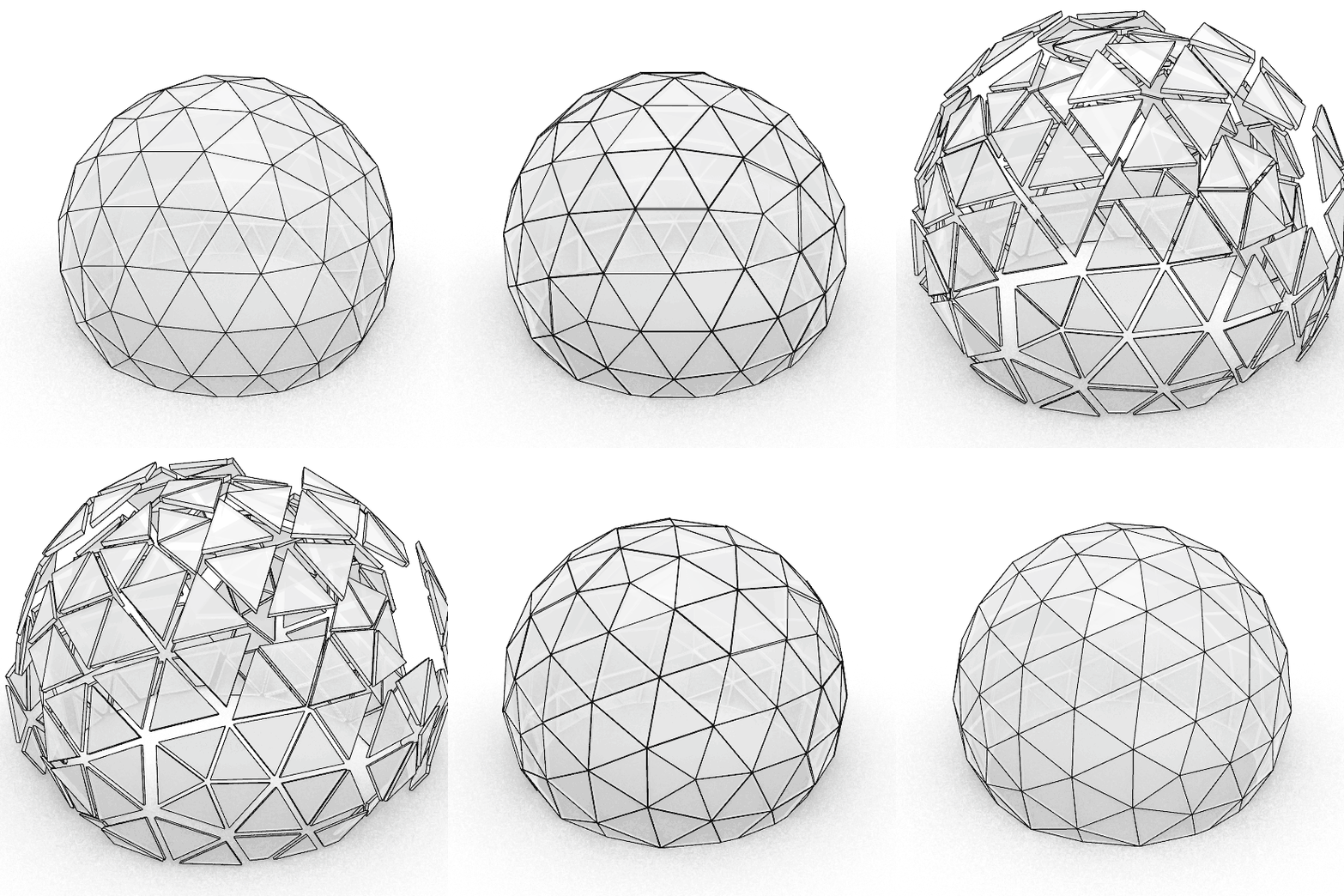
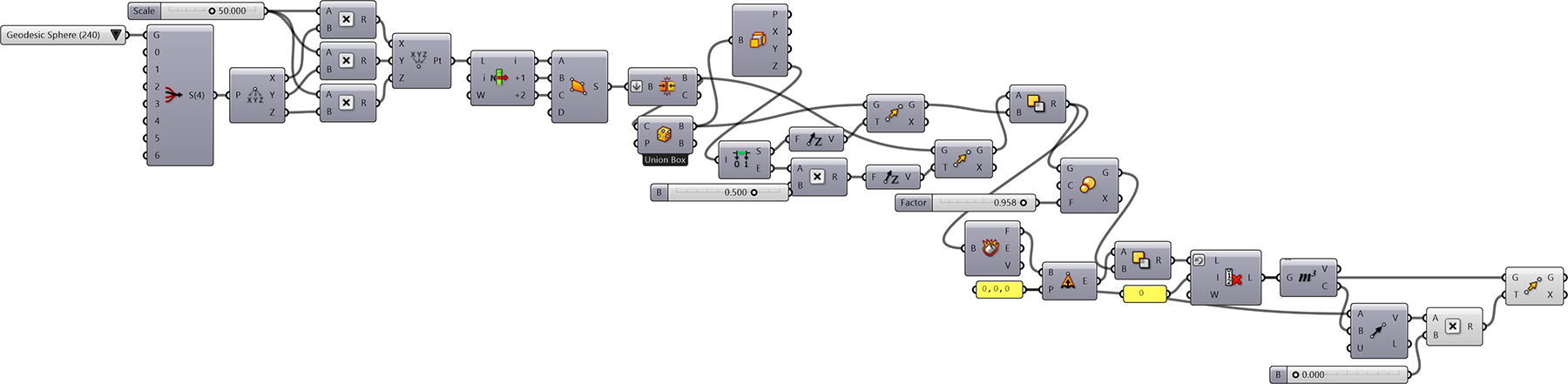
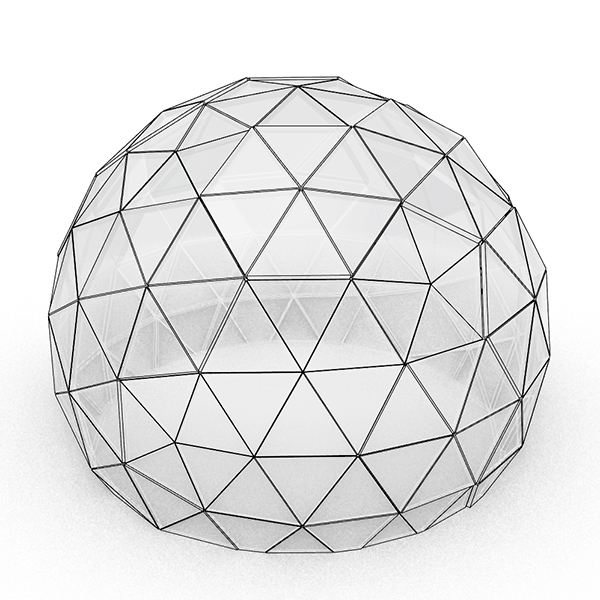
This Grasshopper definition generates variations of Geodesic Dome, including 7 types of it. The input parameters are the type of dome (number of triangles), shell thickness, displacement (you see in the animation), and the spherical ratio. A ratio of 0 creates a full dome (half sphere), and a ratio of 1 creates a full sphere. All values in between generate different dome ratios. The output of the definition is a set of closed polysurfaces for every cell of the dome. Therefore, the output is ready for 3d printing. The code is using native Grasshopper components. Therefore, no add-ons are necessary for it to work.
Cite this post
Related Posts
Modeling a Geodesic Sphere
May 23, 2012
Not all of them, but when you get the idea, you’ll see there are lots of different alternatives for creating Fuller’s famous Geodesic Domes (Although in fact, he is not the inventor of it). I was playing with Platonic Solids in Rhino and realized that the “Pull” command is very useful in subdividing objects. I modeled this in Rhino 4. First, take a regular Icosahedron and divide it. Because, this is the simplest way for modeling a Geodesic sphere, by…
Fibonacci Sphere
April 12, 2023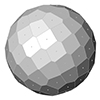
This website explains the problem and several solutions. I managed to implement the formulas to convert a 2D square grid into spherical coordinates. The Fibonacci Sphere is one of the solutions to the equal distribution of points on a sphere. It is not the best solution to this problem. But it is regarded as a quick and efficient one. Suitable for me. I developed this Grasshopper code by studying the above website and some other sources. The code starts with…
Graph Waves with Attractor Geodesic
January 25, 2012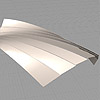
The regular component design technique can be further improved by adding several manipulations. The purpose of this study was to create a surface component that reacts to an inherent parameter (actually a geodesic curve on the surface). However, within the process of parametric modeling, diverse formal potentials emerged. Most interesting results are achieved by adding a graph parameter to control the waves of reaction while splitting the surface as stripes. It is created in the recently updated version (0.8.00066) of…
Catenary Dome without Kangaroo
August 13, 2026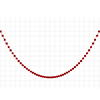
When thinking about serious and specific topics, I suddenly find myself looking back at the basics again. Catenary curves, are not the most beautiful one among those mathematical forms found in nature. However, it still tells us a lot about structures. The name apparently comes from catenaria, the Latin word for “chain”. This Grasshopper code was actually an example from our book 10 years ago (link here). It seems catenary curves could potentially be used in a type of dome…
Parametric Pendentives
August 1, 2024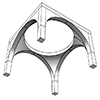
A pendentive is an architectural feature used in domed structures. It is a triangular section of a sphere that allows for the transition from a square or polygonal base to a circular or polygonal dome. Pendentives curve upward from the corners of the base and support the dome above. They help distribute the dome’s weight more evenly and enable the construction of a dome over a non-circular base. I created this Grasshopper model using a technique I had previously presented…