
Modeling an Icosahedron
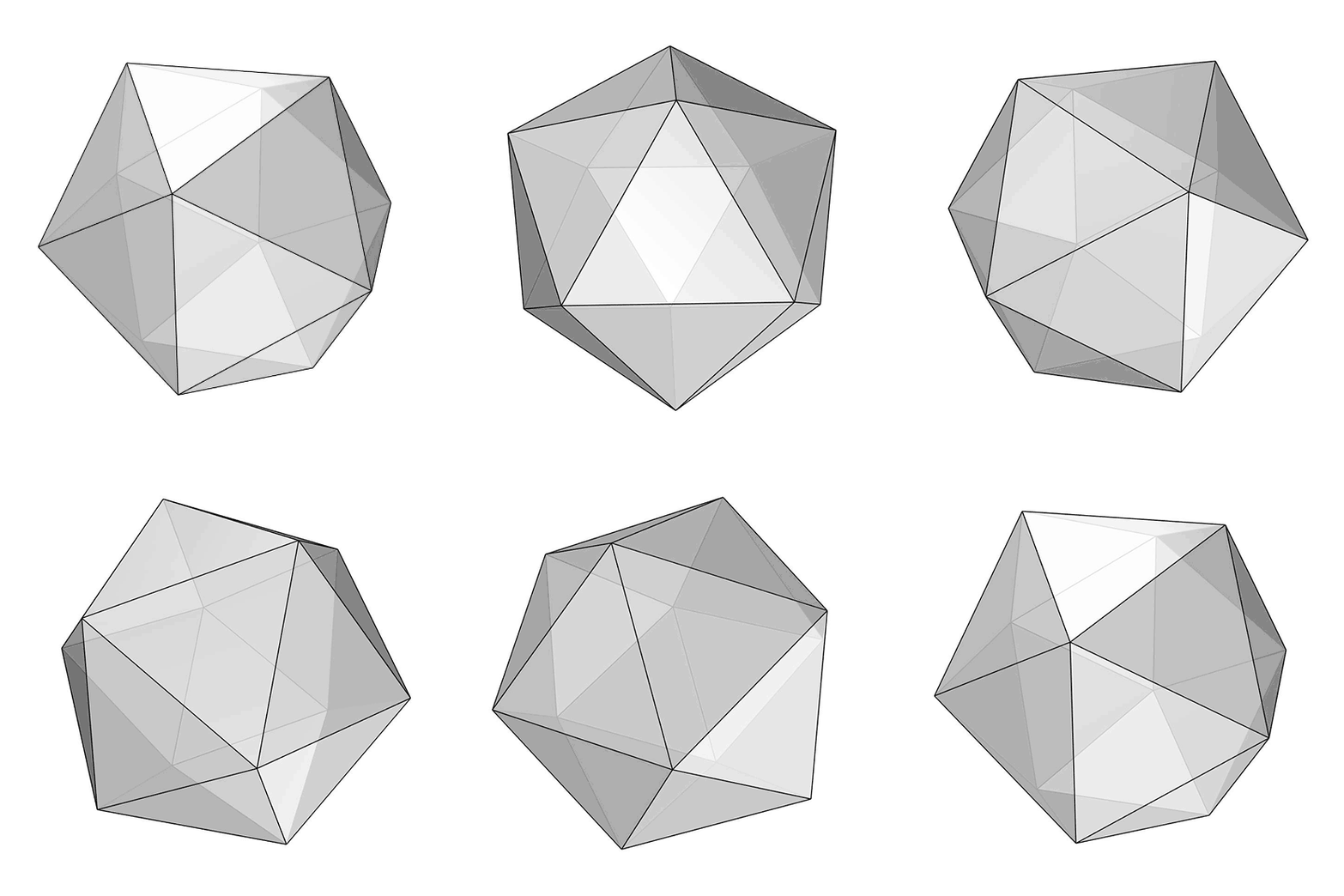
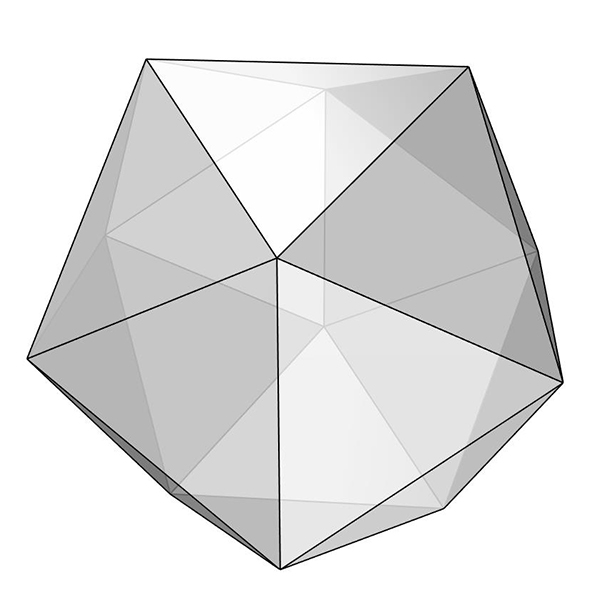
Today’s polyhedra is the beautiful icosahedron. It is one of the five Platonic Solids with twenty equilateral triangular faces. Its dual is the dodecahedron, which has pentagonal faces. Here, I explained the process of modeling an icosahedron. After creating a regular pentagon, you should find the “tip” point of the Icosahedron by intersecting spheres from at least three of the corner points with a radius of the pentagon’s edges. You can exercise Tetrahedron to understand how we find a point in three dimensions. It lies at a certain equal distance from three other points. The trick here is to 3d rotate and copy the pentagon to construct the inner angle of the solid. Then, it’s easy to repeat the process to complete the object by creating all 20 triangular faces and joining them into a single object.
This tutorial creates a Rhino file (3dm Rhino 7 format) including one closed polysurface object. Therefore, it is ready for unrolling flat, or 3d printing without problem. You can use this model to further investigate the archimedean solid of truncated icosahedron (buckyballs), and the famous geodesic spheres. Thus, this solid creates the foundation of many other interesting objects.
Cite this post
Related Posts
Modeling Dual of Dodecahedron
December 14, 2024
A dual polyhedron is a concept in geometry where two polyhedra are related in such a way that the vertices of one polyhedron correspond to the faces of the other, and the faces of the first polyhedron correspond to the vertices of the second. The process of creating a dual polyhedron is called duality, and it applies to many regular, semi-regular, and some irregular polyhedra. In the case of Platonic solids, the cube and octahedron are duals of each other….
Modeling and Unrolling Icosahedron
December 12, 2024
An icosahedron is a three-dimensional polyhedron with twenty triangular faces, twelve vertices, and thirty edges. It is one of the five Platonic solids and is highly symmetrical, with all faces being equilateral triangles. A regular icosahedron has equal edge lengths and angles between its faces, making it one of the most symmetrical shapes in three-dimensional space. In this short tutorial video, I am modeling and unrolling an icosahedron. I studied this beautiful solid here, here, and here before. The Icosahedron…
Modeling Stellated Icosahedron
December 14, 2024
Stellation of polyhedra refers to the process of extending the faces (or edges) of a polyhedron outward to form new, more complex shapes. These new shapes, called stellations, are created by adding extra vertices, edges, and faces that “project” outward from the original polyhedron’s structure. You can create an infinite number of new polyhedral forms, depending on how you extend the faces and edges. In this short tutorial video, I am modeling a stellated icosahedron. I use basic modeling commands…
Modeling Excavated Dodecahedron
December 15, 2024
In geometry, the excavated dodecahedron is a star polyhedron that looks like a dodecahedron with concave pentagonal pyramids in place of its faces. In this short tutorial video, I am modeling an excavated dodecahedron in the Rhinoceros software. I use basic drawing and modeling commands. I aim to introduce this skill to beginner-level architects and designers. As the name suggests, this process includes the construction of the dodecahedron first. Then, the pentagonal faces of this polyhedron were “excavated” to the…
Modeling and Unrolling Cube
December 12, 2024
A cube is a three-dimensional shape with six square faces, twelve edges, and eight vertices. It is one of the most familiar geometric solids and is a special type of rectangular prism where all sides are of equal length. A cube has a high degree of symmetry. Angles between its faces are right angles. It is often referred to as a “regular hexahedron”. Also cube is one of the Platonic solids, known for its perfect symmetry and simplicity. Nevertheless, the…