
Construction of Tetrahedron
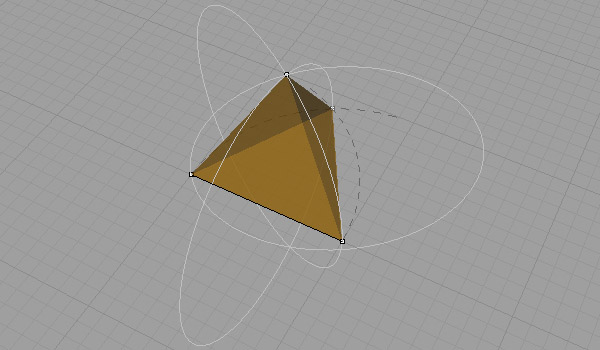
The tetrahedron is a platonic solid with four equal triangular faces (equilateral), six equal edges, and four vertices. In the construction of a tetrahedron, we will look closer at length transfers using compass-like tools in two- and three-dimensional space. To define the edge length of the first triangle, start with any two points in Cartesian space. Using a compass (arc or circle), draw two arches (or circles) using your initial points as corners and the distance between your points as radius. Now, you’ve found the third corner of your equilateral triangle at the intersection of these arches.
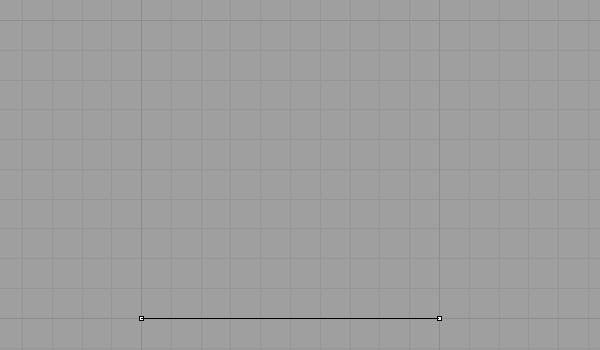
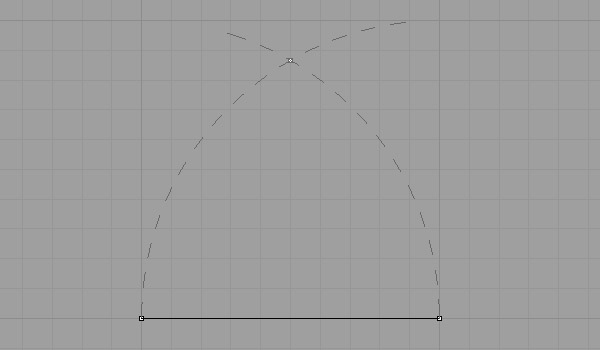
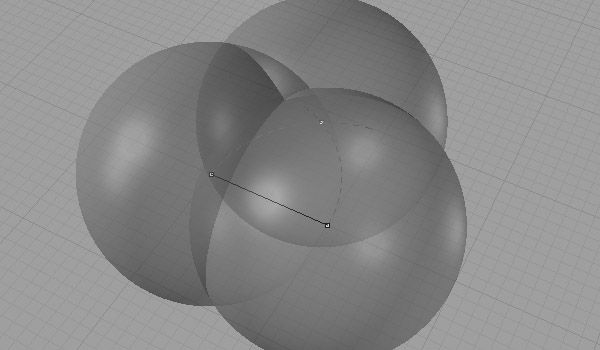
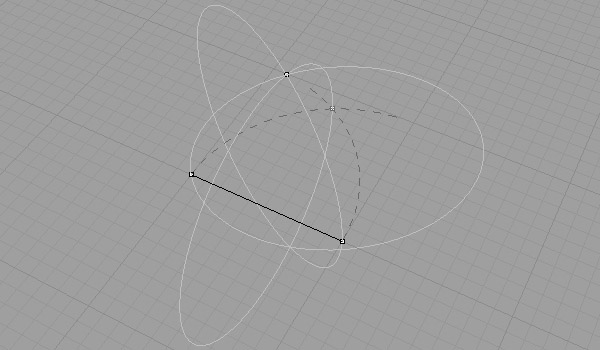
This time, do the same thing in three dimensions. When constructing a tetrahedron, imagine the fourth and last corner point of the tetrahedron above your triangle. As all faces of the tetrahedron are equilateral triangles, this point has to be at the same radius distance you’ve determined above. However, you’ll use a three-dimensional compass (or a sphere) to transfer this distance. This will help you find the intersection of equal distances to these three corners. If you intersect only two spheres, you’ll find a circle. This means the fourth point you are looking for lies in this circle. You need the third sphere to intersect with the circle to find the exact location of the fourth corner. Finally, the triangular faces resulting from the tetrahedron’s construction are created using these four corner points.
Cite this post
Related Posts
Modeling and Unrolling Tetrahedron
December 12, 2024
A tetrahedron is a three-dimensional shape with four triangular faces, four vertices, and six edges. It is the simplest polyhedron and, in its regular form, has equilateral triangles as faces, with all edges of equal length. Thus, known as one of the Platonic solids, a regular tetrahedron is highly symmetrical, and its shape is considered stable and efficient in many natural and man-made structures. In this short tutorial video, I am modeling and unrolling a tetrahedron. I studied this platonic…
Modeling and Unrolling Truncated Tetrahedron
December 14, 2024
Truncation in mathematics and geometry refers to cutting off parts of a shape, typically the vertices, edges, or other extremities, to create a new modified figure. This process is often used with polygons, polyhedra, or functions. A truncated tetrahedron is a polyhedron we can derive from a regular tetrahedron by truncating (cutting off) its four vertices. This process creates a new shape with additional faces while maintaining its symmetry. In this tutorial video, I am modeling and unrolling a truncated…
Modeling and Unrolling Truncated Tetrahedron
March 10, 2024
Truncation refers to the process of shortening something by removing parts. You can apply truncation to numbers, text, or data in various contexts. A truncated polyhedron is a geometric solid formed by truncating the vertices of a regular polyhedron. Truncation involves cutting off the corners or vertices of the polyhedron in such a way that the original faces become polygons with new edges. This process creates new faces at the truncated vertices. It often results in a shape that is…
Folding a Truncated Tetrahedron
February 12, 2023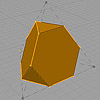
While digging through the lecture archive, I found this video I made in 2017. We introduce Platonic solids and Archimedean solids in the Design Geometry course at Istanbul Bilgi University. This video shows how we can create an Archimedean solid, the Truncated Tetrahedron, by folding it from a flat sheet. While doing this, I intersected the spheres by using the relations between the side lengths of the solid, and I calculated the rotation angles accordingly. First of all, I drew…
Tetrahedron Quick Way
May 20, 2012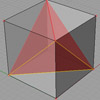
The tetrahedron is a popular platonic solid for designers. We’ve explained how to draw them using equilateral triangles here before. Recently I’ve found (sorry, lost the web address) a much quicker way of modeling a Tetrahedron using a cube. It’s very simple, just connecting the three opposite corners of the cube automatically makes them equal, resulting in the four equal faces. Of course this time you’ll have to calculate the actual edge length, but if you use the “box diagonal”…