
Icosahedron Study
I have come across several high school topics I was afraid of. While I was searching for a geodesic dome definition in Grasshopper, it was quite surprising that I found an easier way of modeling an approximation of icosahedron, the famous platonic solid. Icosahedron was a research topic of this website at various posts before (here, here, and here). In order to generate geodesic spheres, first I had to solve icosahedron. My first experiment was partially successful. I knew icosahedron’s points lie at regular pentagons which are pulled onto a sphere.
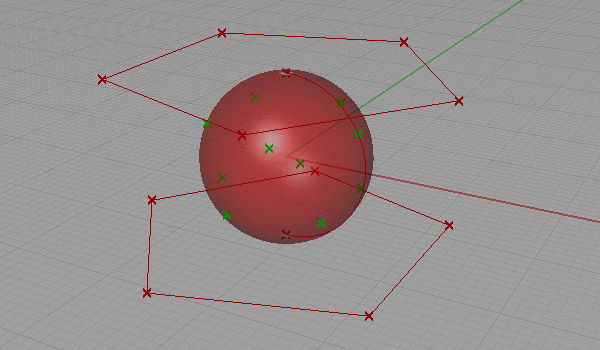
It sounds simple, but it is not. The radius of the planar pentagon to be pulled on the sphere should have a geometric relationship with the sphere radius or the desired edge length of the icosahedron. I found various formulas that represent the relationship between the icosahedron’s sphere radius and edge length. Unfortunately, they are not equal. If we call the radius of the sphere r, and the edge length of the icosahedron as a, here is their formula;
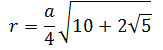 or approximately saying, r = a * 0.9510565162…
However, this does not solve my problem either. I needed to find the radius of the pentagon. I’m sure it is a simple question for a math expert, but as I was not good at math in high school, I realized that I’ll never be.
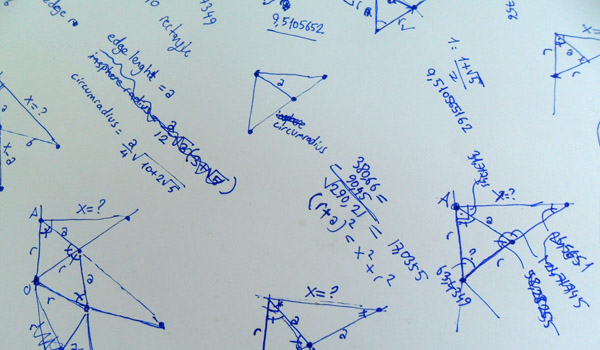
As I couldn’t manage to find or develop an equation, I measured using a unit sphere and found a ratio of 1.90210898. That worked. Although it is the quite a short and efficient definition, it became boring at this stage and I quit this method without constructing icosahedron faces, or a geodesic sphere.
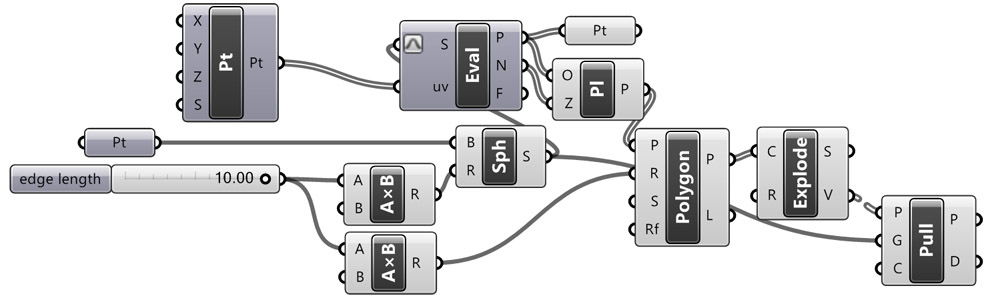
My next try was about another phenomenon of math, which I knew from both high school and the school of architecture. I was completely sure about not using that ancient order in my designs. Yesterday, I used it. The golden ratio was an interesting one (represented by a symbol, phi; equals approximately 1.618034…) for designers and mathematicians because of its connection to nature, physics, and human perception. There is an alternative method of icosahedron construction that uses three golden ratio rectangles, which lie at the same origin but are rotated on different planes. It was simple to model that approach.
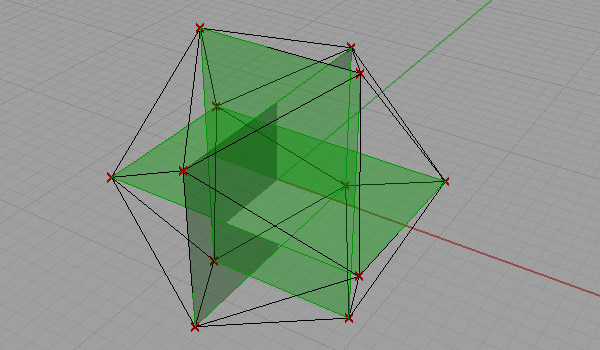
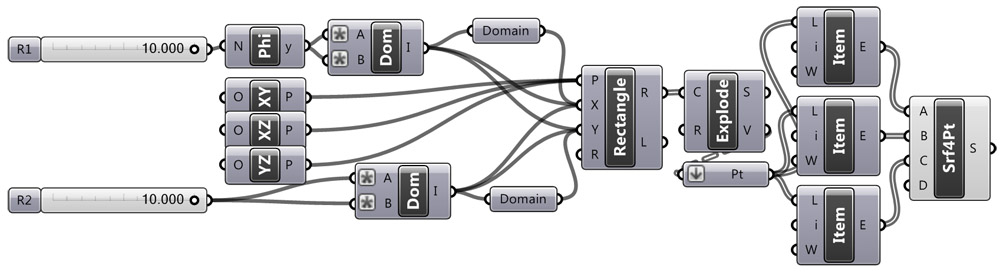
As you see from the definition, I omitted the two radius sliders that create the rectangles. When I animated these values separately, result was very surprising to me;
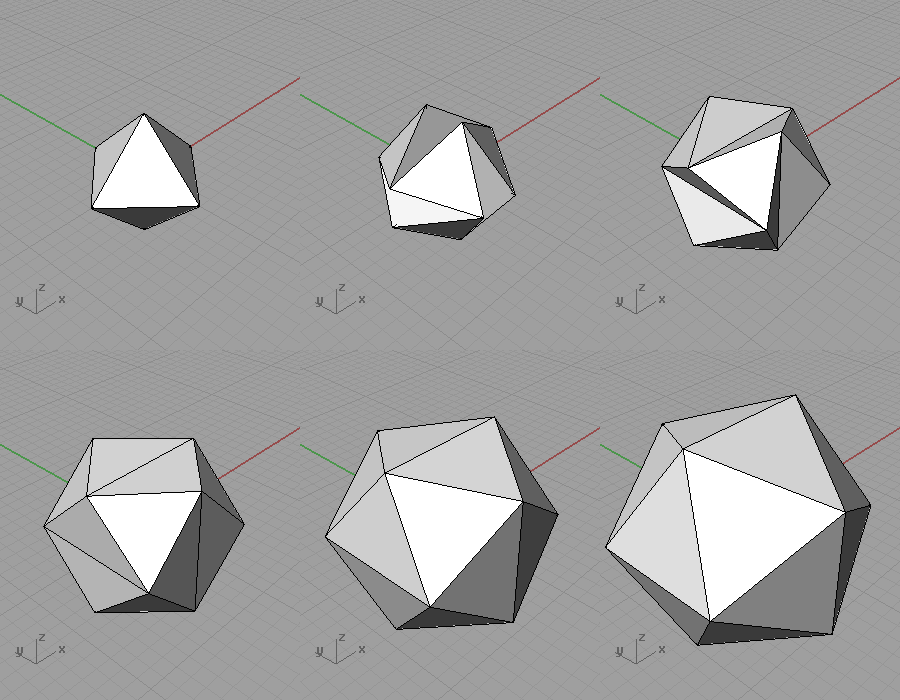
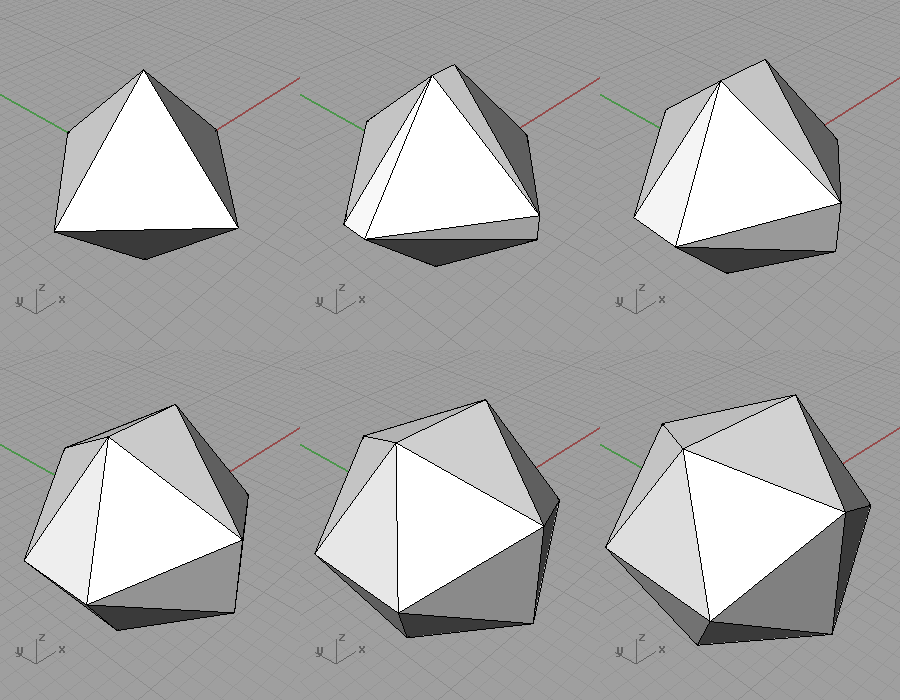
It folds, and creates octahedrons! Somehow, I stopped at this stage to think about it. Maybe I’ll try to continue to the geodesic spheres later.
Cite this post
Related Posts
Coding the Dodecahedron
March 7, 2024
Here is a method for coding the dodecahedron and all its irregular variants in Grasshopper as quickly as possible. I utilized the golden ratio rectangles, usually used to construct the sister polyhedron, the icosahedron. However, the magic component of the Grasshopper, the Faceted Dome rescued me again to generate the dual of it, the dodecahedron. This is a special platonic solid, which has 12 regular pentagonal faces. There are several techniques that I generally prefer to use in Grasshopper. You…
Icosahedron by Code
April 5, 2012
I tried different approaches to drawing platonic solids using Grasshopper’s native components. However, it seems impossible now. In geometric definition, a platonic solid is a set of points, distributed on a sphere with equal distances. If the set contains 12 points, then it’s an icosahedron. I found lots of information about these objects and mathematicians seem to love analyzing them. They created different approaches to building an icosahedron. One of them is very suitable to implement on Grasshopper’s VB component….
Modeling Dual of Dodecahedron
December 14, 2024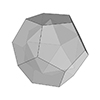
A dual polyhedron is a concept in geometry where two polyhedra are related in such a way that the vertices of one polyhedron correspond to the faces of the other, and the faces of the first polyhedron correspond to the vertices of the second. The process of creating a dual polyhedron is called duality, and it applies to many regular, semi-regular, and some irregular polyhedra. In the case of Platonic solids, the cube and octahedron are duals of each other….
Modeling and Unrolling Icosahedron
December 12, 2024
An icosahedron is a three-dimensional polyhedron with twenty triangular faces, twelve vertices, and thirty edges. It is one of the five Platonic solids and is highly symmetrical, with all faces being equilateral triangles. A regular icosahedron has equal edge lengths and angles between its faces, making it one of the most symmetrical shapes in three-dimensional space. In this short tutorial video, I am modeling and unrolling an icosahedron. I studied this beautiful solid here, here, and here before. The Icosahedron…
Modeling an Icosahedron
December 21, 2011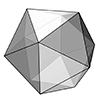
Today’s polyhedra is the beautiful icosahedron. It is one of the five Platonic Solids with twenty equilateral triangular faces. Its dual is the dodecahedron, which has pentagonal faces. Here, I explained the process of modeling an icosahedron. After creating a regular pentagon, you should find the “tip” point of the Icosahedron by intersecting spheres from at least three of the corner points with a radius of the pentagon’s edges. You can exercise Tetrahedron to understand how we find a point…