
Drawing and Unrolling Octahedron
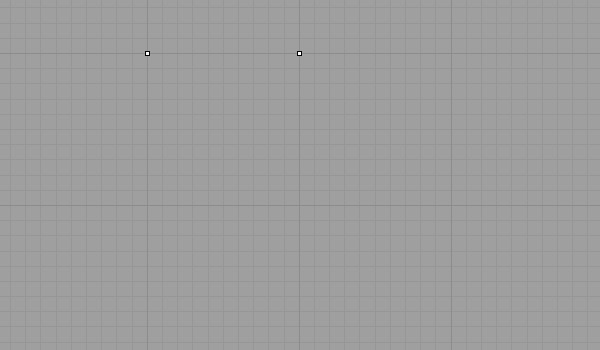
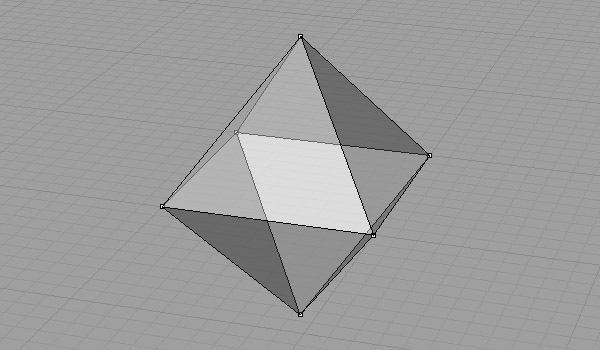
An octahedron is a polyhedron and platonic solid with 8 faces of identical equilateral triangles. In this post, I will try to explain the drawing and unrolling process of the octahedron. It has a close relationship with the cube as it’s dual. In order to construct an octahedron, we first have to create a square. The main problem of drawing the square is determining the right angle (perpendicular axis) to any point in Euclidean space. We’ll draw it here as a two-dimensional projection. However, it can also be established in three dimensions using the same method (except for using spheres instead of circles). Start from any two points in the space;
The Square
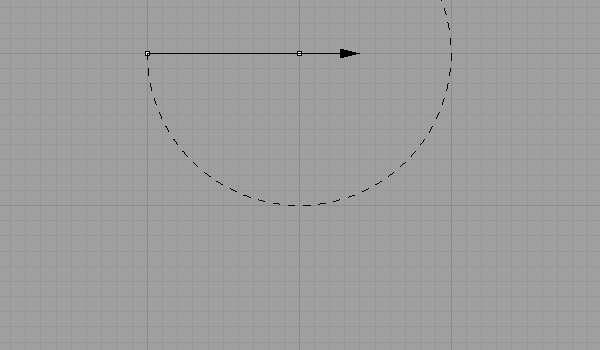
To create a right angle, we need to find a third point on the same axis and distance as the initial points. Using only a compass and ruler we establish that like this;
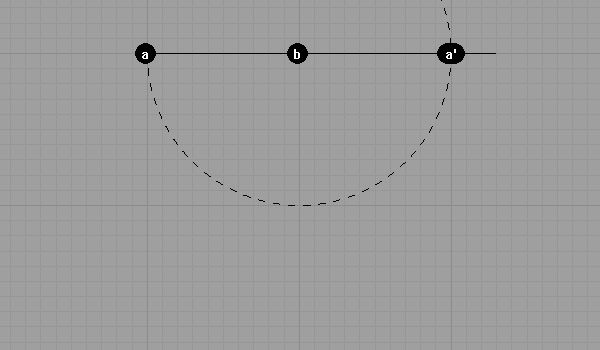
Now, we can find the perpendicular axis to point b, using points a and a’.
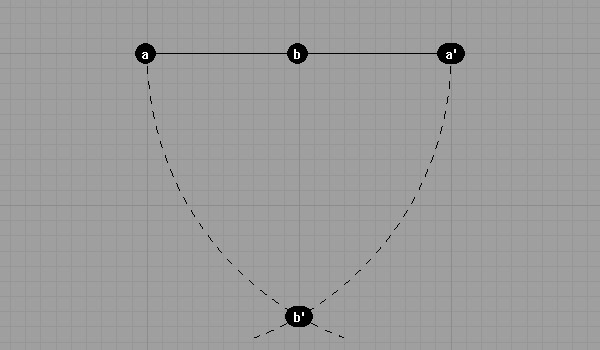
Drawing circles with center a and radius aa’, then center a’ and radius aa’. Found point b’ by intersecting these circles.
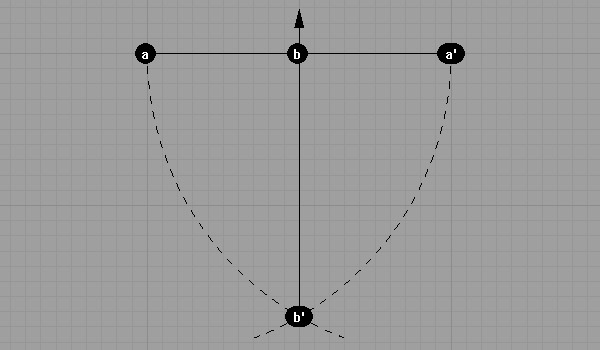
The line drawn using a ruler to connect b and b’ has to be perpendicular to line ab.
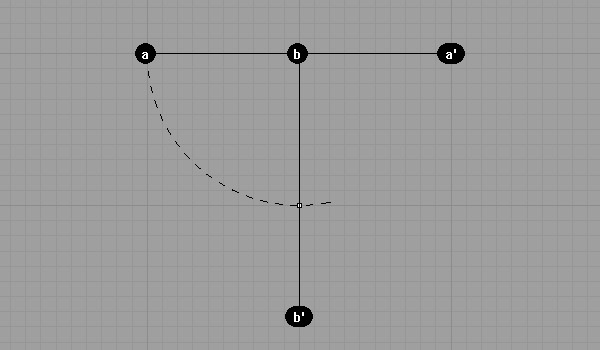
Rest is easier. Now, we can draw the square using this perpendicular. Intersecting the arc with center b and radius ab with line bb’.
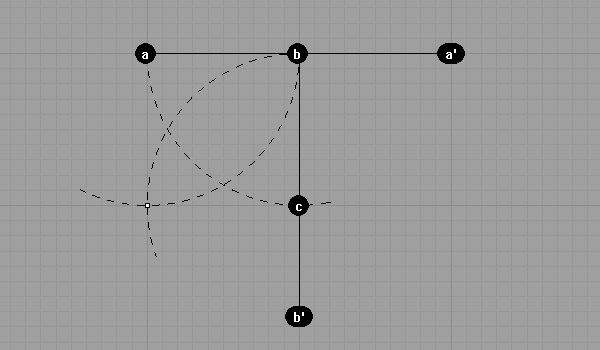
After finding point c, now use it to find point d.
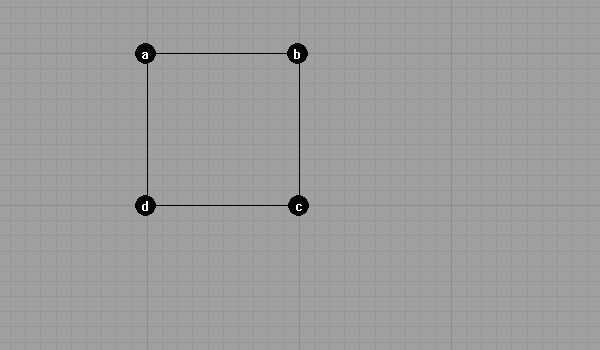
Drawing the Octahedron
In order to construct a regular eight-sided solid, we’ll use a square as a basis.
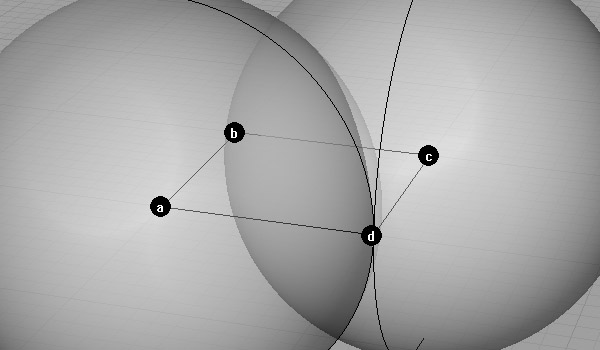
The problem is to find two points above and below this square, which lies at the same distance from all points a,b,c, and d. And the distance is the same as the edge of this square. Remember, we create the octahedron from eight equal and equilateral triangular surfaces. In order to find these points, we’ll intersect any three spheres from square corners with the radius of the square edge.
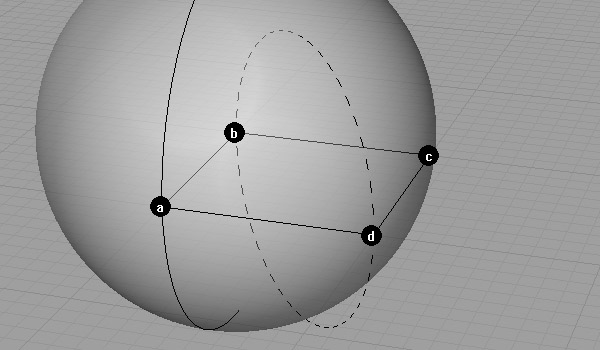
We intersected spheres a and c with radius ab. Found a circle. Thus, we need to intersect the third sphere to find points. This time it could be spheres centered at points b or d.
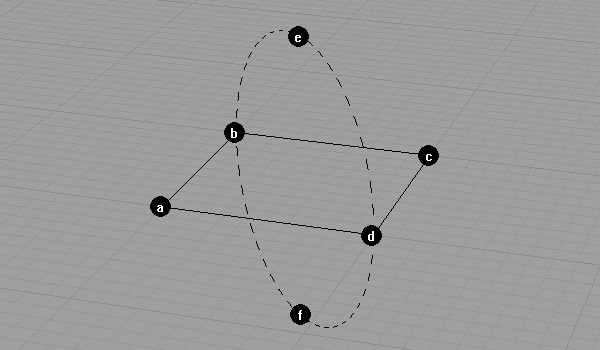
Then, after finding points e and f, the octahedron is almost finished.
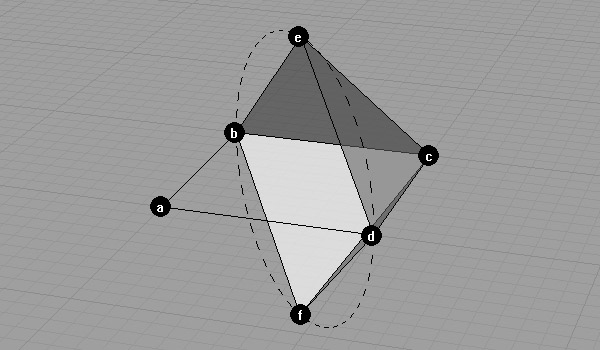
You may check the edge lengths of triangles if they are equal or not.
Unrolling the Octahedron
Octahedron has several unrolling sequences. I described one of them below. Note that the first step in this unrolling sequence creates another famous solid named “Rectified Tetrahedron”.
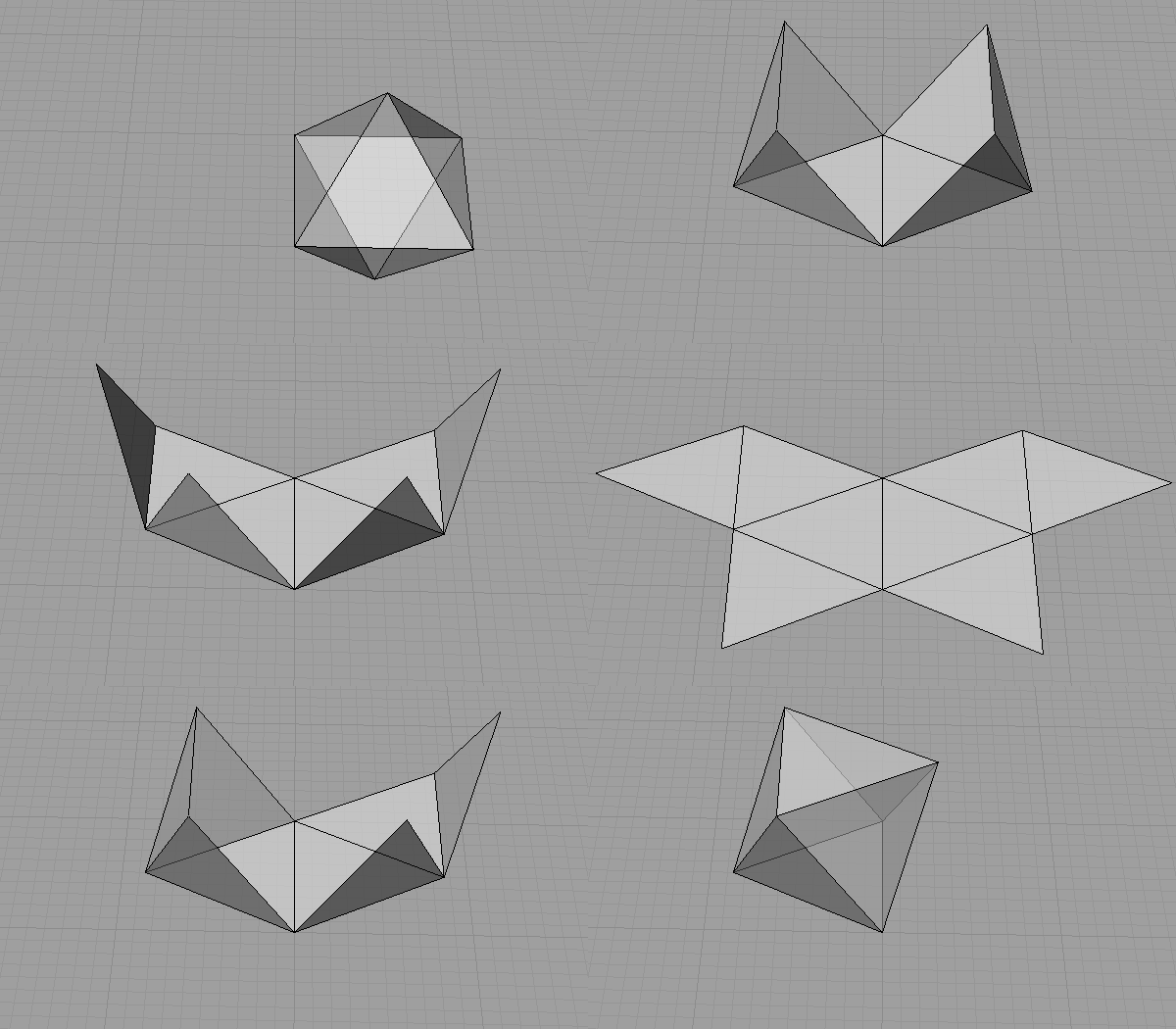
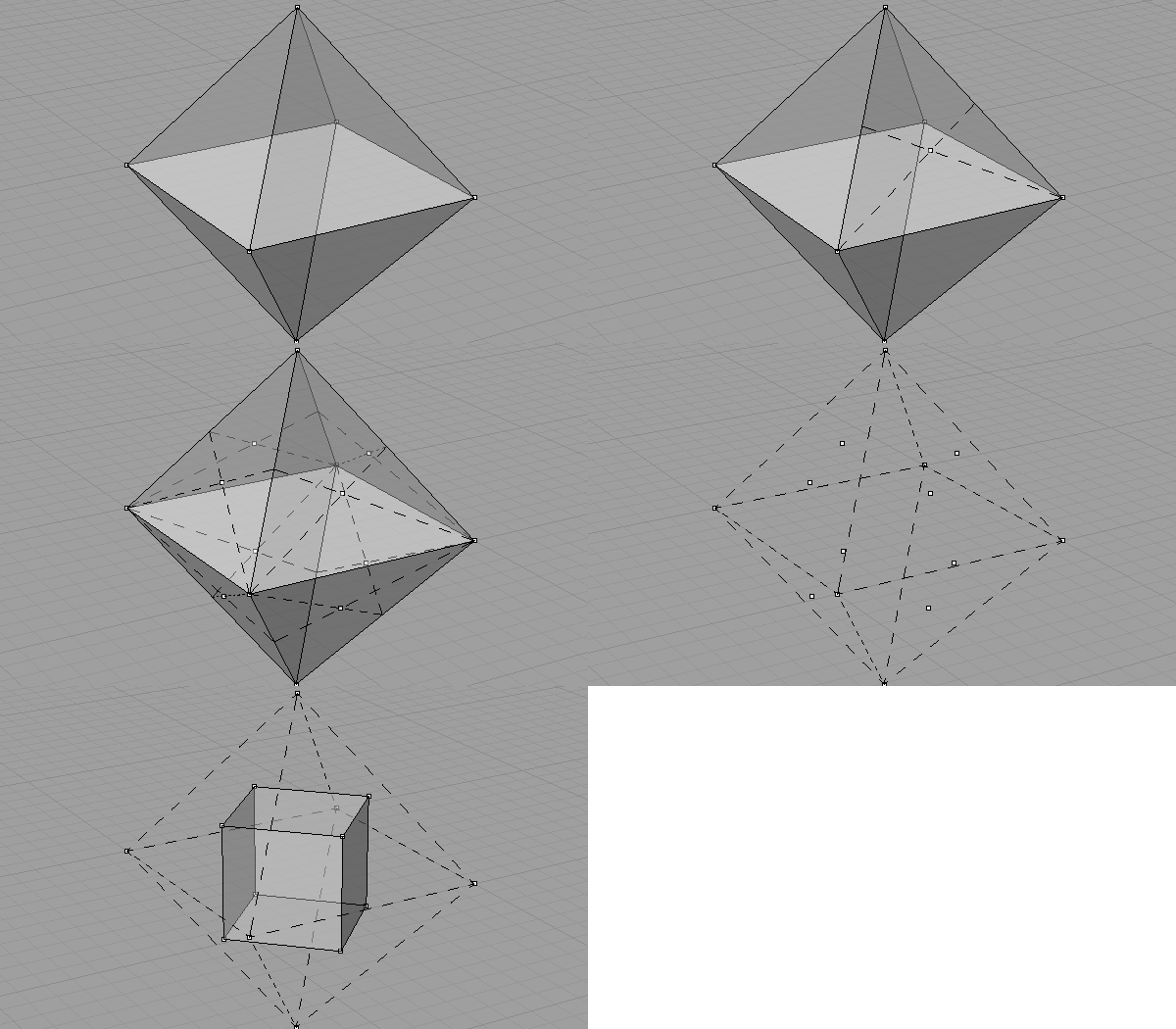
That was the drawing and unrolling of the octahedron. Cube is a dual octahedron as they have symmetrical vertex and face numbers. So, an octahedron has 8 faces and 6 vertices, and a cube has 6 faces and 8 vertices. This means, we may transform octahedron faces into cube vertices with the following method; Center points of all octahedron faces connect to construct a cube.
Cite this post
Related Posts
Modeling and Unrolling Octahedron
December 12, 2024
An octahedron is a three-dimensional polyhedron with eight triangular faces, six vertices, and twelve edges. It is one of the Platonic solids and has high symmetry, with all of its faces being equilateral triangles. A regular octahedron can be visualized as two pyramids joined at their bases. It has the same number of faces as a cube has vertices, and the same number of vertices as a cube has faces. The octahedron is also dual to the cube, meaning that…
Modeling and Unrolling Cube
December 12, 2024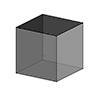
A cube is a three-dimensional shape with six square faces, twelve edges, and eight vertices. It is one of the most familiar geometric solids and is a special type of rectangular prism where all sides are of equal length. A cube has a high degree of symmetry. Angles between its faces are right angles. It is often referred to as a “regular hexahedron”. Also cube is one of the Platonic solids, known for its perfect symmetry and simplicity. Nevertheless, the…
Modeling and Unrolling Dodecahedron
December 12, 2024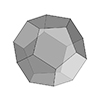
A dodecahedron is a three-dimensional polyhedron with twelve flat, regular pentagonal faces, twenty vertices, and thirty edges. It is one of the Platonic solids and is highly symmetrical, with each face being a regular pentagon. The dodecahedron’s shape is unique among the Platonic solids because its faces are polygons with five sides, unlike the others which have triangular faces. Due to its symmetry, the dodecahedron has been used in various applications, including as a model in geometry and in certain…
Modeling and Unrolling Icosahedron
December 12, 2024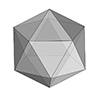
An icosahedron is a three-dimensional polyhedron with twenty triangular faces, twelve vertices, and thirty edges. It is one of the five Platonic solids and is highly symmetrical, with all faces being equilateral triangles. A regular icosahedron has equal edge lengths and angles between its faces, making it one of the most symmetrical shapes in three-dimensional space. In this short tutorial video, I am modeling and unrolling an icosahedron. I studied this beautiful solid here, here, and here before. The Icosahedron…
Modeling and Unrolling Tetrahedron
December 12, 2024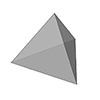
A tetrahedron is a three-dimensional shape with four triangular faces, four vertices, and six edges. It is the simplest polyhedron and, in its regular form, has equilateral triangles as faces, with all edges of equal length. Thus, known as one of the Platonic solids, a regular tetrahedron is highly symmetrical, and its shape is considered stable and efficient in many natural and man-made structures. In this short tutorial video, I am modeling and unrolling a tetrahedron. I studied this platonic…