
Macroforming WFC Shanghai
WFC Shangai is a design exercise in our first-year Design Computing class introduced by Onur Yüce Gün. This exercise emphasizes both analytical thinking and associative geometry and aims to utilize boolean operations as solid and void references in creating forms. We asked students to develop variations of this building. In order to discuss this formation in class, I studied a simple algorithm to test variations in real-time. The initial shape, developed by a boolean intersection of a rectangular prism and two giant spheres. Of course, first-year students manually explored positions and orientations of solid and void forms by creating reference points. Below is the Grasshopper definition to examine the macro-formation of WFC.
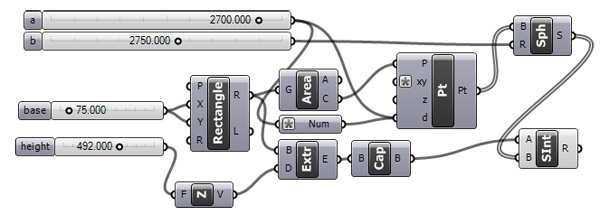
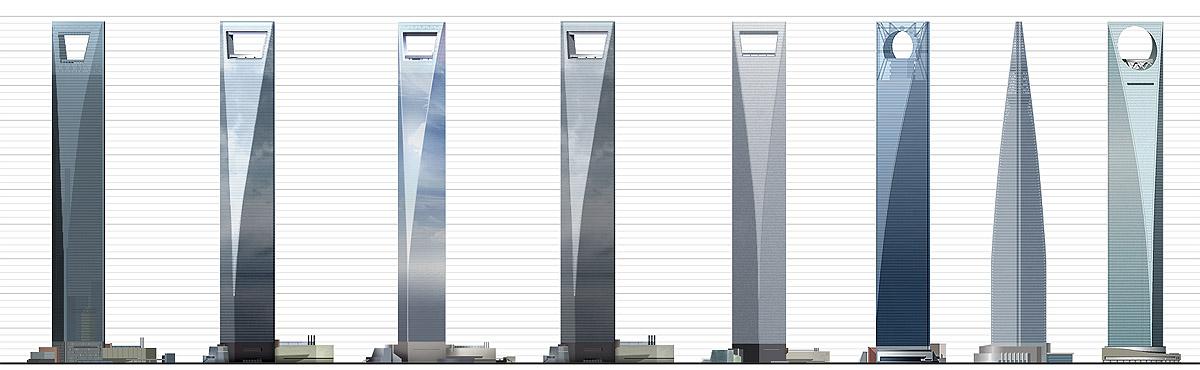
These diagrams can be found here. The current Grasshopper definition only creates the macro form without the “big hole”, floors, and basement.
Cite this post
Related Posts
Porous Solids
April 16, 2013
This is a solid-void (or boolean) exercise for first-year students. It is initially introduced by Onur Yüce Gün as an in-class exercise but later became a design problem also. Before getting into the parametric wall and eventually muqarnas exercises, this small but effective assignment helps students understand some of the fundamental concepts such as associativity, solid/void relationships, and component-based design compositions in three dimensions. Here is the initial object we used to introduce in the design computing class: As you…
Gaudi Column Macro
March 7, 2015
Gaudi-like columns are generated as part of the “boolean” classes of Design Computing. The most inspiring, beautiful, and ugly variations are often done by boolean intersection, as this operation is the surprising one of the three brothers. While the class deals with the concept of emergence once again via solid and void relationships, constructive solid modeling techniques are introduced. Although it is widely used as a spatial analysis approach in architecture, there are some examples of using boolean algebra in…
Gosper-Peano Fractal Curves
January 8, 2018
Introducing the new YouTube channel for designcoding! The architectural Geometry playlist will contain video tutorials on several topics of basic geometry exercises for designers. Below are the introductory exercises of polyline drawing and some planar transformations such as scale and rotation. It is also an interesting plane-filling fractal you know I like it very much. I studied this particula fractal (Gosper-Peano) earlier here, and here. I find it very inspiring and educational.
Parametric Wall Exercise
April 19, 2013
This is a first-year design computing problem we studied last month. It is a simple parametric wall exercise introduced by Mete Tüneri. Creating a simple definition of a building brick to be placed on a straight path, and then manipulating the path to reform different variations of the brick. This aims to introduce a fundamental concept of associativity in contemporary architectural geometry and design computing. Students are then encouraged to develop their own parametric brick to be tested in different…
Parametric Muqarnas
March 13, 2012
This was an interesting topic in design computing class. Geometric constructions based on strict relationships are becoming exciting in parametric modeling environments. I think muqarnas includes such a relationship. There is a primary method of modeling this shape, introduced by Mete Tüneri. His solution to a simple parametric muqarnas object includes a surface with six reference points, with two boolean differences (one cylinder and one box) creating the component. In Grasshopper, I tried to simulate his process by adding real-time…