
Gaudi Column Macro
Gaudi-like columns are generated as part of the “boolean” classes of Design Computing. The most inspiring, beautiful, and ugly variations are often done by boolean intersection, as this operation is the surprising one of the three brothers. While the class deals with the concept of emergence once again via solid and void relationships, constructive solid modeling techniques are introduced. Although it is widely used as a spatial analysis approach in architecture, there are some examples of using boolean algebra in actual design processes. CSG trees are one of the interesting techniques that utilize boolean operations with a diagram language. The so-called Gaudi columns exercise uses macro explication instead.
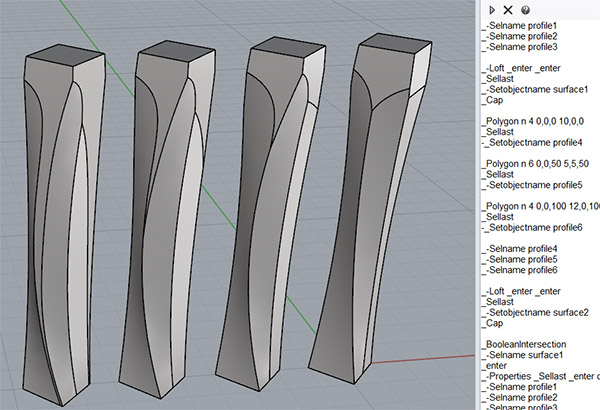
This macro we have studied in the classroom draws three profiles, and lofts and boolean intersect them to generate column designs.
! ; This is an example
; Copy and paste me to Rhino's Macro Editor

_Polygon n 4 0,0,0 10,0,0
_Sellast
-_Setobjectname profile1

_Polygon n 4 0,0,50 12,0,50
_Sellast
_-Setobjectname profile2

_Polygon n 4 0,0,100 10,0,100
_Sellast
-_Setobjectname profile3

_-Selname profile1
_-Selname profile2
_-Selname profile3

_-Loft _enter _enter
_Sellast
_-Setobjectname surface1
_Cap

_Polygon n 4 0,0,0 10,0,0
_Sellast
-_Setobjectname profile4

_Polygon n 6 0,0,50 8,5,50
_Sellast
_-Setobjectname profile5

_Polygon n 4 0,0,100 12,0,100
_Sellast
-_Setobjectname profile6

_-Selname profile4
_-Selname profile5
_-Selname profile6

_-Loft _enter _enter
_Sellast
_-Setobjectname surface2
_Cap

_BooleanIntersection
_-Selname surface1
_enter
_-Properties _Sellast _enter o s n _enter _enter
_-Selname profile1
_-Selname profile2
_-Selname profile3
_-Selname profile4
_-Selname profile5
_-Selname profile6
_Delete
_Selnone
Cite this post
Related Posts
A Text Effect
January 2, 2015
This is a macro exercise in Rhino, showing that Rhino is pretty much capable of automating some cool text effects. Just copy and paste the below code into the command bar of the Rhino, or open the macro editor by typing macro edit, then paste it there and press play. You’ll enter any string when prompted, then the macro handles the rest of the process. You can play with the parameters by changing the numeric values you see in the…
Waffle Macro
May 7, 2014
Here are two macros that automate some of the classical structural styles in today’s architectural geometry. They could be developed more to include joint details, however. It is a relaxing experience to study macros when the process doesn’t have algorithmic expressions (such as recursion, iteration, or conditionals). It is today’s subject in the first-year design computing course at İBU. The first one requires at least two curves already present in order to define a lofted surface (to be “waffled”): The second…
Binary Branching using Macro
April 15, 2013
Today’s design computing class was about fractals. In Rhino, writing macro statements are very easy to learn as it just mimics your behaviors in a sequential text. There are a few syntactic rules that we should know. First, you should watch the command line carefully to understand the steps of your design process. Each command in Rhino requires different inputs from the user. In macro, you may enter these values or tell the macro to ask the user by typing…
Back to Macro
December 14, 2012
Can we go back to the beginnings of algorithmic design tools, when it was still as simple as possible (not to the binary level of course)? Most of the theorists agree about the fact that contemporary parametric design tools sometimes provide needlessly many possibilities that suppress the designer’s own creativity. The Voronoi component in Grasshopper was one of the cult examples of that (mentioned here). Throughout this blog, I always search for simple and powerful definitions to design problems, without…
Macroforming WFC Shanghai
April 19, 2013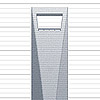
WFC Shangai is a design exercise in our first-year Design Computing class introduced by Onur Yüce Gün. This exercise emphasizes both analytical thinking and associative geometry and aims to utilize boolean operations as solid and void references in creating forms. We asked students to develop variations of this building. In order to discuss this formation in class, I studied a simple algorithm to test variations in real-time. The initial shape, developed by a boolean intersection of a rectangular prism and…