
Escher Patterns in the Classroom
Here is one of the exercises I tested with a few students in Architectural Geometry. The exercise is about creating Escher-like patterns. It is an introductory topic on the designerly utilization of regular tessellations. We use square, hexagonal, or triangular tessellations as underlying structures of complex patterns. Below are some of the student works from this exercise. I think the black-and-white coloring helps in terms of reducing the requirements. Although the patterns designed in this exercise are not Escher patterns, it seems that the results resemble them a lot. This is because of the fact that the underlying regular tessellations are the reason for this resemblance. However, the real function of these patterns lies in the fact that the resulting pattern has multiple visual outcomes. We generally use the figure and background interchangeably to display meaningful shapes. Escher also studied pattern deformations by changing the underlying tessellation.
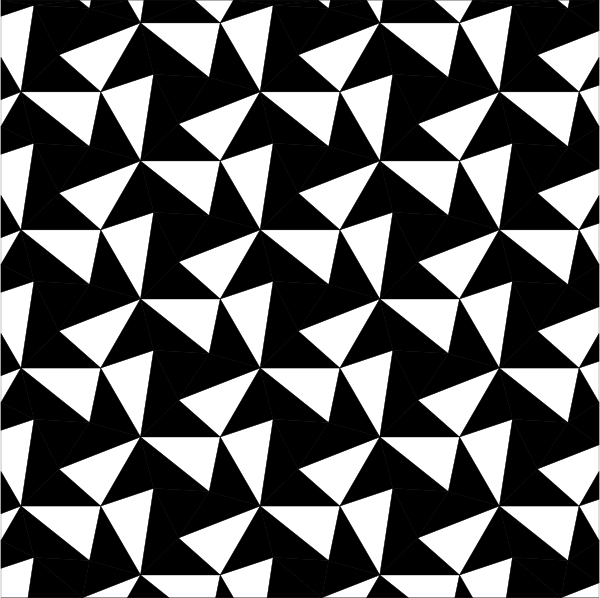
Berfin Sanem Top

Beste Tekdoğan
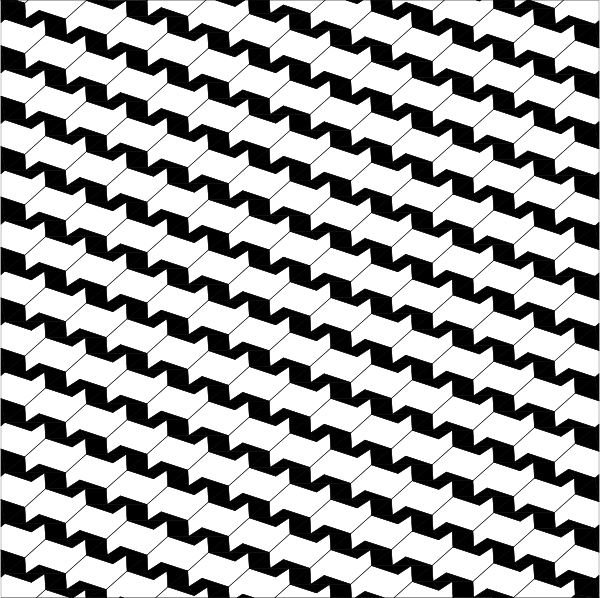
Kerem Yücel

Utkan Kanberoğlu
Here are some of the quotes attributed to the M.C. Escher:
“Only those who attempt the absurd…will achieve the impossible. I think …I think it’s in my basement…Let me go upstairs and check.”
“Are you really sure that a floor can’t also be a ceiling?”
“I don’t use drugs, my dreams are frightening enough.”
“We adore chaos because we love to produce order.”
“What I give form to in daylight is only one percent of what I have seen in darkness.”
“He who wonders discovers that this in itself is wonderful.”
“So let us then try to climb the mountain, not by stepping on what is below us, but to pull us up at what is above us, for my part at the stars; amen.”
Cite this post
Related Posts
Drawing Escher-like Tiling
December 11, 2024
Escher tilings, inspired by the work of Dutch artist M.C. Escher, are inspiring tessellations that cover a plane using repeated geometric shapes without gaps or overlaps. He often used interlocking, recognizable figures like animals and birds to create these patterns, blending art with mathematical precision. His tilings explore symmetry, transformations, and the interplay between two- and three-dimensional space. Escher’s work has influenced both artistic and mathematical fields, particularly in the study of tessellations and geometry. Thus, In this short tutorial,…
Parquet Deformation Handmade
October 31, 2012
This is not to explain the method of the Parquet Deformation but to see the potential. After we’ve studied regular, semi-regular, dual, and truncated tessellations with students, the Architectural Geometry course expects them to develop a Parquet Deformation handmade such as those shown below. I call them Parquet Deformation handmade. Because they are manually designed but drawn using traditional CAD. The samples you see below are from this website. It is a good source for other topics of tessellation as well….
Eschers Tessellations
March 29, 2012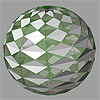
After Puzzling, I tried to establish more of Escher’s basic grid transformations using Grasshopper’s native components. This definition simulates Escher’s transformation of four-cornered grids. The postulate is based on the fact that every quadrilateral (or triangular) planar shape can create regular tessellations without gaps or overlaps. In the traditional method, this tessellation is achieved by rotating the shape 180 degrees and copying afterward. However, in Grasshopper we simply define the fifth point for each shape and divide subsurfaces into four…
Some more Patterns
February 16, 2014
While preparing the Geometry yearbook, I picked these four patterns from the 4th week’s assignment, “Seamless Patterns”. I still love to see how these patterns are generated by students with very limited knowledge of computers and geometry. There are other posts about this assignment here and here. Below are four from this semester; Ceren Atik Zeynep Dutipek Ceren Atik Meltem Bayrak
Pattern Deformations Student Works
November 18, 2013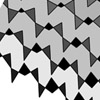
Below is some student works from this year’s Architectural Geometry / Pattern Deformations assignment. Students developed their own pattern deformation sequences mostly on regular tessellations. Based on the classical Parquet Deformation exercise, we tried to implement a rule-based approach in order to explore emergent patterns. The exercise seems to reveal endless improvisation potential. The exercise requires students to design a pattern deformation on a 28cm by 28cm area. It should include at least 100 cells. First, we explained several classical…