
Parquet Deformation Handmade
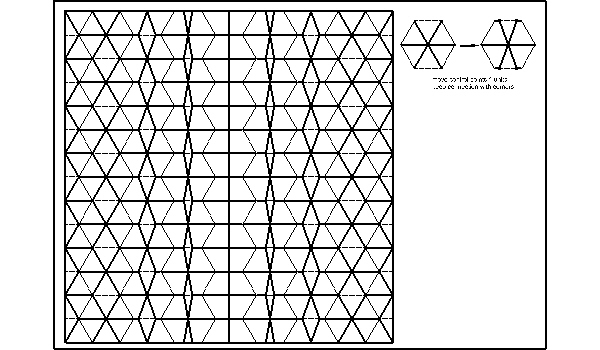
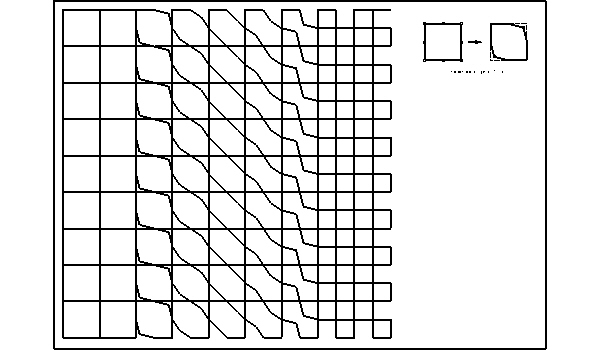
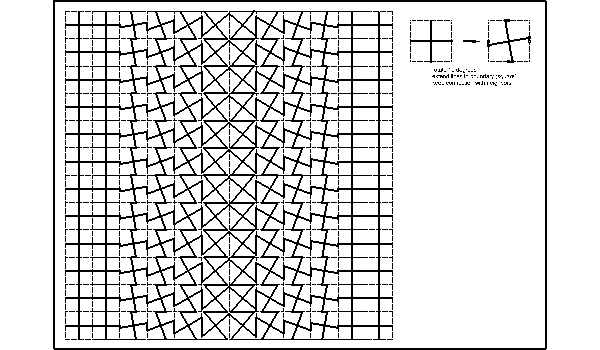
This is not to explain the method of the Parquet Deformation but to see the potential. After we’ve studied regular, semi-regular, dual, and truncated tessellations with students, the Architectural Geometry course expects them to develop a Parquet Deformation handmade such as those shown below. I call them Parquet Deformation handmade. Because they are manually designed but drawn using traditional CAD. The samples you see below are from this website. It is a good source for other topics of tessellation as well.
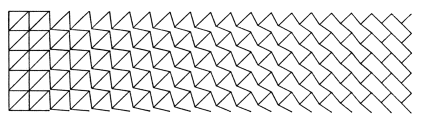
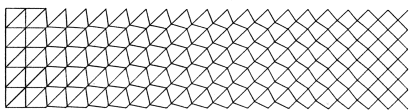
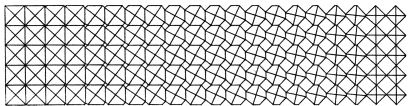
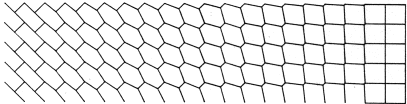
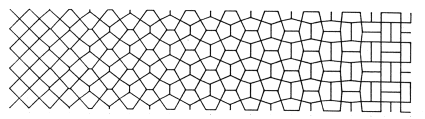
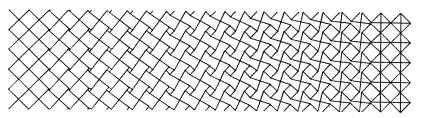
We can draw them with simple commands, line, control point editing, trim, extend, and rotate. Their firing rule is so simple that they may not need complex algorithms to model such structures. Instead, anyone can create them by hand. Again, sometimes it seems to be better that way. Yes, a script might speed up the process to see lots of different variations but at some point that would result in a non-controlled, or a random choice, lack of deeper reasoning. Escher made repeated use of a family of metamorphosis techniques in his graphic work. Perhaps the most famous example of all of these techniques is his print Metamorphosis II.
A few decades later, architect William Huff began to assign his students the task of drawing “Parquet Deformations”, abstract designs depicting tilings that slowly evolve in space. The results are related to Escher’s metamorphoses, though more abstract and mathematical. Douglas Hofstadter popularized Parquet Deformations in his Metamagical Themas column in Scientific American, later reprinted in the book of the same name.
Craig S. Kaplan (http://www.cgl.uwaterloo.ca/~csk/projects/morph/)
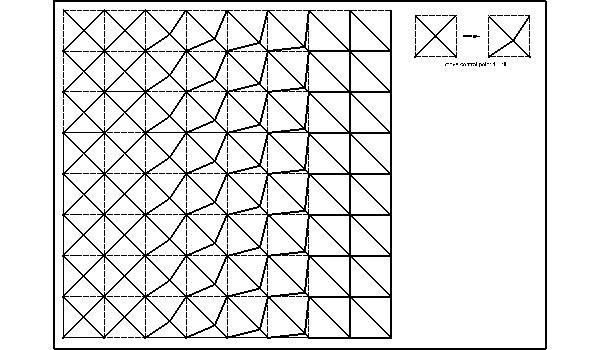
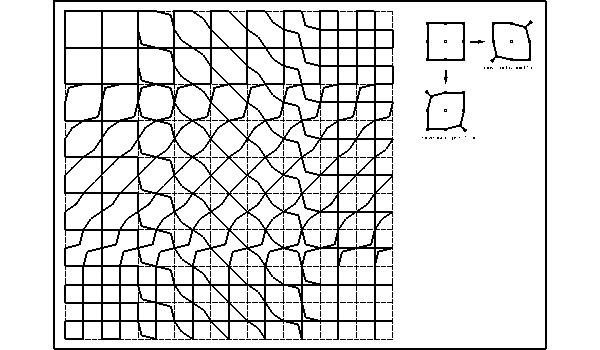
Here are some of the designs of my Architectural Geometry students testing and utilizing the above methods:
Cite this post
Related Posts
Pattern Deformations Student Works
November 18, 2013
Below is some student works from this year’s Architectural Geometry / Pattern Deformations assignment. Students developed their own pattern deformation sequences mostly on regular tessellations. Based on the classical Parquet Deformation exercise, we tried to implement a rule-based approach in order to explore emergent patterns. The exercise seems to reveal endless improvisation potential. The exercise requires students to design a pattern deformation on a 28cm by 28cm area. It should include at least 100 cells. First, we explained several classical…
3D Pattern Deformation
December 12, 2012
These are examples of 2.5D exercises in the design geometry course in my freshman year of architecture. We asked students to create extruded or referenced solids referenced from their previous exercise of pattern deformations, (examples are here and here). We also started to inject some of the most used concepts of design computing here, by perceiving each tessellation cell as the variation of a predefined algorithm, such as a relationship with an attractor object (a distance value with a point)….
Pattern Deformations Exercise
November 17, 2012
Last week, the first-year architectural geometry course was about pattern deformations. Students are expected to familiarize themselves with 2d drawing, transformation, and control point editing commands while trying to design a deformation. After studying regular and semi-regular tessellations of the plane, they are expected to develop reasoning on the rule-based and iterative processes. This also constructed an underpinning for Basic Design’s “Metamorphosis” study, where they have discussed more conceptual frameworks derived from such systems. Below are some of the results…
Escher Patterns in the Classroom
August 22, 2017
Here is one of the exercises I tested with a few students in Architectural Geometry. The exercise is about creating Escher-like patterns. It is an introductory topic on the designerly utilization of regular tessellations. We use square, hexagonal, or triangular tessellations as underlying structures of complex patterns. Below are some of the student works from this exercise. I think the black-and-white coloring helps in terms of reducing the requirements. Although the patterns designed in this exercise are not Escher patterns,…
Deformation of Islamic Patterns
March 2, 2024
This is the new version of my previous study on the deformation of Islamic Patterns. I love the purity and simplicity of the geometric construction processes of these patterns. It is possible to observe them in many places in many different forms. By continuing this work, I aimed to highlight the pattern deformations that map out all the variation possibilities of these patterns. Unlike previous versions, this time I aimed to achieve results ready for laser-cutting production. As you will…