
Spooning
Urban Atölye, led by architect Nilüfer Kozikoğlu initiated the development of this Grasshopper code. The concept was to create a random relief pattern on a surface to be carved out using CNC technology. In Turkish, this technique is referred to as “kaşıklama,” as the resulting shapes resemble those carved out by a spoon. Consequently, I named this Grasshopper definition “spooning.” The definition employs the Populate Geometry component to achieve a random distribution. However, you can further refine it to allow for more controlled density and deformations using an attractor point. While developing the parametric model, I found that using boolean operations was necessary, despite their inefficiency in Rhino and Grasshopper.
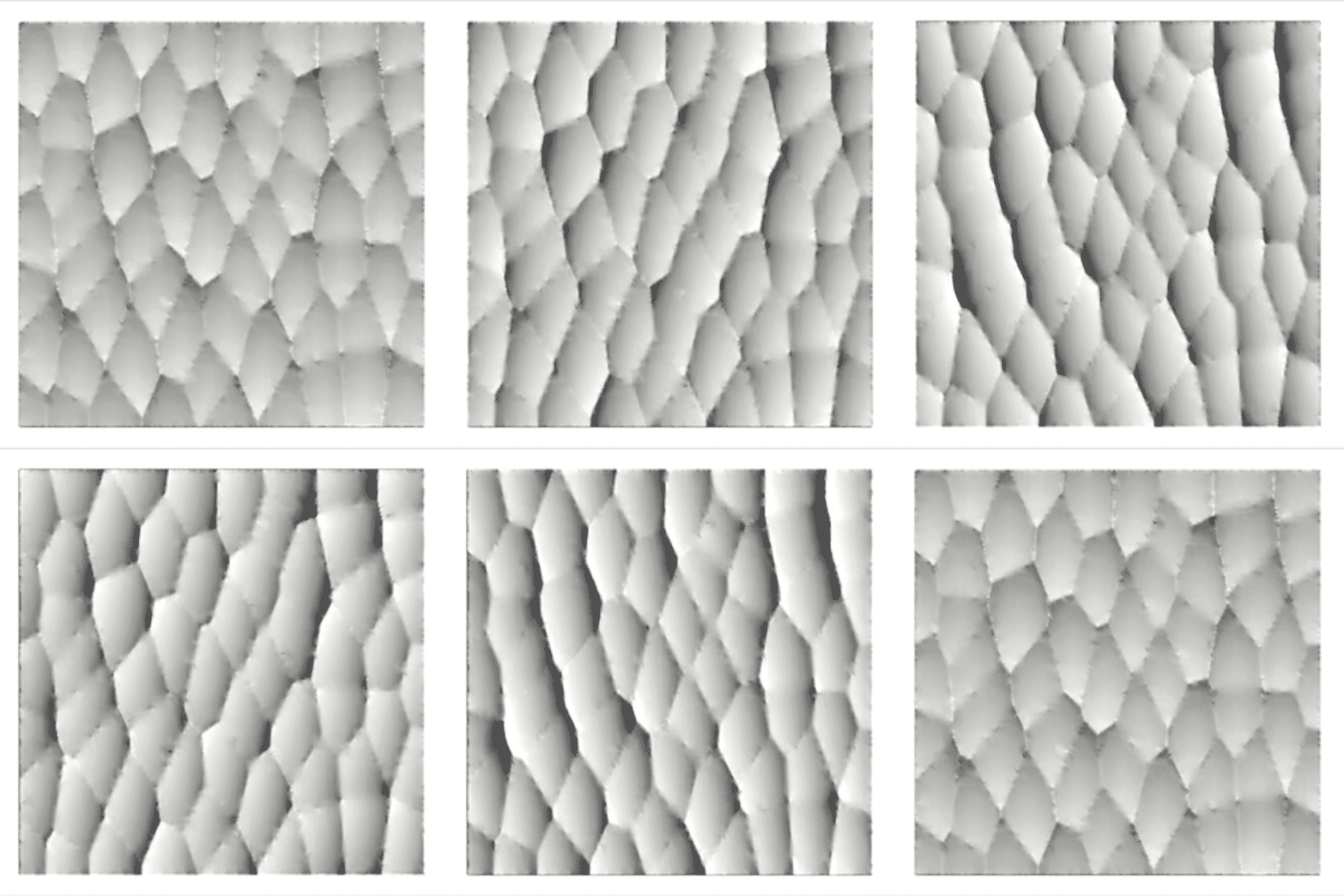
This Grasshopper definition generates a random relief pattern on a surface by subtracting numerous ellipsoids from a block. I created a parametric model for this operation to control the density and size of the ellipsoids. However, Grasshopper’s built-in boolean difference cannot handle such a large number of operations. I used a specialized add-on, Dendro, to quickly generate the results to address this. I fabricated several outputs with our CNC router, and the results look promising. However, if you increase the size of the surface or the number of ellipsoids, even Dendro may crash your computer. To mitigate this, I included a Rhinoceros 7 file in the package. You can open it along with the Grasshopper file.
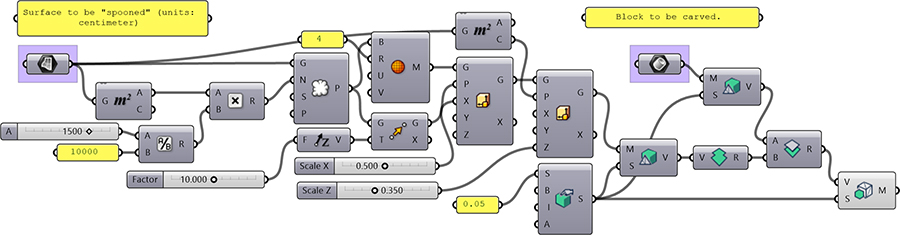
You can rebuild the definition by referring to the diagram above. However, to run this definition, you will need the Dendro add-on.
Cite this post
Related Posts
Robotic Milling for a Reciprocal Structure
August 7, 2026
The 2025 IAAC Istanbul Summer school was conducted at İstanbul Bilgi University last year. Yesterday, a video was published about it on YouTube. It was prepared by Arkitekt. Here is the video: This reminded me the workshop and I decided to write about my side of the study. The reciprocal structure was designed by Gamze Gündüz, where she finalized it using a Grasshopper code. Then, the timber elements were labeled and sized with the help of Grasshopper again and integrated…
Common-action Gardens #2
January 8, 2018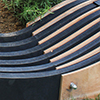
It has been nearly 2 years since we designed and produced this garden. Similar to the first version, Common-action Gardens #2 is injected in formal park layouts. We build it for recreation as garden structures with an aim to support the “preserve, sustain, and share” idea. Thus, we expect to bring people together while producing. These gardens organize sustainable models for communal living by integrating raised beds, planting holes, water bowls, compost holes, seedboxes, tool pots, niches for animals, and…
Common-action Gardens #1
August 8, 2017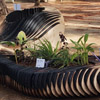
COMMON action GARDENS I is an urban garden structure that is exhibited and still in use in Karaalioglu Park as part of the 3rd Architecture Biennial Programme in Antalya. These structures are injected in formal park layouts as edible gardens whose aim is to support the “preserve, sustain, and share” concept and to bring people together while producing. These gardens organize sustainable models for living by integrating raised beds, planting holes, water bowls, compost holes, seedboxes, tool pots, niches for…
Hexagonal Star Lattice
December 18, 2023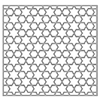
Here are the variations of classical six-pointed star patterns generated by Grasshopper. Generally, you can see these patterns under the title “Islamic patterns” because they are frequent in the decorations of mosques and palaces. I studied these patterns in Grasshopper earlier in these posts. I always find this an interesting geometry exercise. This time, my main goal was to develop a useful code only with the native Grasshopper components that create laser-cut-ready products of hexagonal star lattice. Thus, I made…
A-Chord Folding Structure
April 12, 2015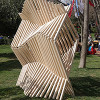
The A-Chord folding structure was developed and constructed for the World Wood Day 2015 event in İstanbul. The structure had fifty wooden struts of 4 cm X 4cm with changing heights from 200 cm to 230 cm. Two struts joined with a hinge enabled the folding motion of the structure. Thus, the nearby unit is folding in the opposite direction. The Grasshopper model generated all construction details and drawings automatically. As a result, these data enabled the revisions needed for structural experiments. In…