
Robotic Milling for a Reciprocal Structure
The 2025 IAAC Istanbul Summer school was conducted at İstanbul Bilgi University last year. Yesterday, a video was published about it on YouTube. It was prepared by Arkitekt. Here is the video:
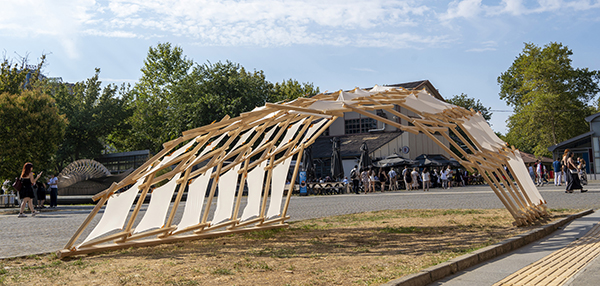
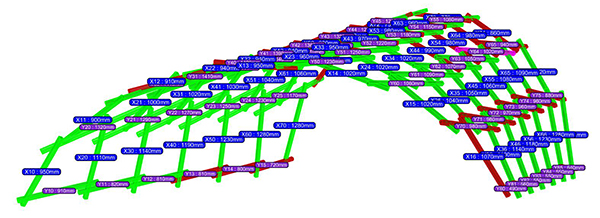
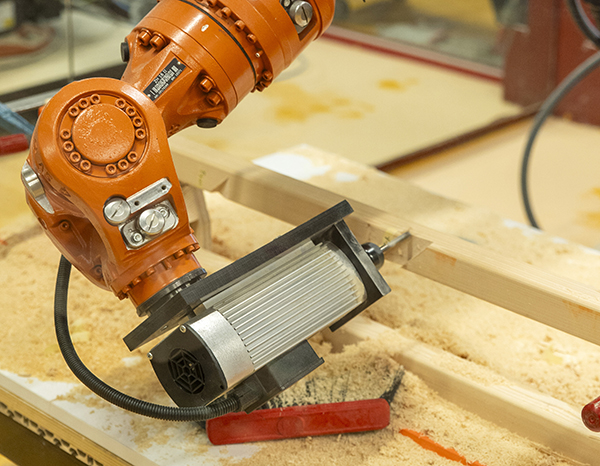
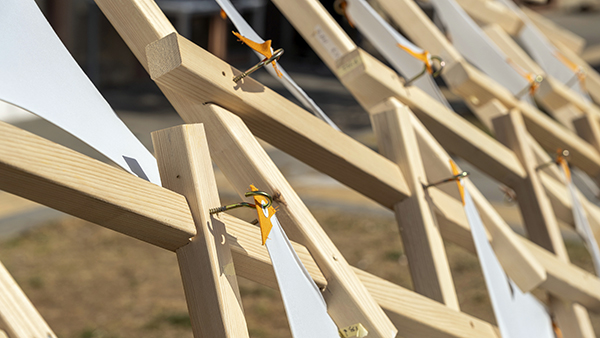
This reminded me the workshop and I decided to write about my side of the study. The reciprocal structure was designed by Gamze Gündüz, where she finalized it using a Grasshopper code. Then, the timber elements were labeled and sized with the help of Grasshopper again and integrated into my robotic fabrication code. My task here was carving out the notch details on each wooden stick. Carving these notches, which were two, three, or four per stick on a total of 97 sticks quickly became a difficult but exciting challenge. The interlocking details on the sticks were located on different sides and angles. This required a bit of Grasshopper and a bit of Kuka-PRC exercise and many dead ends in coding. On this project, I had the opportunity to mount the milling spindle on the robotic arm for the first time.
First, we made the necessary calibrations, coded the sticks, and cut each one to its length. We made a custom clamp to secure them in front of the robot. Since milling introduces vibration and mechanical load, it was crucial for the sticks to be fixed on the designated plane. What I wanted Kuka-PRC to do was scan the intersection surfaces of the sticks, which form parallelograms. Doing this for a single stick was easy, you can draw the path and define the planes. However, doing it for a large number of sticks requires abstract thinking. In fact, these abstractions are what attract me to this kind of work in the first place. We grouped all the sticks together with their intersecting ones and move them to the calibrated position in Rhino. If I remember correctly, this part was done manually, unfortunately. Last year, I only had three days to complete the fabrication, so the code turned out much more complex and longer than necessary. Meryem Yabanigül ve Almir Sinanoğlu helped me a lot in the robot operation. The reason for this complex code was that after thinking a setup worked fine for one case, errors and collision issues appeared with other sticks, requiring patches to the Grasshopper code.
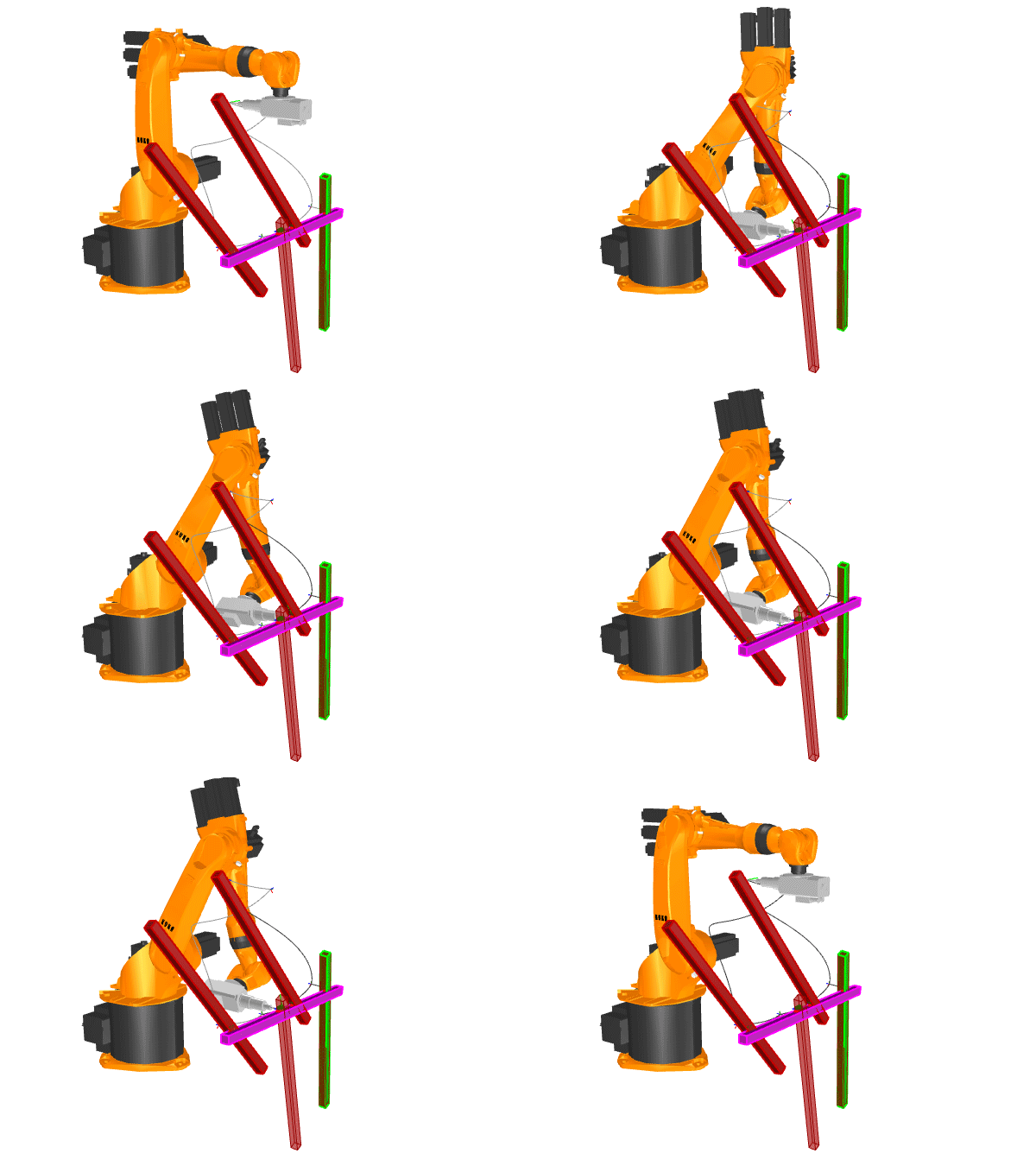
What I learnt was this process doesn’t work simply by subtracting two sticks from each other. Because, in the real world, the edges of those notches need to be ninety degrees so they can actually interlock. As soon as you realize this, you understand that the robotic milling code won’t be that simple. You get why interlocking systems are usually ninety degrees and end up getting annoyed at your designer! Right after that, the second shock comes when you try to designate that paralellogram surface between two sticks. If a plane passes right through the middle of the intersection, you can join them by removing equal amounts of material from each. Again, this is very easy for ninety degree interlockings. But when these joints have three-dimensional angles, defining that planar interface requires a whole separate level of geometric acrobatics.
We were a crowded group of instructors and students. I particularly enjoyed the robotic fabrication part and working with wood. In this post, published exactly one year later, I am sharing an instructional demo of the Grasshopper definition. The Kuka-PRC addon must be installed for the code to run. In our project, this turned into an extremely complex because of the issues I summarized above. In the attached file, however, there is a simplified demo for you to examine. I usually don’t like sharing such long and messy scripts, but cleaning it up would have meant starting completely from scratch.
Cite this post
Related Posts
Robotic Earthcrafts III
August 16, 2026
Last month, we completed the third edition of the Robotic Earthcrafts workshop series, which I co-organized with Fulya Akipek, following the first in 2018 and the second in 2023. An earthen mixture composed of clayey soil, lime, fibers, and cement was rammed into molds produced via robotic hot-wire cutting. The geometry of the fabricated wall is based on a hexagonal grid and features a Truchet-like variation. Constructed using four different block types, the wall was completed within 5 days and…
Spooning
July 6, 2024
Urban Atölye, led by architect Nilüfer Kozikoğlu initiated the development of this Grasshopper code. The concept was to create a random relief pattern on a surface to be carved out using CNC technology. In Turkish, this technique is referred to as “kaşıklama,” as the resulting shapes resemble those carved out by a spoon. Consequently, I named this Grasshopper definition “spooning.” The definition employs the Populate Geometry component to achieve a random distribution. However, you can further refine it to allow…
Common-action Gardens #2
January 8, 2018
It has been nearly 2 years since we designed and produced this garden. Similar to the first version, Common-action Gardens #2 is injected in formal park layouts. We build it for recreation as garden structures with an aim to support the “preserve, sustain, and share” idea. Thus, we expect to bring people together while producing. These gardens organize sustainable models for communal living by integrating raised beds, planting holes, water bowls, compost holes, seedboxes, tool pots, niches for animals, and…
RHWC of Convex Polyhedra
September 12, 2026
Hot-wire cutting (HWC) is a cost-effective subtractive fabrication technique used across many industries. The basic idea of HWC is to cut a block of material by melting it with a resistance-heated wire under tension. It is effective for materials with low melting temperatures, such as expanded polystyrene (EPS) and extruded polystyrene (XPS). Generally, HWC is associated with mold production in the architecture, engineering, and construction (AEC) industries. Robotic hot-wire cutting (RHWC) is a subtopic of HWC. In a standard RHWC…
Robotic Path Planning for Concrete Printing
August 19, 2026
Three-dimensional concrete printing (3DCP) is an innovative digital fabrication and automation technique based on additive manufacturing that enables the creation of complex and customized structures in the architecture and construction industry. Its most notable advantages include eliminating formwork costs and labor (Buswell et al., 2020; Lyu et al., 2021; Kaliyavaradhan et al., 2022) and facilitating the fabrication of structural elements with complex curvatures, particularly in printing systems utilizing industrial robotic arms (Alabbasi et al., 2023; De Soto et al., 2018)….