
Curvature Approximation by Drawing
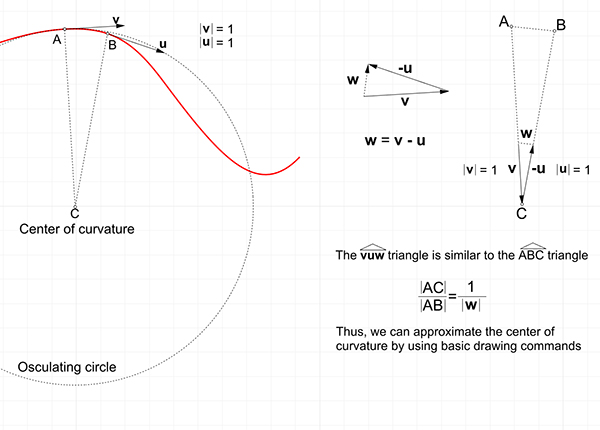
Curvature can be roughly described as how much a curve is “turning” at point a P. We place two “very” close tangents and measure the difference between them. The closer these tangents are, the more precise our approximation would be. An osculating circle is a tangent circle that has the same curvature as the curve at point P. The larger the circle, the more “flat” the curve is. An infinitely large osculating circle means the curve is linear at point P. Another term, the center of curvature represents the center point of the osculating circle. Rhino can calculate these with the Curvature command quickly and easily. However, I wondered how I could calculate them manually. In this tutorial, I am attempting to make a curvature approximation by drawing commands in Rhinoceros. These are line, circle, point, and scale.
I am using the similar triangles approach and trying to locate the center of curvature by using two tangents with equal Euclidean distance on both sides of a point. So, I did this easily by drawing a circle. The smaller this circle is, the better our approximation would be. Then, I created a triangle and scaled it so that it would become the same size as the triangle formed by the center of curvature.
While drawing and testing, I realized that I could also do this by only using Euclidean compass and straightedge, since I can draw and extend the normal directions with them. So, instead of using the scale command, I can do the same calculation by drawing two normal directions and extending them until they intersect. However, this is another story.
Cite this post
Related Posts
Gaussian Curvature
September 23, 2026
The development of geometry began by measuring the world as discrete objects. Moving beyond measuring nature, it evolved into reasoning, calculation, and mathematics. Platonic solids were one of the most elegant and beautiful ideas reached by geometry. Pondering why there are only five of them was a tribute to collective human intelligence. Earlier in this blog, we modeled polyhedra, like the Platonic solids, using geometric construction methods. This process was like solving a puzzle. To construct a point whose distances…
Quad Tiling on Double Curvature
April 3, 2024
It is not possible to cover a double curvature surface with planar quads. Here is one method that overcomes quad tiling on double curvature by pulling one vertex of the quads to the plane defined by the other three. This method was used in architecture on several occasions such as the exterior facade of The Yas Hotel, designed by Asymptote Architecture in 2009. The same approach is also evident in the roof design covering the central courtyard of the Smithsonian…
Modeling Waves Relief
December 16, 2024
Relief in the context of art and sculpture refers to a technique where a three-dimensional form is created on a flat surface. The object or figure “protrudes” from the background, creating depth and texture. In this short tutorial video, I am modeling waves relief using the basic drawing and modeling commands of the Rhinoceros software. Here, I use the point surface command. Because, in Rhinoceros, generally we describe the parametric surfaces as four-sided objects. So, this exercise is a basic…
Modeling Truchet Relief
December 16, 2024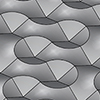
Truchet patterns refer to a set of geometric designs based on simple, repeating shapes, usually tiles or squares. These tiles can be rotated or flipped to create complex and visually interesting patterns. A French mathematician, Michel Truchet introduced these patterns in the 1970s. Since then, you can see them often in art, design, and mathematics. In this short video tutorial, I am modeling truchet relief in Rhinoceros CAD software. My purpose of this modeling process is to demonstrate the basic…
Modeling Cylinder Hypar
December 16, 2024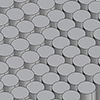
A “hypar” is short for a hyperbolic paraboloid, a double-curved, saddle-shaped surface often used in architecture and structural design due to its unique geometric properties. It is a ruled surface, meaning it can be constructed entirely with straight lines, despite its curved appearance. In this short tutorial video, I am building a beginner-level 3D pattern that resembles the hypar surface. This is a basic drawing exercise to control the viewport and place primitive objects precisely. Thus, more advanced tutorials would…