
Modeling Waves Relief
Relief in the context of art and sculpture refers to a technique where a three-dimensional form is created on a flat surface. The object or figure “protrudes” from the background, creating depth and texture. In this short tutorial video, I am modeling waves relief using the basic drawing and modeling commands of the Rhinoceros software. Here, I use the point surface command. Because, in Rhinoceros, generally we describe the parametric surfaces as four-sided objects. So, this exercise is a basic one, introducing these objects and view shading modes.
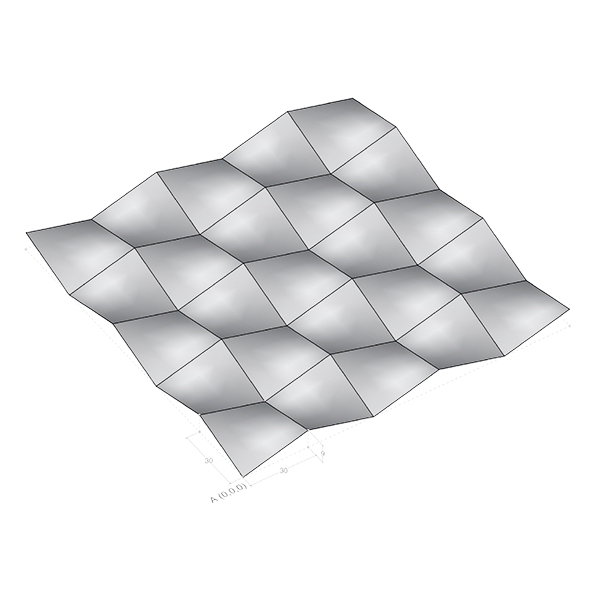
In this video series, I present a variety of in-class exercises from my first-year architectural geometry course. Using Rhinoceros software, we delve into Euclidean constructions, basic drawing, and transformation commands. In addition, I tried to include introductory fractals, regular and semi-regular tessellations, patterns, modeling, and unrolling polyhedra. These concise drawing and modeling exercises are beneficial for junior architects, interior designers, industrial designers, and enthusiasts from other disciplines. So, I’ll be sharing exercises each week on my blog and other platforms. Today’s exercise is about modeling waves relief patterns in Rhinoceros.
The software used in this course is Rhinoceros 3d (www.rhino3d.com). However, if you want to find out more and see the whole list of this video series, you can check my YouTube channel at www.youtube.com/@designcodingnet. The music of this video is ‘Resolutions’ by Scott Buckley (CC-BY 4.0). www.scottbuckley.com.au
Cite this post
Related Posts
Modeling Truchet Relief
December 16, 2024
Truchet patterns refer to a set of geometric designs based on simple, repeating shapes, usually tiles or squares. These tiles can be rotated or flipped to create complex and visually interesting patterns. A French mathematician, Michel Truchet introduced these patterns in the 1970s. Since then, you can see them often in art, design, and mathematics. In this short video tutorial, I am modeling truchet relief in Rhinoceros CAD software. My purpose of this modeling process is to demonstrate the basic…
Modeling Folds Relief Pattern
December 16, 2024
In art, design, and geometry, folding involves bending or creasing a material, such as paper, fabric, or other flexible materials into defined shapes or patterns. In this short tutorial video, I am modeling a folds relief pattern. This pattern stands out due to its resemblance to a collapsible folding system, combining both structural and aesthetic qualities. We refer to it as a folds relief pattern because it also mimics a relief design, creating light and shadow effects. This video series…
Modeling Cylinder Hypar
December 16, 2024
A “hypar” is short for a hyperbolic paraboloid, a double-curved, saddle-shaped surface often used in architecture and structural design due to its unique geometric properties. It is a ruled surface, meaning it can be constructed entirely with straight lines, despite its curved appearance. In this short tutorial video, I am building a beginner-level 3D pattern that resembles the hypar surface. This is a basic drawing exercise to control the viewport and place primitive objects precisely. Thus, more advanced tutorials would…
Wave Generator
April 17, 2024
Here is a wave generator code I developed using Grasshopper and Python. While searching for a solution to the realistic water simulations, I came up with the Gerstner Waves. I tried to implement it. However, I came up with this final result, which is not a Gerstner Wave generator, but a much simpler one. It combines many user-fed wave components and calculates the resulting single wave. I played with this code for hours with different components. So, it is worth…
Point Waves
May 29, 2023
Here is another basic exercise in Grasshopper. This exercise “Point Waves” creates wave-like deformations on the grids of points. The major function of the definition is to calculate the distances from every point of a grid to an attractor point, with the help of Distance (Dist). Then it sorts them from the smallest to the largest (= closest to farthest) with the Sort List (Sort) component. This component takes and matches two lists of the same size, called key (K)…