designcoding
About Table of Contents Keywords Monthly Archive
Support designcoding!

August 2017

10 posts

Escher Patterns in the Classroom

August 22, 2017
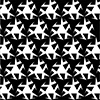
Here is one of the exercises I tested with a few students in Architectural Geometry. The exercise is about creating Escher-like patterns. It is an introductory topic on the designerly utilization of regular tessellations. We use square, hexagonal, or triangular tessellations as underlying structures of complex patterns. Below are some of the student works from this exercise. I think the black-and-white coloring helps in terms of reducing the requirements. Although the patterns designed in this exercise are not Escher patterns,…
Parametric Wall Revisited

August 20, 2017

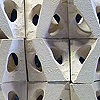
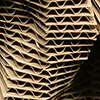
This exercise was a popular one in the 2015 and 2016 Architectural Geometry classes. Recently, I found these images of student works. However, some of the students’ names are missing (please e-mail me if one of them is yours). I love this exercise because it is a quick and efficient way of explaining and experimenting with the workflow of digital to physical production. In this particular exercise, students created Rhino Macro codes to develop these 3d pattern deformations. It is…

Gosper-Peano Curve in Grasshopper

August 19, 2017

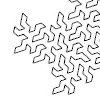
Anemone components are still working great, extending the abilities of Grasshopper. Here, I studied a space-filling (or plane-filling) fractal called the Gosper-Peano Curve. You should be very careful about the number of iterations (the N input). Because it can crash your Rhino if you change it to more significant numbers. Also, you should have Anemone components installed in order to run this definition. The generator curve is a special one. This website explains the generation of the curve from the…

Unity of Voids

August 9, 2017

In the last semester’s mid-term project of Computation-based Basic Design 2, we experimented with the casting method for studying solids and voids. Students worked in groups of four. First, they designed a set of components within a 10cm bounding cube. These cubes represent 1m3 on a 1:10 scale. After that, they multiplied them into a system of voids with a function for human use. They fabricated at least 24 pieces in the final 3d composition. David Umemoto’s Soma Cubes was…

Common-action Gardens #1

August 8, 2017

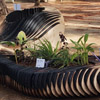
COMMON action GARDENS I is an urban garden structure that is exhibited and still in use in Karaalioglu Park as part of the 3rd Architecture Biennial Programme in Antalya. These structures are injected in formal park layouts as edible gardens whose aim is to support the “preserve, sustain, and share” concept and to bring people together while producing. These gardens organize sustainable models for living by integrating raised beds, planting holes, water bowls, compost holes, seedboxes, tool pots, niches for…

Low-Poly Habitat

August 7, 2017

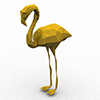
Below is a simple tutorial class we studied in Rhino in 2015 and 2016. The exercise is called “A Low-Poly Habitat”. The aim is to create simple polygon models by analyzing the overall geometric topology of an animal body. First-year design students attended the exercise and they are encouraged to create these models using blueprints from www. They used simple commands such as point, line, and surface from 3 or 4 points and that’s all. Such exercises (hopefully) help them…

Cycloid Curves with Rhino Python

August 7, 2017

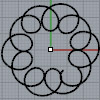
Studied earlier in Grasshopper here, creating a cycloid-like curve actually mimics the physical process of rotating disks on a path. Below is a test in Rhino Python (I know the variable names are not conventional).

Dual Polyhedra Generator

August 3, 2017

According to Wolfram, By the duality principle, for every polyhedron, another polyhedron exists in which faces and polyhedron vertices occupy complementary locations. This polyhedron is known as the dual, or reciprocal”. We can use this method to generate new polyhedra from known ones. I tried to develop a Dual Polyhedra Generator in this Rhino Python script. First, the script asks a user to select a closed polysurface object. Then, it attempts to identify the area centroids of the faces. By…

Polygon Fractals with Rhino Python

August 2, 2017

We will see a simple Rhino Python exercise here. I called these Polygon Fractals (or Pentaflakes sometimes). It is both educational and fun to play with them. In Rhino, it can be a good exercise for basic CAD commands and transformations such as move, copy, and scale, and precision drawing operations such as object snapping. Also, in Grasshopper, it can be a good challenge for looping. In Rhino Python, it is already a good exercise for understanding Python and the…

The First Grasshopper Book in Turkish

August 1, 2017

Together with Serkan Uysal, we pubished a comprehensive guide to Grasshopper. The book is in Turkish and is currently published by Pusula. Grasshopper (GH) is a plug-in running on the Rhinoceros (Rhino) modeling software. It is used for algorithmic form-finding and real-time parametric modeling. This book presents techniques aimed at architects, interior designers, industrial product designers, jewelry designers, and anyone interested in exploring parametric and algorithmic modeling for hobby purposes. Anyone who wishes to discover dynamic and unconventional geometric forms…

  • Chapters

    • Algorithms
    • Discourses
    • Fabrications
    • Studios
  • Explore

    • All Keywords
    • Table of Contents
    • Monthly Archive
    • #geodesic
    • #rammed-earth
    • #puzzle
    • #vbnet
    • #philosophy-of-language
    • #rhombicosidodecahedron
    • #growth
    • #packing
    • #nesting
    • #boolean
    • #delaunay-triangulation
    • #space-syntax
    • #paper
    • #phyllotaxis
    • #exhibition
    • #islamic-pattern
    • #concrete
    • #relief
    • #shape-grammars
    • #regulations
  • Search

  • Support designcoding!

  • Enjoying designcoding? Support me on Patreon to keep it growing. Thank you!

  • copyright 2026 designcoding.net | about | privacy policy | end user license agreement