
Unity of Voids
In the last semester’s mid-term project of Computation-based Basic Design 2, we experimented with the casting method for studying solids and voids. Students worked in groups of four. First, they designed a set of components within a 10cm bounding cube. These cubes represent 1m3 on a 1:10 scale. After that, they multiplied them into a system of voids with a function for human use. They fabricated at least 24 pieces in the final 3d composition. David Umemoto’s Soma Cubes was an inspirational example for our students.
They used EPS or wood as the material for moulds. Designing a strategy for using the same mould multiple times was a good bonus. As a release agent, they used WD40, duck tape or liquid soap. The aim was to encourage them to think about the moulding and casting strategies as design inputs. Mould design and application are an important part of this study (not all forms are feasible to be fabricated with this method). We feel that this first experiment was very successful in terms of its educational purposes and final outcomes.
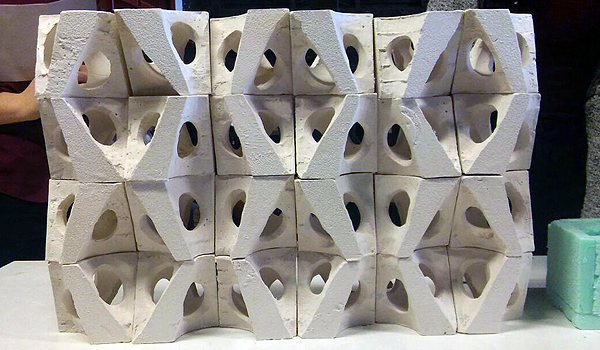
Students: Yaren Şirin, Gözde Ergül, Duru Kalınoğlu, Bengisu Yüksel
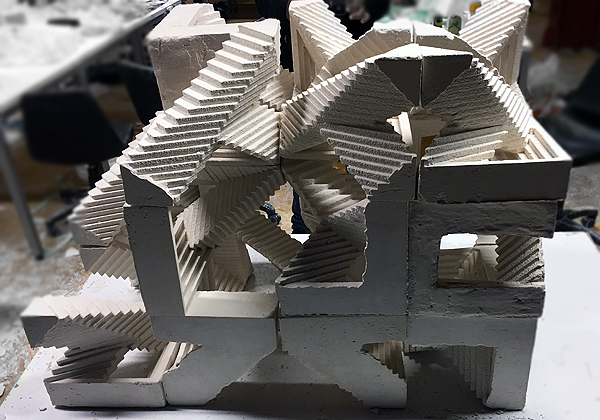
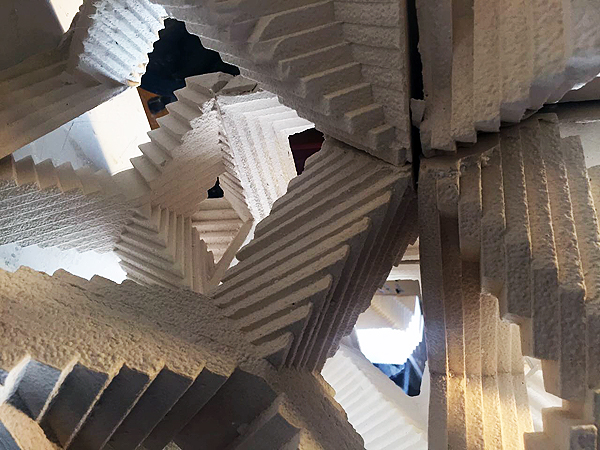
Students: Berkan Kaya, Mustafa Banzaroğlu, Gözde Akkoyun, İlker Yetik
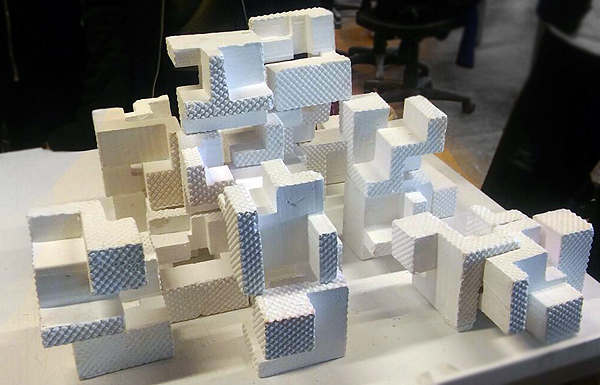
Students: Dilruba Polat, Selin Yazıcı, Beritan Polat, Bilge Yılmaz
Tutors: Nur Gürbüz, Ece Çakır, Gizem Akgün and Tuğrul Yazar
Cite this post
Related Posts
Earthbound
August 14, 2026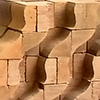
Rammed earth is an unpredictable, labor-intensive building material, and far less durable than concrete. It cannot deliver the standard strength expected by engineering academia. And perhaps it is for the better that it cannot. Because it tells us an entirely different story. It reminds us architectural thinking that dares to look outside the box. What I want to share here, is not just a simple studio project, but a profound life lesson for many of us here, lived in the…
Robotic Earthcrafts III
August 16, 2026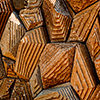
Last month, we completed the third edition of the Robotic Earthcrafts workshop series, which I co-organized with Fulya Akipek, following the first in 2018 and the second in 2023. An earthen mixture composed of clayey soil, lime, fibers, and cement was rammed into molds produced via robotic hot-wire cutting. The geometry of the fabricated wall is based on a hexagonal grid and features a Truchet-like variation. Constructed using four different block types, the wall was completed within 5 days and…
Robotic EarthCrafts II
April 1, 2025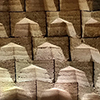
Robotic EarthCrafts II occurred in the summer of 2024 at Istanbul Bilgi University, seven years after the first. Together with Fulya Özsel Akipek, Nilüfer Kozikoglu, Abdullah Mallah, and Halit Mallah, we experimented with the robotic fabrication of molds for rammed-earth structures. The focus shifted toward a human scale based on the experience gained from Robotic EarthCrafts I. At the workshop’s core were spatial systems resembling muqarnas, which incorporated non-planar geometric transitions. Unlike the first workshop, we utilized a parametric model to design and generate robot…
Robotic Earthcrafts Student Project: ZOM
November 6, 2018
This project is developed in the summer workshop titled Robotic Earthcrafts conducted at İstanbul Bilgi University Architectural Design graduate program. Students call this project “ZOM”. Students are Murat Sökün, Zeynep Çakmak, and Özlem Güven. We organized the workshop together with Fulya Akipek and Hülya Oral. You can find more details about the workshop here. In this project, a simple robot code created the EPS molds of the rammed-earth module. Below are some of the photos of the design and construction…
Robotic Earthcrafts Workshop
July 18, 2018
Can digital design and robot technology be integrated with an ecological design approach? The robotic earthcrafts workshop at Istanbul Bilgi University attempts to relate to biological parameters and digital design and fabrication processes. Thus, the summer school will include seminars and practices on computational design, robotic fabrication, rammed-earth construction techniques, and permaculture design principles to discuss and experience the relationships between technology and ecology. So, the results will be the proposals for micro-permaculture systems, constructed from rammed-earth blocks, with plantings….