
Euclidean Construction for Dummies
Here is a simple explanation of the famous Euclidean Constructions:
Why didn’t Euclid just measure things with a ruler and calculate lengths? For example, one of the basic constructions is bisecting a line (dividing it into two equal parts). Why not just measure it with a ruler and divide by two?
One theory is the the Greeks could not easily do arithmetic. They had only whole numbers, no zero, and no negative numbers. This meant they could not for example divide 5 by 2 and get 2.5, because 2.5 is not a whole number – the only kind they had. Also, their numbers did not use a positional system like ours, with units, tens , hundreds etc, but more like the Roman numerals. In short, it was quite difficult to do useful arithmetic.
So, faced with the problem of finding the midpoint of a line, they could not do the obvious – measure it and divide by two. They had to have other ways, and this lead to the constructions using compass and straightedge or ruler. It is also why the straightedge has no markings. It is definitely not a graduated ruler, but simply a pencil guide for making straight lines. Euclid and the Greeks solved problems graphically, by drawing shapes instead of using arithmetic.
This is a popular pedagogical tool for Architectural Geometry education today as it reflects the need for referential systems derived from pure geometric (formal) relations, not arithmetic ones.
Cite this post
Related Posts
Tangent Circles Exercise
November 19, 2012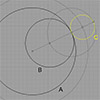
The first-year Architectural Geometry course includes Euclidean constructions as a study of associative geometry. We have exercised the below questions to study this topic. These are three mutually tangent circles, that can be drawn using only a compass and ruler, without built-in tangency functions in Rhino. Such exercises are expected to improve students’ reasoning. We believe architectural geometry education should encourage a conception that allows students to think about what they are doing and control their process, rather than just…
Compass only Construction of Bézier Curves
September 2, 2021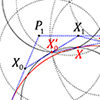
This is a new paper published in Nexus Network Journal. I tried to implement euclidean constructions by compass in the approximation of famous parametric curves; Bézier curves, and B-Splines. Then, I created the algorithms to calculate the number of steps on a compass-only construction of Bézier curves. I developed a simple Python script to simulate the geometric constructions. However, I have been studying this topic for nearly four years. In the future, I wish that it would be a good…
Online Virtual Studio (OVS)
July 31, 2024
This is the latest reel video of the Online Virtual Studio (OVS) project. We conducted it together with Oğulcan Üneşi and Serkan Uysal since 2022. We tried to develop a tool for online and blended education in architectural studios. The tool has specific features tailored for design studios. İstanbul Bilgi University Scientific Research Fund partially supported this project. This video showcases the latest toolset OVS provided. The tool takes some interaction concepts from gaming and incorporates them into the needs…
Virtual Environments in Design Studios
May 30, 2023
There are cognitive, technological, and pedagogical ideas and experimental studies on architectural design education in virtual environments. In the existing literature; new software tools were developed, add-ons to existing software were developed, or software prototypes were developed and tested on various platforms such as game engines. In the distance education model, currently, there is no stand-alone software, specifically developed for the needs of architectural design studios. Similarly, there is no generally accepted pedagogical approach in this field yet. Virtual Environments…
Parquet Deformations Revisited
January 9, 2018Here is the abstract of my last publication in the International Journal of Architectural Computing. Parquet Deformations is an architectural studio exercise of William Huff in the 1960s. It aims to improve students’ reasoning of spatiotemporal variation by utilizing sequential shape-shifting of patterns. This article examines the outcomes of this educational research from the perspective of design computing. A multilayered reading about the exercise will reveal its historical, theoretical, and artistic backgrounds. Then we explain the common structural elements and different construction approaches…