
Parquet Deformations Revisited
Here is the abstract of my last publication in the International Journal of Architectural Computing. Parquet Deformations is an architectural studio exercise of William Huff in the 1960s. It aims to improve students’ reasoning of spatiotemporal variation by utilizing sequential shape-shifting of patterns. This article examines the outcomes of this educational research from the perspective of design computing. A multilayered reading about the exercise will reveal its historical, theoretical, and artistic backgrounds. Then we explain the common structural elements and different construction approaches of Parquet Deformations along with a novel design and analysis method. The proposed method embeds variations of two-dimensional pattern deformations on a third dimension. It enables various analyses such as the measurement of regularity and locating the attractor points. In this study, we expect to exemplify how computational thinking and new digital tools change the way designers would approach such systematic compositions.

The geometric relationships underneath pattern deformations are usually directed by two things. These are the intrinsic capacities of cells, and the deformability potentialities of underlying lattices. First, the geometric properties of a pattern itself, while the capacity to deform a pattern is highly related to the setting and properties. Then, forces of the n-dimensional space it exists in. From this perspective, we can describe a pattern deformation as an equilibrium. This is between the intrinsic deformability capacities of a geometric pattern; and an external capacity. Scripting languages introduce designers to algorithmic methods such as component-based design, attractor objects, and force fields.
The new generation of architects develops or transfers such methods in design processes. This makes it possible or easier for them to control the generation, optimization, and adaptation of complex patterns.
Cite this post
Related Posts
Pattern Deformations Student Works
November 18, 2013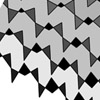
Below is some student works from this year’s Architectural Geometry / Pattern Deformations assignment. Students developed their own pattern deformation sequences mostly on regular tessellations. Based on the classical Parquet Deformation exercise, we tried to implement a rule-based approach in order to explore emergent patterns. The exercise seems to reveal endless improvisation potential. The exercise requires students to design a pattern deformation on a 28cm by 28cm area. It should include at least 100 cells. First, we explained several classical…
3D Pattern Deformation
December 12, 2012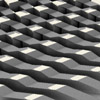
These are examples of 2.5D exercises in the design geometry course in my freshman year of architecture. We asked students to create extruded or referenced solids referenced from their previous exercise of pattern deformations, (examples are here and here). We also started to inject some of the most used concepts of design computing here, by perceiving each tessellation cell as the variation of a predefined algorithm, such as a relationship with an attractor object (a distance value with a point)….
Pattern Deformations Exercise
November 17, 2012
Last week, the first-year architectural geometry course was about pattern deformations. Students are expected to familiarize themselves with 2d drawing, transformation, and control point editing commands while trying to design a deformation. After studying regular and semi-regular tessellations of the plane, they are expected to develop reasoning on the rule-based and iterative processes. This also constructed an underpinning for Basic Design’s “Metamorphosis” study, where they have discussed more conceptual frameworks derived from such systems. Below are some of the results…
Parquet Deformation Handmade
October 31, 2012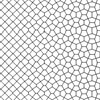
This is not to explain the method of the Parquet Deformation but to see the potential. After we’ve studied regular, semi-regular, dual, and truncated tessellations with students, the Architectural Geometry course expects them to develop a Parquet Deformation handmade such as those shown below. I call them Parquet Deformation handmade. Because they are manually designed but drawn using traditional CAD. The samples you see below are from this website. It is a good source for other topics of tessellation as well….
Field Deformation
October 8, 2026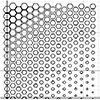
Ever since I restructured designcoding, I’m still sorting through the trash folder. All 580 posts published on the blog have been reviewed, and their files have been uploaded as open source. The mysterious trash folder, where I couldn’t even tell where things belonged, is shrinking fast. While checking this folder yesterday, I found a video. This is probably a simple tutorial I prepared about 10 years ago for the parametric modeling elective course (probably related to this 2012 post). The…