designcoding
About Table of Contents Keywords Monthly Archive
Support designcoding!

July 2012

14 posts

Hyperbolic Tessellations Continued

July 26, 2012
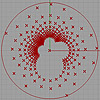
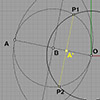
We can create tessellations of outer points in a Poincare Disk, using the manual method explained in the last post (here). But repeating that compass and straightedge process is becoming a little useless after a couple of repeats. If you say “ok. I understood the concept, let’s get faster!” then we can model just the same process in Grasshopper3D to examine varying results in seconds; If we connect any grid of points into this definition, we can clearly see the similar…
Hyperbolic Space: Invert a Point

July 26, 2012

The poincare disk is still an interesting representation of hyperbolic space for me, full of mysteries. I’ve had several attempts to understand it previously (here and here). Finally, I found a resource* explaining basic concepts about it. I tried to repeat some of the constructions in Rhinoceros, (without any logical purpose). The most important part is the conversion of a Euclidean point into a hyperbolic space. There is no clear formula, for directly projecting a point into Hyperbolic space, but…

Animate Sketching of a Parametric Truss

July 25, 2012

Previous studies on the timer component were based on understanding its use. This time, I tried to implement it in a geometric design task. Moreover, manipulating the timer component to change the regular animation of parameters. Time does not have to be equally divided into sequences. Rather, new possibilities may emerge with different time flows. A simple triangulation system is developed with a potential manipulation, based on a timer. This definition is exciting and new for me because I’m not…

Pedagogical Pattern Languages

July 24, 2012

Joseph Bergin‘s pedagogical patterns for computer science education returned my attention to teaching methods I’ve searching for almost five years. Here is a phrase from a paper submitted to pedagogical pattern language project: Most educators and trainers are not taught how to teach. Rather, they often find themselves teaching by accident. Typically, a person with a skill that is in demand, such as a particular programming language, will be asked to teach it. People assume that if the person is good in this…

MusicXML to Grasshopper

July 20, 2012

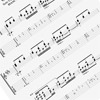
We can model a musical composition using native Grasshopper components. After the experiments with the timer component (here and here), I managed to build a definition that allows us to produce outputs in various time intervals. I converted a small part of Bach’s Bouree in E-Minor into Grasshopper as a guitar tablature. I used Guitar Pro 5’s MusicXML export function to convert classical guitar tablature into XML data, then organized that file in Excel to suit my data tree design…

Metronome Continued

July 19, 2012

Here is today’s improvement on my metronome with the timer component, which started here. It’s straightforward to tell Grasshopper about seconds and organize it according to it. Using an interval smaller than 1 second, this small script catches every second and returns a different value. However, it’s much harder to implement smaller values than seconds. It seemed easy at first sight but getting accurate results smaller than seconds requires working with milliseconds. You can output the current millisecond’s value, but…

Revisiting the Cartesian House

July 18, 2012

The logical structure of computer-aided architectural design tools is based on object orientation. New design methodologies named Building Information Modeling or Virtual Building aim to improve this structure by synchronizing the digital object classes with real architectural products. Therefore, CAD becomes smart and parametric. But from the design educator’s point of view, most commercial CAD tools are not useful and too complicated to implement basic spatial concepts. This is the introduction to the above conceptions using a short-term design exercise….

Breaststroke Surface

July 17, 2012

This was before Spherical Fantasies, while I was trying to update my surface equation definition. In between designerly intentions and mathematical facts, it’s hard to maintain a process, while keeping the definition yet simple and open to exploration. A little tired of mathematical definitions, I started to give names to the animate surfaces I develop. Like the Spherical one, this is also a trigonometric equation of z = cos(x) + sin(x-y2) / 2. The most boring part of these is…

Spherical Fantasies

July 16, 2012

This is about conforming distortions on surfaces and creating imperfect (say ugly) surfaces. I started with planar surfaces, however, I continued with spherical ones. There are interesting results when applying trigonometric functions to spherical surfaces. Example surface equations: Please be patient if animations are loading slowly. But they represent a way of creating free-form-looking surfaces, highly mathematical behind the scene. As you see, I used the UVW coordinate system of the sphere, subdivided into 20 pieces. W represents the amount…

Timer Component

July 16, 2012

This is probably the most simple definition on this site but I think it’s very useful. The timer is a special component of Grasshopper that is significant in terms of the real-time sketching paradigm. This basic use of a timer includes a 1-second update to a Vb script. Inside the script, the system date’s seconds are returned, so we see a real-time increasing number at output A. Beyond this point, It’s up to your imagination, how you can use that…

1 2 »
  • Chapters

    • Algorithms
    • Discourses
    • Fabrications
    • Studios
  • Explore

    • All Keywords
    • Table of Contents
    • Monthly Archive
    • #spiral
    • #cube
    • #phenomenology
    • #snub-square
    • #dual
    • #linear-algebra
    • #le-corbusier
    • #attractor
    • #brick
    • #workshop
    • #puzzle
    • #unity
    • #wave
    • #unrolling
    • #tensegrity
    • #enneahedron
    • #buckminster-fuller
    • #parametric-curve
    • #visualization
    • #bezier-curve
  • Search

  • Support designcoding!

  • Enjoying designcoding? Support me on Patreon to keep it growing. Thank you!

  • copyright 2026 designcoding.net | about | privacy policy | end user license agreement