designcoding
Search
About Table of Contents Keywords Support designcoding!

Fractals

22 posts

Why is the Hilbert Curve Beautiful?

April 8, 2025
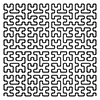
The Hilbert Curve is one of the results of David Hilbert’s vision of mathematics as a network of symbolic systems. Defined in 1891, this curve is a fractal that fills a two-dimensional plane with a one-dimensional line in the limit. It exhibits self-similarity. It emerged…
Drawing Koch Pentagon

December 11, 2024

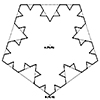
The Koch pentagon is a fractal shape that starts with a regular pentagon. Here, we divide each side of the pentagon into three equal parts. Then, we replace the middle with two sides of an outward-pointing equilateral triangle. We repeat this process for every new…

Drawing Fractal Tree

December 11, 2024

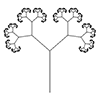
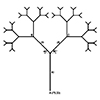
A fractal is a complex geometric shape that we can split into parts, each of which is a reduced-scale copy of the whole. This property is self-similarity. Fractals often exhibit patterns that repeat at different scales. We can find fractals in nature, such as in…

Drawing Gosper Curve

December 10, 2024

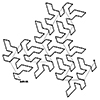
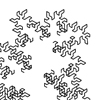
The Flowsnake, or Gosper curve is a space-filling fractal. It is also known as the Peano-Gosper curve. There are other similar space-filling fractals such as the Dragon curve, or the Hilbert curve. A space-filling fractal is a special type of curve, that fills a plane…

Drawing Gosper Unit

December 10, 2024

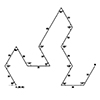
In computer-aided design (CAD), a polyline is a series (or a chain) of straight lines. Each straight section of a polyline is a “segment,” and the points where the segments connect are “vertices.” If a polyline’s starting and ending vertices coincide, it is a “closed…

Sierpinski Triangle

February 20, 2024

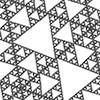
Today’s computational curve is the beautiful Sierpinski Triangle. It is a fractal named after the Polish mathematician Waclaw Sierpinski, who described it in 1915, though it had been previously described by other mathematicians. It is a self-replicating pattern that arises from a simple recursive process….

Hilbert Curve

January 16, 2024

The Hilbert Curve, also referred to as the Hilbert space-filling curve, was initially introduced by the German mathematician David Hilbert in 1891. It is a continuous fractal curve, presenting a variation of the space-filling Peano curves uncovered by Giuseppe Peano in 1890. After a study…

Dragon Curve Fractal

December 25, 2023

This week’s fractal is the famous Dragon Curve. Dragon Curve exhibits self-similarity, meaning parts of the curve resemble the overall shape, regardless of scale. It’s fascinating because a relatively simple construction process generates a complex and visually captivating fractal pattern. The Dragon Curve is often…

Cesaro Fractal

December 19, 2023

In this study, I explore Cesaro Fractal, generated by Grasshopper. Usually, it is not possible to code recursive algorithms in Grasshopper. With the help of the Anemone add-on, these fractal curves are easy to model. I studied similar fractal algorithms here before. This one is…

Animated Tree Growth

May 26, 2023

The Animated Tree Growth is an interesting study for Grasshopper. First, I developed a regular tree generation definition similar to those I studied earlier, here, here, and here. In component group 1, I develop an initial generator arc. Then, in group 2, I generate the…

Tattoo Design

April 27, 2023

Here is a tattoo design I am currently developing by using Grasshopper. 11 years ago, I developed a Grasshopper definition that approximates Julia Sets here. One of the experimental outputs of that definition looks suitable for a tattoo design. It is a beautiful fractal shape….

Koch Snowflake Fractal

April 12, 2023

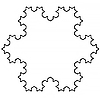
This is an implementation of the famous Koch Snowflake Fractal in Grasshopper. We will be using the Anemone add-on to handle the iterations. In this fractal, we start from an equilateral triangle. Then, we form new equilateral triangles, one-third of the side. So that each…

Gosper-Peano Fractal Curves

January 8, 2018

Introducing the new YouTube channel for designcoding! The architectural Geometry playlist will contain video tutorials on several topics of basic geometry exercises for designers. Below are the introductory exercises of polyline drawing and some planar transformations such as scale and rotation. It is also an…

Gosper-Peano Curve in Grasshopper

August 19, 2017

Anemone components are still working great, extending the abilities of Grasshopper. Here, I studied a space-filling (or plane-filling) fractal called the Gosper-Peano Curve. You should be very careful about the number of iterations (the N input). Because it can crash your Rhino if you change…

Polygon Fractals with Rhino Python

August 2, 2017

We will see a simple Rhino Python exercise here. I called these Polygon Fractals (or Pentaflakes sometimes). It is both educational and fun to play with them. In Rhino, it can be a good exercise for basic CAD commands and transformations such as move, copy,…

Fractal Curves with Rhino Python

July 31, 2017

A simple Rhino Python script that generates fractal curves. An example is a test with the Gosper-Peano curve. However the script is not supporting segment directions, which is why the result is not the intended curve. Curve directions could be implemented in the future.

Arc Tree Revisited: Anemone Update

April 26, 2015

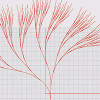
This is a classical method of generating tree-like forms utilizing a simple command “Arc SED”. The idea is simple, as the command draws arcs using an input direction vector, so this could easily be implemented creating a “smooth” composition of curves just by iteration. Actually,…

Fractal Trees

April 11, 2015

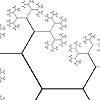
Based on this post, the problem of modeling tree-like fractal shapes is still a good question for the early years of computational design education. Last time, I used Rhino’s macro to study these fractal trees in an “impossibly” limited interface. But this time I used a…

Binary Branching using Macro

April 15, 2013

Today’s design computing class was about fractals. In Rhino, writing macro statements are very easy to learn as it just mimics your behaviors in a sequential text. There are a few syntactic rules that we should know. First, you should watch the command line carefully…

Mandelbrot Set

October 10, 2012

Today’s fractal is the famous Mandelbrot Set. The Mandelbrot set is a well-known and complex mathematical set often associated with fractals and chaos theory. Named after the mathematician Benoît B. Mandelbrot, it’s a set of complex numbers defined by a simple iterative process. The Mandelbrot…

1 2 »
  • Search

  • Categories

    • Education
      • Basic Design
      • Design Geometry
      • Design Mathematics
      • Digital Fabrication
      • Parametric Modeling
      • Tutorials
    • Philosophy
      • Analytical Tradition
      • Phenomenology
    • Practice
      • 3D Models
      • Projects
      • Publications
      • Workshops
    • Research
      • 3D Printing
      • Building Facade
      • Calculus
      • Climate Analysis
      • Compass Constructions
      • Computational Geometry
      • Curves
      • Decorative Arts
      • Digital Fabrication
      • Evolutionary Solvers
      • Folding Structures
      • Fractals
      • Graph Theory
      • Interlocking Structures
      • Islamic Patterns
      • Linear Algebra
      • Minimal Surfaces
      • Muqarnas
      • Non-Euclidean Geometry
      • Paneling
      • Parametric Curves
      • Parametric Objects
      • Parametric Surfaces
      • Pattern Deformations
      • Patterns
      • Pavilions
      • Polyhedra
      • Rammed Earth Structures
      • Robotic Fabrication
      • Shape Grammars
      • Simulation
      • Space Syntax
      • Surface Constructions
      • Tessellations
      • Tools
      • Vector Fields
      • Virtual Reality
    • Tools and Languages
      • 3DS Max
      • 3DS Max Script
      • Grasshopper
      • Photoshop
      • Physical Prototyping
      • Revit
      • Rhino
      • Rhino Macro
      • Rhino Python
      • Rhino Script
      • Unity
  • Monthly Archive

    • August 2026 (1)
    • October 2025 (1)
    • June 2025 (2)
    • May 2025 (2)
    • April 2025 (5)
    • December 2024 (40)
    • August 2024 (5)
    • July 2024 (6)
    • April 2024 (4)
    • March 2024 (10)
    • February 2024 (10)
    • January 2024 (8)
    • December 2023 (10)
    • August 2023 (3)
    • July 2023 (3)
    • June 2023 (7)
    • May 2023 (8)
    • April 2023 (7)
    • March 2023 (2)
    • February 2023 (2)
    • January 2023 (3)
    • December 2022 (6)
    • November 2022 (7)
    • January 2022 (1)
    • December 2021 (1)
    • October 2021 (3)
    • September 2021 (4)
    • August 2021 (4)
    • May 2019 (2)
    • April 2019 (1)
    • March 2019 (5)
    • January 2019 (2)
    • December 2018 (1)
    • November 2018 (4)
    • October 2018 (9)
    • July 2018 (1)
    • June 2018 (3)
    • May 2018 (1)
    • April 2018 (4)
    • February 2018 (2)
    • January 2018 (7)
    • August 2017 (9)
    • July 2017 (6)
    • October 2016 (1)
    • May 2015 (5)
    • April 2015 (8)
    • March 2015 (12)
    • February 2015 (4)
    • January 2015 (11)
    • November 2014 (1)
    • August 2014 (1)
    • June 2014 (2)
    • May 2014 (12)
    • April 2014 (5)
    • March 2014 (3)
    • February 2014 (6)
    • January 2014 (4)
    • December 2013 (5)
    • November 2013 (11)
    • October 2013 (2)
    • September 2013 (9)
    • August 2013 (4)
    • July 2013 (2)
    • June 2013 (14)
    • May 2013 (4)
    • April 2013 (10)
    • March 2013 (11)
    • February 2013 (11)
    • January 2013 (10)
    • December 2012 (10)
    • November 2012 (6)
    • October 2012 (13)
    • September 2012 (2)
    • August 2012 (5)
    • July 2012 (14)
    • June 2012 (6)
    • May 2012 (17)
    • April 2012 (15)
    • March 2012 (9)
    • February 2012 (16)
    • January 2012 (18)
    • December 2011 (20)
    • November 2011 (2)
  • Support designcoding!

    Enjoying designcoding? Support its future with a small donation on Patreon. Thank you!

    Patreon


    copyright 2026 designcoding.net | about | table of contents | keywords | privacy policy | end user license agreement