designcoding
Search
About Table of Contents Keywords Support designcoding!

Computational Geometry

13 posts

Gaussian Curvature and Surface Paneling

January 24, 2019
As the design of free-form architectural surfaces becomes easier, questioning and foreseeing the feasibility of the construction of these surfaces becomes important. Such an inquiry requires sufficient knowledge of architectural geometry besides the knowledge of materials and structural systems. In this article, we present a…
Convex Hull with Rhino Python

July 28, 2017

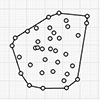
This Rhino Python code calculates the cross-product determinant used to determine the orientation of three points (current, next_point, and point) to see if they form a left turn or a right turn. This is a well-known technique in computational geometry to check the relative orientation…

Delaunay Triangulation with Rhino Python

July 27, 2017

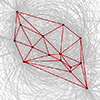
Boris Nikolayevich Delaunay was a Russian mathematician and mountain climber. He developed the Delaunay triangulation, which is a method in computational geometry. It is a triangulation of a set of points such that no point is inside the circumcircle of any triangle formed by the…

Detecting Inner Regions in Grasshopper

August 26, 2013

This is a simple trick that shows the utilization of the “surface split” component in Grasshopper. It is used for detecting the inner regions of any given two-dimensional linework. Thus, it resembles the hatch boundary detection of AutoCAD and similar software. There is no built-in…

Curve Farthest Point

August 26, 2013

Today’s tip is about two-dimensional curve-point calculations. It is very handy to use “closest point” components in Grasshopper. You can calculate distances and directions between curves, surfaces, and points. Then, place point objects in relation to the proximity of another object. However, there is no…

Delaunay Exercise

June 28, 2013

After becoming a ready-made component in Grasshopper, the Delaunay triangulation lost its popularity quickly. It used to be a nice problem of computational geometry for designers obsessed with scripting.  Last month, Benay reminded me of the method of circle checking. She showed her Rhinoscript that…

Variable Voronoi Study

November 30, 2012

I’ve been searching for a method to study the Voronoi subdivision in order to manipulate it. There are well-known algorithms for that. But I thought it would be better if I use a projective approach just as I did in studying hyperbolic space (here). This…

Möbius Strip Fabrication

October 31, 2012

The Möbius strip is a famous mathematical object. Although being in three-dimensional space, it is a closed-loop of only one surface and only one edge. This quality alone makes the object an interesting study for computational design. I aimed to create an object to test…

Isovist Component

May 26, 2012

Yesterday, Kağan asked me about the isovist component in Grasshopper and how it works. In fact, it is a long story, I said because once upon a time, I was curious about Space Syntax theory as my old friend Ela Çil introduced it. So, here…

MetaBalls in 3D

May 23, 2012

Playing with the 2D Metaball component in Grasshopper. I was curious about why there are no Metaballs in 3D in Grasshopper. Then, I realized that in fact, the 2D Metaball component is creating a section of a 3D Metaball computation. I think it is a…

Shortest Path Generator

April 30, 2012

This is the continuation of my scripting experiment within Grasshopper. Like the minimum spanning tree algorithm, this is also a famous problem of computational geometry; the shortest path problem. I’m now coding faster and understanding the namespace more easily in Grasshopper. This time, the challenge was…

Minimum Spanning Tree

April 26, 2012

This is the updated version of my MST code from 2012. After over a hundred hours of Rhinocommon and Grasshopper SDK studies, and lots of dead ends, I was finally able to calculate the minimum spanning tree of any given curve network in Grasshopper. Problems…

Voronoi Sketching on Spatial Allocation

February 10, 2012

That was about six months ago, our study for a design competition required a spatial allocation algorithm. An office building with a rectangular plot and a strict functional requirement forced me to the good old Voronoi diagrams, subdividing a surface. Here is the definition file: [GHX:…

  • Search

  • Categories

    • Education
      • Basic Design
      • Design Geometry
      • Design Mathematics
      • Digital Fabrication
      • Parametric Modeling
      • Tutorials
    • Philosophy
      • Analytical Tradition
      • Phenomenology
    • Practice
      • 3D Models
      • Projects
      • Publications
      • Workshops
    • Research
      • 3D Printing
      • Building Facade
      • Calculus
      • Climate Analysis
      • Compass Constructions
      • Computational Geometry
      • Curves
      • Decorative Arts
      • Digital Fabrication
      • Evolutionary Solvers
      • Folding Structures
      • Fractals
      • Graph Theory
      • Interlocking Structures
      • Islamic Patterns
      • Linear Algebra
      • Minimal Surfaces
      • Muqarnas
      • Non-Euclidean Geometry
      • Paneling
      • Parametric Curves
      • Parametric Objects
      • Parametric Surfaces
      • Pattern Deformations
      • Patterns
      • Pavilions
      • Polyhedra
      • Rammed Earth Structures
      • Robotic Fabrication
      • Shape Grammars
      • Simulation
      • Space Syntax
      • Surface Constructions
      • Tessellations
      • Tools
      • Vector Fields
      • Virtual Reality
    • Tools and Languages
      • 3DS Max
      • 3DS Max Script
      • Grasshopper
      • Photoshop
      • Physical Prototyping
      • Revit
      • Rhino
      • Rhino Macro
      • Rhino Python
      • Rhino Script
      • Unity
  • Monthly Archive

    • August 2026 (1)
    • October 2025 (1)
    • June 2025 (2)
    • May 2025 (2)
    • April 2025 (5)
    • December 2024 (40)
    • August 2024 (5)
    • July 2024 (6)
    • April 2024 (4)
    • March 2024 (10)
    • February 2024 (10)
    • January 2024 (8)
    • December 2023 (10)
    • August 2023 (3)
    • July 2023 (3)
    • June 2023 (7)
    • May 2023 (8)
    • April 2023 (7)
    • March 2023 (2)
    • February 2023 (2)
    • January 2023 (3)
    • December 2022 (6)
    • November 2022 (7)
    • January 2022 (1)
    • December 2021 (1)
    • October 2021 (3)
    • September 2021 (4)
    • August 2021 (4)
    • May 2019 (2)
    • April 2019 (1)
    • March 2019 (5)
    • January 2019 (2)
    • December 2018 (1)
    • November 2018 (4)
    • October 2018 (9)
    • July 2018 (1)
    • June 2018 (3)
    • May 2018 (1)
    • April 2018 (4)
    • February 2018 (2)
    • January 2018 (7)
    • August 2017 (9)
    • July 2017 (6)
    • October 2016 (1)
    • May 2015 (5)
    • April 2015 (8)
    • March 2015 (12)
    • February 2015 (4)
    • January 2015 (11)
    • November 2014 (1)
    • August 2014 (1)
    • June 2014 (2)
    • May 2014 (12)
    • April 2014 (5)
    • March 2014 (3)
    • February 2014 (6)
    • January 2014 (4)
    • December 2013 (5)
    • November 2013 (11)
    • October 2013 (2)
    • September 2013 (9)
    • August 2013 (4)
    • July 2013 (2)
    • June 2013 (14)
    • May 2013 (4)
    • April 2013 (10)
    • March 2013 (11)
    • February 2013 (11)
    • January 2013 (10)
    • December 2012 (10)
    • November 2012 (6)
    • October 2012 (13)
    • September 2012 (2)
    • August 2012 (5)
    • July 2012 (14)
    • June 2012 (6)
    • May 2012 (17)
    • April 2012 (15)
    • March 2012 (9)
    • February 2012 (16)
    • January 2012 (18)
    • December 2011 (20)
    • November 2011 (2)
  • Support designcoding!

    Enjoying designcoding? Support its future with a small donation on Patreon. Thank you!

    Patreon


    copyright 2026 designcoding.net | about | table of contents | keywords | privacy policy | end user license agreement