
Deviation
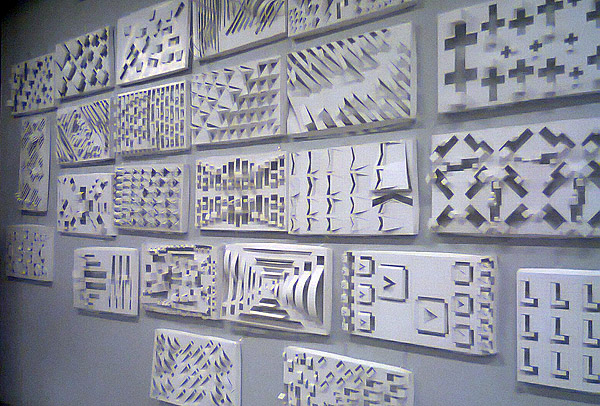
Basic Design I exercise called “Cut and Fold: Deviation” explores diversity within relationships and material behavior. It is initially introduced by Salih Küçüktuna as a simple but effective exercise platform. Below are some students’ works on this one-week exercise. The term “deviation” has many uses in a range of fields from medicine to sociology. However, it is frequently used in statistics with an interesting evocation to design computing:
In mathematics and statistics, deviation is a measure of difference between the observed value of a variable and some other value, often that variable’s mean. The sign of the deviation (positive or negative), reports the direction of that difference (the deviation is positive when the observed value exceeds the reference value). The magnitude of the value indicates the size of the difference.
When deviations refer to the difference between a variable and its value implied by some function of other variables, or between a variable and its value implied by the estimated version of that function, they are also known as errors or residuals respectively, and are applicable for data at the interval and ratio levels of measurement. When the reference point is simply a mean, deviations from the population mean are errors while deviations from the sample mean are residuals.
The sum of the deviations across the entire set of all observations from the overall sample mean is always zero, and the average deviation is zero.Wikipedia
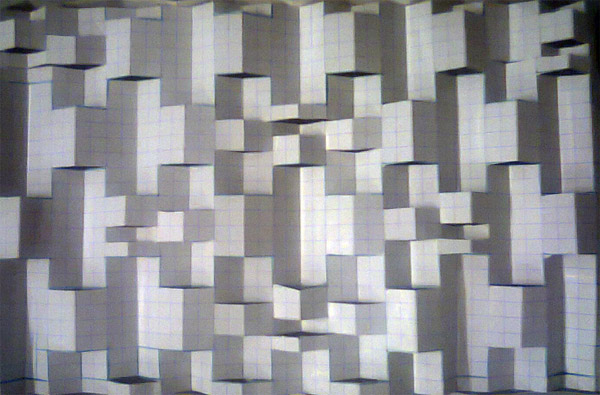
Nur Özdamar
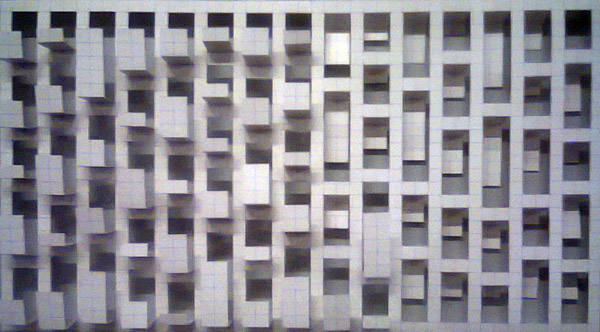
Meltem Bayrak
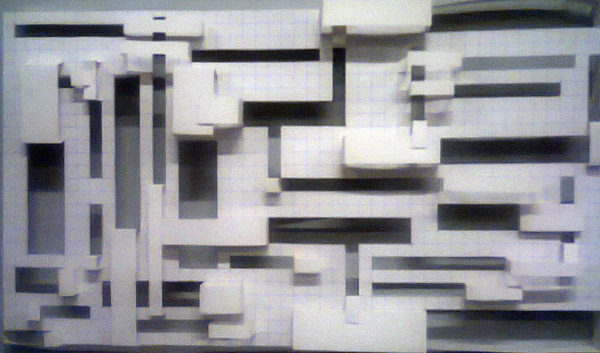
Cansu Karaman
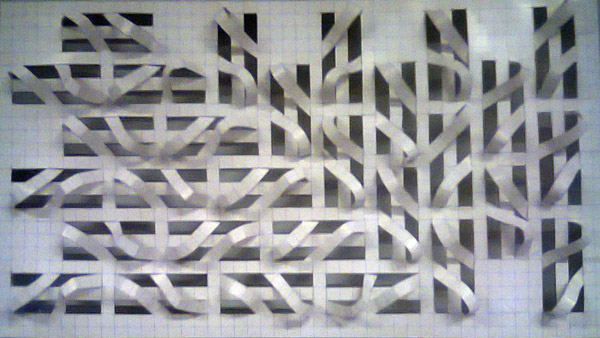
Ayşe Pınar Girgin
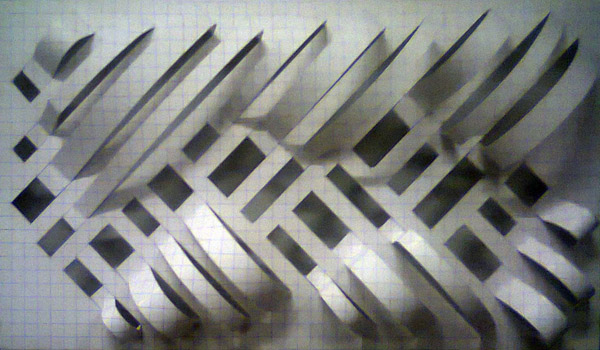
Berat Bayrampınar
Cite this post
Related Posts
Trifoliolate
April 30, 2013
The Parquet Deformation exercise is generally originated with William Huff. Huff conducted it at several schools of architecture since the 1960s. Huff defines the exercise as rooted in two analytical disciplines; monohedral tilings in geometry, and the continuous deformations in biological morphology. This is generally exemplified by D’Arcy Thompson’s and Albrecht Dürer’s studies. One of the student’s works of Huff, Trifoliolate is a single-axis, single-prototile hexagonal parquet deformation. It was designed by Glen Paris at the studio of William Huff…
Constructing Irregular Tiling
December 11, 2024
Using a compass and straightedge enables precise geometric constructions, allowing for the creation of complex tessellations. To begin these constructions, a single starting point is sufficient. Circles, which represent a collection of points at a specific distance from the center, and straight lines, which represent a collection of points in a particular direction, are utilized for geometric constructions. In this short tutorial, we move on with the beginner-level drawing exercises. This time, I am drawing an irregular tiling with triangles…
Drawing Escher-like Tiling
December 11, 2024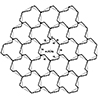
Escher tilings, inspired by the work of Dutch artist M.C. Escher, are inspiring tessellations that cover a plane using repeated geometric shapes without gaps or overlaps. He often used interlocking, recognizable figures like animals and birds to create these patterns, blending art with mathematical precision. His tilings explore symmetry, transformations, and the interplay between two- and three-dimensional space. Escher’s work has influenced both artistic and mathematical fields, particularly in the study of tessellations and geometry. Thus, In this short tutorial,…
Constructing Snub Square Tiling
December 11, 2024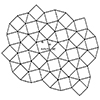
Snub Square Tiling is a semi-regular tessellation of the plane, composed of two squares and three regular triangles at each vertex. The arrangement of these two regular shapes seamlessly covers the plane without any gaps or overlaps. It is one of the eight semi-regular tessellations known in geometry. The dual of Snub Square Tiling is Cairo Pentagonal Tiling, which we will explore later. In this short tutorial, I am drawing and constructing the Snub Square Tiling by using an abstract…
Drawing Kagome Tiling
December 11, 2024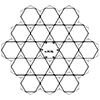
In Japanese, “kagome” refers to basket weaving, and the name of this tiling derives from the traditional basket-weaving craft of Japanese culture. In geometry, we know Kagome tiling as a semi-regular tessellation, Tri-Hexagonal Tiling. This tiling is composed of regular hexagons and triangles that cover the plane completely without gaps or overlaps. The dual of this tiling is the Rhombille Tiling. In this short tutorial, I am explaining the drawing of Kagome tiling in Rhinoceros. Thus, I am using some…