
Mirror by Curve
In today’s drawing class, we taught methods of drawing basic transformations by hand. Mirror was one interesting subject of that. However, then I opened Grasshopper and Rhino to test the effects of curved mirror planes. Unfortunately, I realized that there is already a curved mirror component in Grasshopper :(
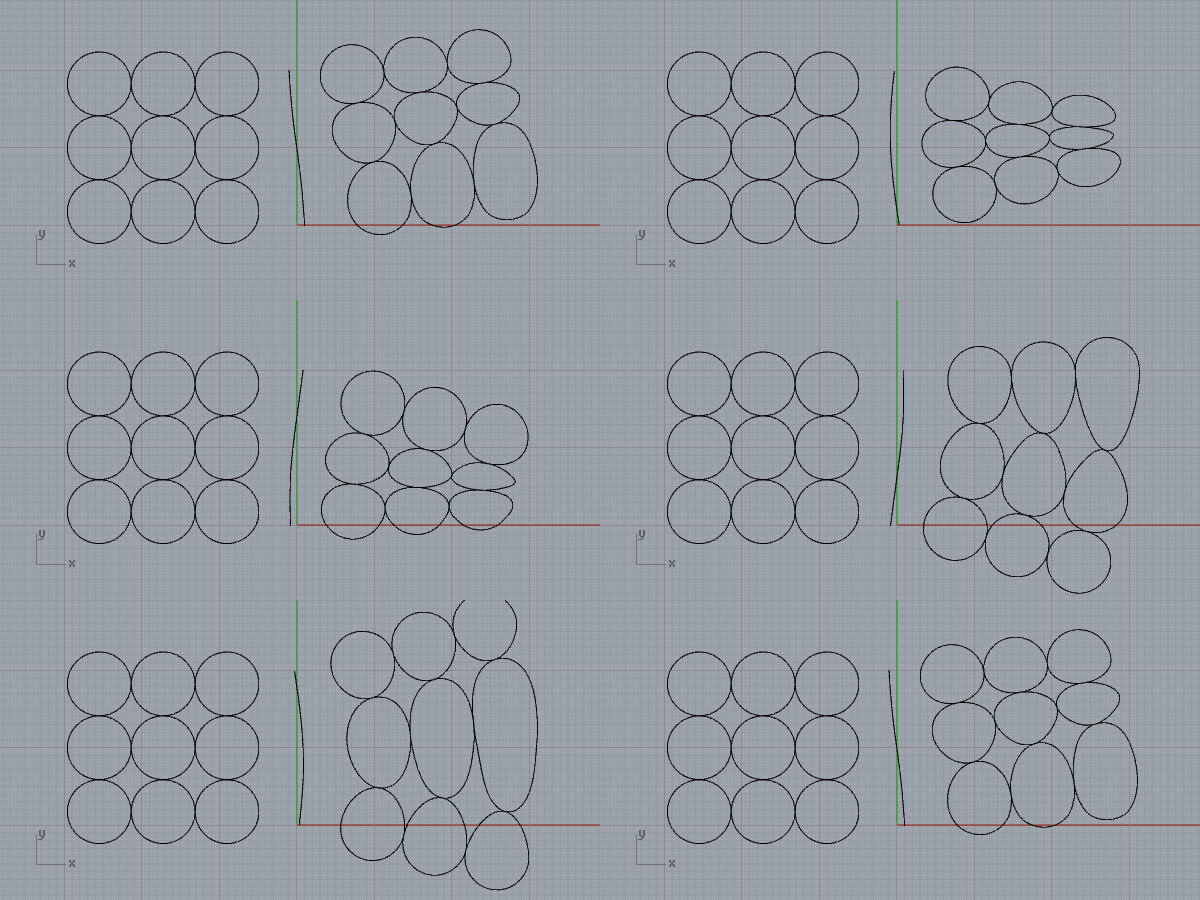
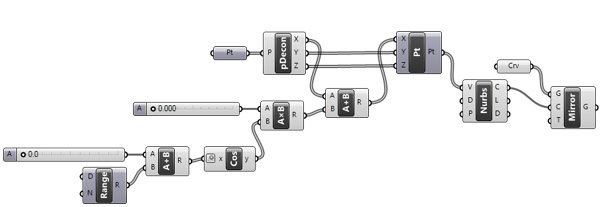
This might be one of the simplest ways of introducing generative deformations for design geometry.
Cite this post
Related Posts
Conformal Circle Packing
September 19, 2012
After a couple of days of studying the mysterious Doyle spiral, I’ve decided to test an approach of circle packing from conformal mapping. First, I tried to understand the Poincare disk (earlier at here, here, and here and here). I used it as the hyperbolic representation of space on a two-dimensional plane. Then, I linked a regular hexagonal grid and rebuilt it after the hyperbolic distortion. This led me to find the below hexagonal grid. Therefore, it looks like a suitable…
Hyperbolic Tessellations Continued
July 26, 2012
We can create tessellations of outer points in a Poincare Disk, using the manual method explained in the last post (here). But repeating that compass and straightedge process is becoming a little useless after a couple of repeats. If you say “ok. I understood the concept, let’s get faster!” then we can model just the same process in Grasshopper3D to examine varying results in seconds; If we connect any grid of points into this definition, we can clearly see the similar…
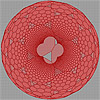
Truncated hexagonal tessellation (or named 3-12-12) is represented in hyperbolic space (as far as I understood it). The idea is simple if you don’t mix it with complex equations. Below is the 2-dimensional representation of hyperbolic projection. Paper space is defined by the thick line there. Projection is based on a two-sheet hyperboloid surface. Euclidean version of this tessellation is described here.
Moebius Transformation
July 5, 2012
This is my second attempt on getting into non-euclidean representations of space. Althouth it seems easy at first sight, this represents a close point of theory between mathematics and contemporary computational design geometry. As always, architects tend to use mathematical terms such as “non-euclidean geometries” but as far as I saw, most of them have no idea about what it is. So, I’m trying to learn and understand this connection by experiencing small parts of it, sailing at the edges…
Poincarés Hyperbolic Disk
June 26, 2012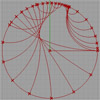
This is my first attempt at representing a non-euclidean space. There are several representations of a non-euclidean space in euclidean means such as Beltrami-Klein or Klein, Poincare, Poincare half-plane, and Weierstrass. Here, I tried to understand Poincare’s approach. Random straight lines are drawn on a hypothetical hyperbolic space using a simulation of Poincare’s famous disk representation. Although there is a precise description of the disk and its construction, I used a ready-made arc component of Grasshopper3d, showing start and end points along…