
Moebius Transformation
This is my second attempt on getting into non-euclidean representations of space. Althouth it seems easy at first sight, this represents a close point of theory between mathematics and contemporary computational design geometry. As always, architects tend to use mathematical terms such as “non-euclidean geometries” but as far as I saw, most of them have no idea about what it is. So, I’m trying to learn and understand this connection by experiencing small parts of it, sailing at the edges of architectural geometry, but trying not to get into equations of mathematics.
There are diverse approaches to study spherical and hyperbolic geometries but there seem to be no clear and easy equation that maps an Euclidean space into a non-Euclidean one, unless we are not dealing with the real projective way of describing them. My initial experiment was to understand the transformation between Cartesian coordinates and a projective transformation such as Moebius transformation. There is a beautiful video called “a video worth thousand words” at youtube (here) showing this process. While I was trying to get into the equations of these conversions from Cartesian to Hyperbolic space, that visual explanation changed my orientation back to the designerly way.
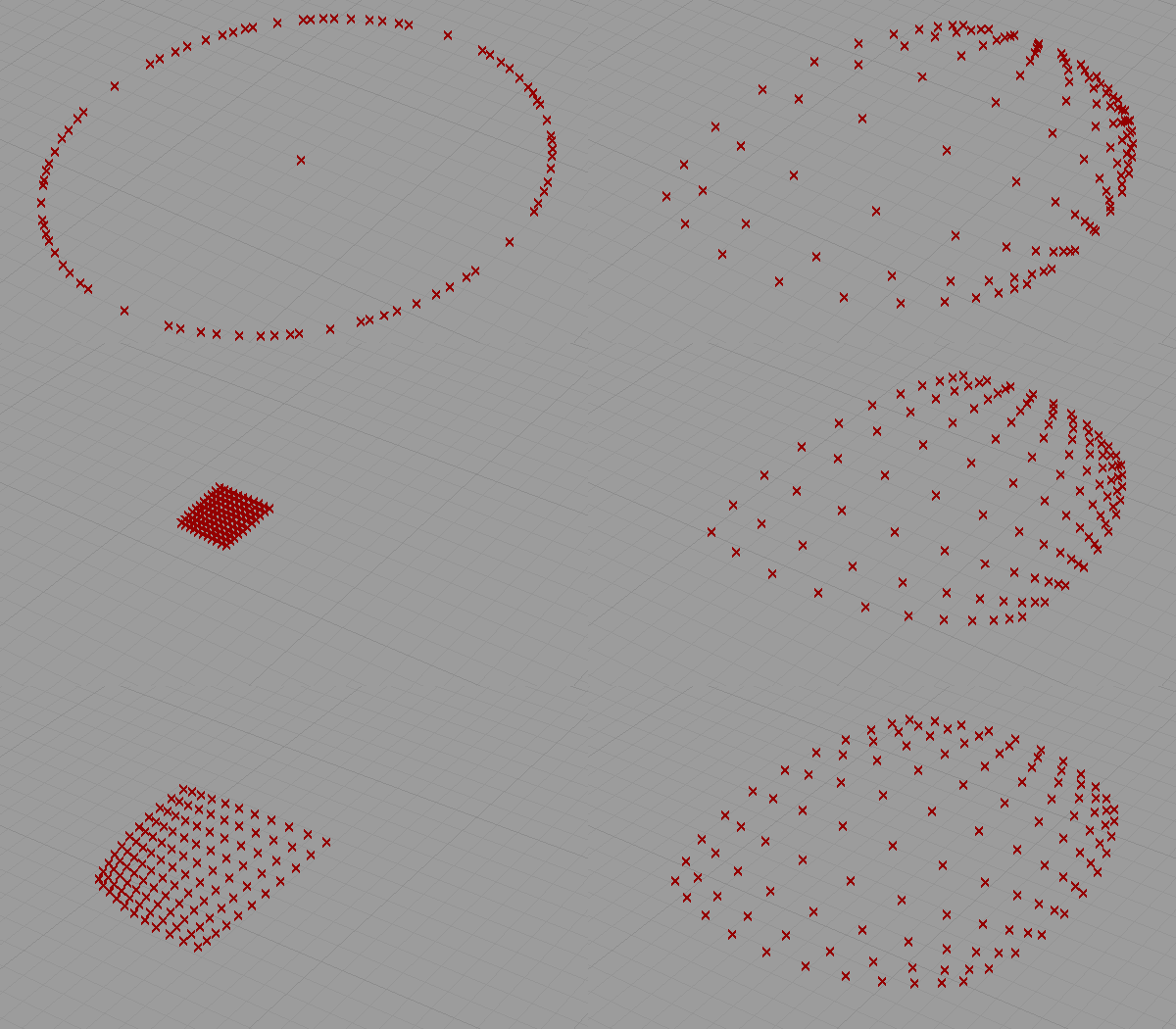
Below is my first attempt to describe a regular square tessellation using stereographic projection. The sphere used here is named Riemann sphere, there is a whole branch of mathematics about that.
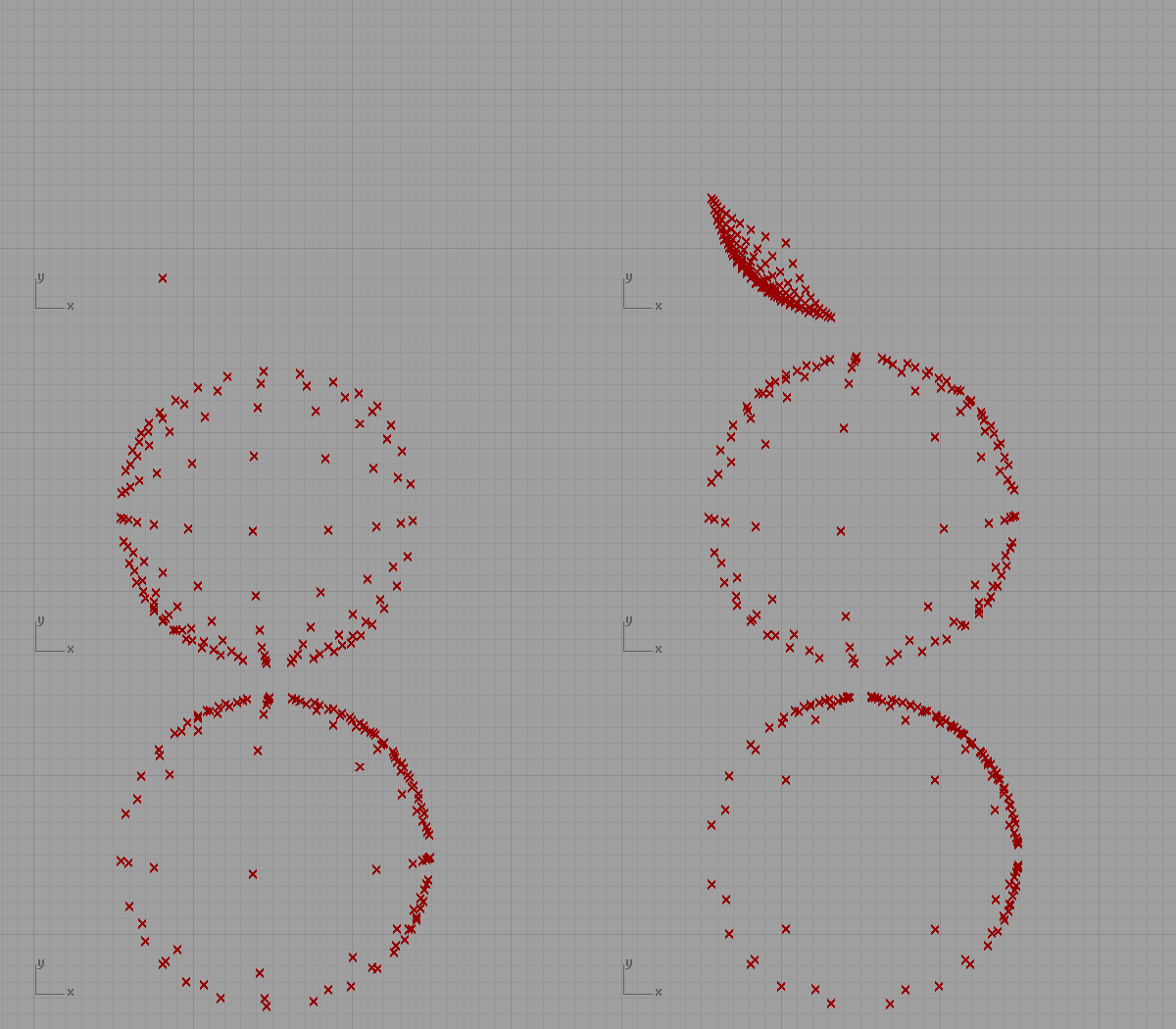
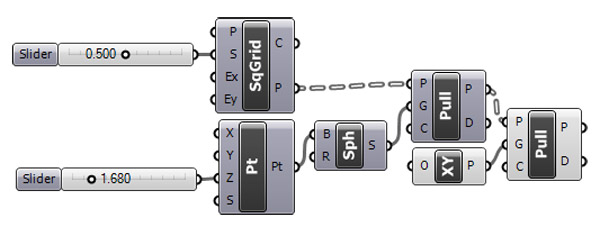
As you see, this is very effective and easy in Grasshopper for now. But getting into deeper areas of tessellations might be further interesting and complex. I’ll get more into this ASAP.
Cite this post
Related Posts
Möbius Strip Fabrication
October 31, 2012
The Möbius strip is a famous mathematical object. Although being in three-dimensional space, it is a closed-loop of only one surface and only one edge. This quality alone makes the object an interesting study for computational design. I aimed to create an object to test our new CNC machine. I wanted to test the egg-crate interlocking fabrication method. This is why the study became a Möbius strip fabrication. Apart from its uses in science and technology, here is an interesting…
The Moebius Strip
January 18, 2012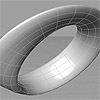
A Moebius strip, also known as a Moebius band, is a fascinating mathematical object and a type of non-orientable surface. It was discovered independently by the German mathematicians August Ferdinand Möbius and Johann Benedict Listing in the 19th century. To visualize a Moebius strip, imagine taking a long, narrow strip of paper and giving it a half twist before connecting its ends to form a loop. The result is a surface with only one side and one edge. This Grasshopper…
Moebius Basics
January 15, 2012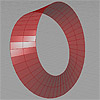
One of the most popular shapes in topology studies is the one-edge, one-face Moebius strip. Here is a basic definition that generates Moebius-like lofted surfaces. I say Moebius-like because, in Grasshopper, Rhino, or any NURBS surface method, I couldn’t manage to model this shape in its real topological singularity. The tricky part of this Grasshopper definition lies at the end, as I take the first segment of the surface, flip it, and attach it to the end of the segment…
Mirror by Curve
November 21, 2013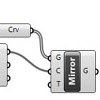
In today’s drawing class, we taught methods of drawing basic transformations by hand. Mirror was one interesting subject of that. However, then I opened Grasshopper and Rhino to test the effects of curved mirror planes. Unfortunately, I realized that there is already a curved mirror component in Grasshopper :( This might be one of the simplest ways of introducing generative deformations for design geometry.
Conformal Circle Packing
September 19, 2012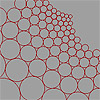
After a couple of days of studying the mysterious Doyle spiral, I’ve decided to test an approach of circle packing from conformal mapping. First, I tried to understand the Poincare disk (earlier at here, here, and here and here). I used it as the hyperbolic representation of space on a two-dimensional plane. Then, I linked a regular hexagonal grid and rebuilt it after the hyperbolic distortion. This led me to find the below hexagonal grid. Therefore, it looks like a suitable…