
The Moebius Strip
A Moebius strip, also known as a Moebius band, is a fascinating mathematical object and a type of non-orientable surface. It was discovered independently by the German mathematicians August Ferdinand Möbius and Johann Benedict Listing in the 19th century. To visualize a Moebius strip, imagine taking a long, narrow strip of paper and giving it a half twist before connecting its ends to form a loop. The result is a surface with only one side and one edge.
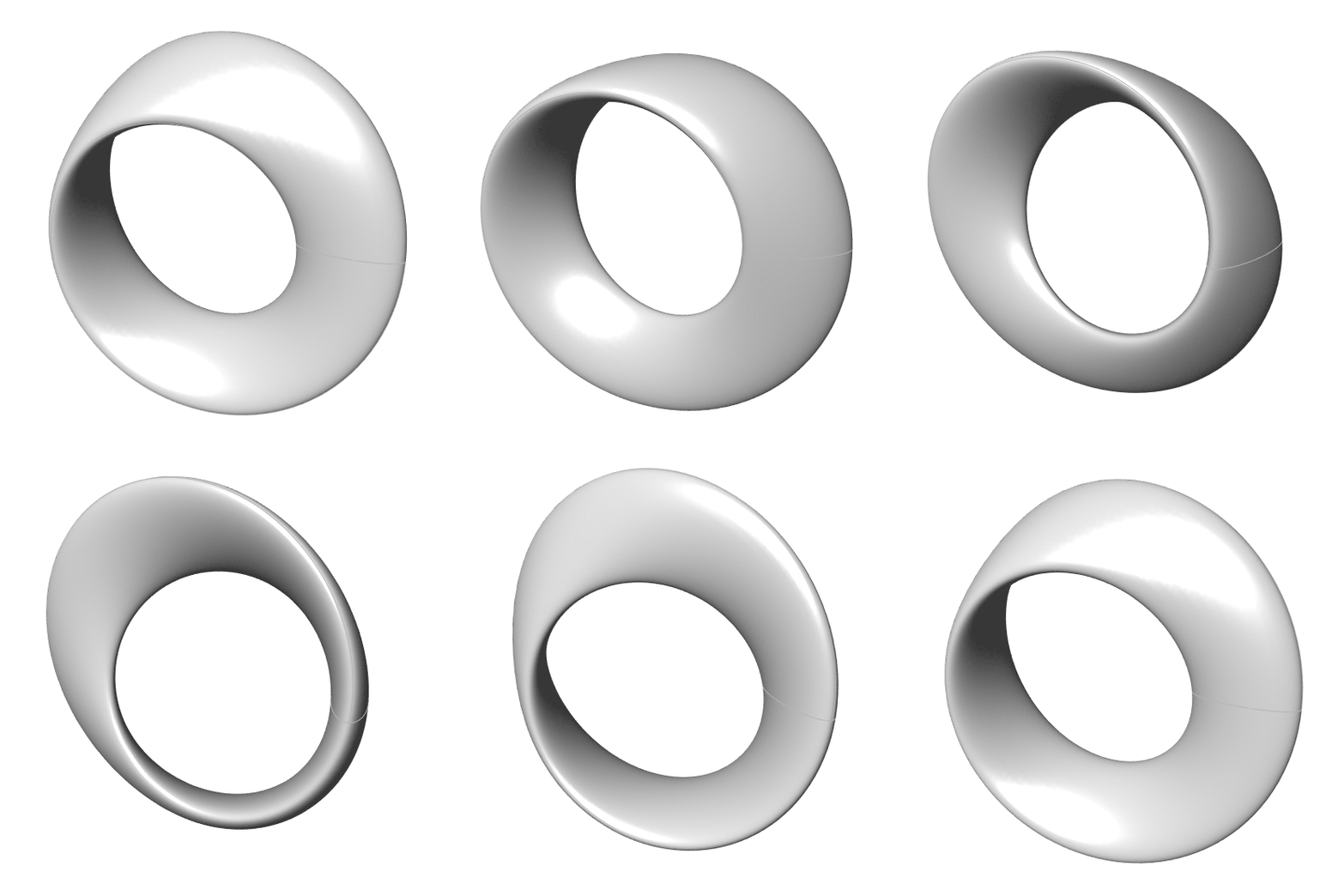
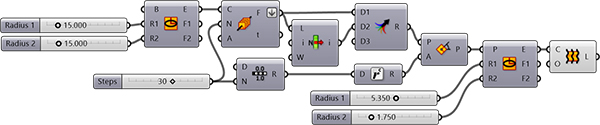
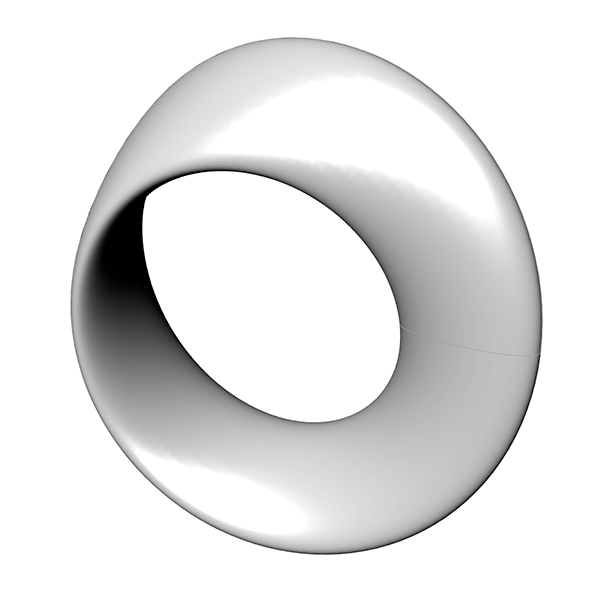
This Grasshopper definition generates a parametric Moebius strip with a thickness parameter input. Inspired by the works of Andrew F. Scott, (here especially). I decided to create a parametric Moebius strip model used as a foundation for various sculpture projects and educational exercises. The most challenging part of this problem was creating a single surface (not a Brep) to process it easier later on. The construction process of the model starts with a 3D ellipse, divided into equal distances. Then, I created new ellipses at each division point over specific planes. I duplicated the first ellipse. Then I put it at the end of this list to create an illusion of the continuous surface. After all, the Loft component generates the surface. Further experiments on this model could include the fabrication of this model.
Cite this post
Related Posts
Möbius Strip Fabrication
October 31, 2012
The Möbius strip is a famous mathematical object. Although being in three-dimensional space, it is a closed-loop of only one surface and only one edge. This quality alone makes the object an interesting study for computational design. I aimed to create an object to test our new CNC machine. I wanted to test the egg-crate interlocking fabrication method. This is why the study became a Möbius strip fabrication. Apart from its uses in science and technology, here is an interesting…
Moebius Basics
January 15, 2012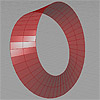
One of the most popular shapes in topology studies is the one-edge, one-face Moebius strip. Here is a basic definition that generates Moebius-like lofted surfaces. I say Moebius-like because, in Grasshopper, Rhino, or any NURBS surface method, I couldn’t manage to model this shape in its real topological singularity. The tricky part of this Grasshopper definition lies at the end, as I take the first segment of the surface, flip it, and attach it to the end of the segment…
Moebius Transformation
July 5, 2012
This is my second attempt on getting into non-euclidean representations of space. Althouth it seems easy at first sight, this represents a close point of theory between mathematics and contemporary computational design geometry. As always, architects tend to use mathematical terms such as “non-euclidean geometries” but as far as I saw, most of them have no idea about what it is. So, I’m trying to learn and understand this connection by experiencing small parts of it, sailing at the edges…
Tensile Fabric with Kangaroo
September 25, 2026
How much work we did last year for first-year architectural education! The tensile fabric study we carried out using Grasshopper Kangaroo in “Design Computing”, a first-year course I coordinated alongside my colleague Serkan Uysal, served as a baseline for the material research addressed in the Basic Design studio at that time. Such geometric optimizations in Kangaroo are no longer surprising or novel to anyone. However, experiencing these tools and possibilities in architectural education in the very first year offers a…
Interlocking Structure with Boolean
August 23, 2026
You are seeing the last of the interlocking system trials that I have previously tested in two exercises. If you remember, in our first trial, we were drawing interlocking joinery details on cross-sections using closed curves, without any solid modeling. And here is the most advanced one, I guess. In this exercise, however, we are creating a solid model that incorporates these interlocking details. This time, we will look at how to construct the same system using Boolean operations. Boolean…