designcoding
Search
About Table of Contents Keywords Support designcoding!

Grasshopper

225 posts

Baklava

January 23, 2013
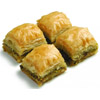
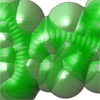
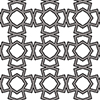
In Turkish, there is a strange word “baklava” that has many uses. According to Wikipedia: Baklava is a rich, sweet pastry made of layers of filo pastry filled with chopped nuts and sweetened with syrup or honey. It is characteristic of the cuisines of the…
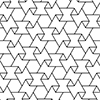
Waterbomb Tessellation

January 23, 2013

It all started with my new passion for origami tessellations, not much of origami, but the tessellation part. I was too lazy to fold it physically, nor model them using an engine such as Kangaroo. That would also be very unnecessary (and yes, very boring)…

Parametric Brickwork

January 7, 2013

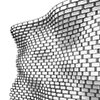
You might recall this type of parametric brickwork from architectural classics, such as the Programmed Wall by ETH Zurich and Gramazio Kohler Research, or the facade of the Mulberry House by SHoP Architects. Initially, I explored the simplest method for placing boxes on a surface,…

Icons

January 2, 2013

Here are funny icons from Martin Berube (other icon sets of him here) if you plan to build your components or clusters in Grasshopper. It somehow became a fashion of Rhinoceros, to give names of animals to products, that at first seemed to be only…

Clustering

January 2, 2013

The famous “Deutsch limit” says, “you cannot have more than -say a hundred- components in a visual programming environment, that is why you cannot write an operating system with it.”; so it says, the perceptual and pedagogical advantages of visual programming are limited according to…

Inflating Grids

December 28, 2012

After playing with vector fields in 2d (here) it was quite easy to create a 3d surface deformation. Here is my first experiment on a regular triangular grid’s three-dimensional behavior within a vector space, that includes a point charge of varying z coordinates. That makes…

Vector Fields

December 28, 2012

Back to the basics. I finally had time to test the vector fields components in Grasshopper. It was a couple of updates ago, a new tool group emerged in the vector tab, introducing different types of vector fields to users. Then, these fields could be…

Archimedean Spirals

December 17, 2012

In this exercise, Grasshopper draws various Archimedean spirals. It constructs polar points and maps them onto a range of angles and a number of points. The spiral’s turning speed is determined by the constant “a,” while the constant “n” gives unique names to the spirals…

Variable Voronoi Study

November 30, 2012

I’ve been searching for a method to study the Voronoi subdivision in order to manipulate it. There are well-known algorithms for that. But I thought it would be better if I use a projective approach just as I did in studying hyperbolic space (here). This…

Spherical Attraction

November 28, 2012

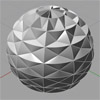
Today’s Architectural Geometry course was about platonic solids and different attractor objects in introducing component-based design systems. Benay’s idea was both pedagogical and interesting to test in Grasshopper. I searched for the most fundamental type of attractor solid in creating a composition such as this;…

Möbius Strip Fabrication

October 31, 2012

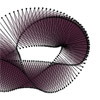
The Möbius strip is a famous mathematical object. Although being in three-dimensional space, it is a closed-loop of only one surface and only one edge. This quality alone makes the object an interesting study for computational design. I aimed to create an object to test…

Cairo Pentagonal Tiling

October 22, 2012

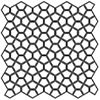
This is a late update for my 2012 study on Cairo Pentagonal Tiling (or Cairo Tessellation). Originally, it was an exercise of dual tessellations. Because this tiling is the dual of the famous semi-regular tessellation of Snub Square. After coding the Snub Square tiling, I…

Snub Square Tiling

October 22, 2012

Here is the step-by-step generation of the old Snub Square Tiling. Frankly, this is the first step in the generation of Cairo Pentagonal Tiling I generated with Grasshopper earlier. Because Cairo pentagonal is the dual of a snub square. The first step was easy. Just…

Islamic Patterns of Semi-Regular Tessellations

October 22, 2012

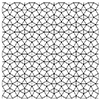
The intricate harmony of the Islamic Patterns is amazing. The geometry of this and other Islamic pattern designs are explained in the 3rd chapter of Craig S. Kaplan’s Ph.D. dissertation. I constructed a semi-regular tessellation, particularly the 4.8 because it seems to open interesting explorations…

Subdivide by Image Contrast

October 17, 2012

This was my old plan to work with images in Grasshopper. Certainly, that was not the result I expected, but this could be counted as a starting point. After seeing beautiful circle packing compositions here, I decided to program Grasshopper, so that it’ll create a…

Mandelbrot Set

October 10, 2012

Today’s fractal is the famous Mandelbrot Set. The Mandelbrot set is a well-known and complex mathematical set often associated with fractals and chaos theory. Named after the mathematician Benoît B. Mandelbrot, it’s a set of complex numbers defined by a simple iterative process. The Mandelbrot…

Julia Set

October 10, 2012

Today’s fractal is the Julia Set, the amazing simplicity of chaos. There are lots of applets and articles on the internet about this fractal. You can generate this with the iteration of a basic function many times and placing points on the complex plane. I…

Conformal Circle Packing

September 19, 2012

After a couple of days of studying the mysterious Doyle spiral, I’ve decided to test an approach of circle packing from conformal mapping. First, I tried to understand the Poincare disk (earlier at here, here, and here and here). I used it as the hyperbolic representation…

Hyperbolic Tessellations Continued

July 26, 2012

We can create tessellations of outer points in a Poincare Disk, using the manual method explained in the last post (here). But repeating that compass and straightedge process is becoming a little useless after a couple of repeats. If you say “ok. I understood the concept,…

Animate Sketching of a Parametric Truss

July 25, 2012

Previous studies on the timer component were based on understanding its use. This time, I tried to implement it in a geometric design task. Moreover, manipulating the timer component to change the regular animation of parameters. Time does not have to be equally divided into…

« 1 2 3 4 5 6 7 8 9 10 11 12 »
  • Search

  • Categories

    • Education
      • Basic Design
      • Design Geometry
      • Design Mathematics
      • Digital Fabrication
      • Parametric Modeling
      • Tutorials
    • Philosophy
      • Analytical Tradition
      • Phenomenology
    • Practice
      • 3D Models
      • Projects
      • Publications
      • Workshops
    • Research
      • 3D Printing
      • Building Facade
      • Calculus
      • Climate Analysis
      • Compass Constructions
      • Computational Geometry
      • Curves
      • Decorative Arts
      • Digital Fabrication
      • Evolutionary Solvers
      • Folding Structures
      • Fractals
      • Graph Theory
      • Interlocking Structures
      • Islamic Patterns
      • Linear Algebra
      • Minimal Surfaces
      • Muqarnas
      • Non-Euclidean Geometry
      • Paneling
      • Parametric Curves
      • Parametric Objects
      • Parametric Surfaces
      • Pattern Deformations
      • Patterns
      • Pavilions
      • Polyhedra
      • Rammed Earth Structures
      • Robotic Fabrication
      • Shape Grammars
      • Simulation
      • Space Syntax
      • Surface Constructions
      • Tessellations
      • Tools
      • Vector Fields
      • Virtual Reality
    • Tools and Languages
      • 3DS Max
      • 3DS Max Script
      • Grasshopper
      • Photoshop
      • Physical Prototyping
      • Revit
      • Rhino
      • Rhino Macro
      • Rhino Python
      • Rhino Script
      • Unity
  • Monthly Archive

    • August 2026 (1)
    • October 2025 (1)
    • June 2025 (2)
    • May 2025 (2)
    • April 2025 (5)
    • December 2024 (40)
    • August 2024 (5)
    • July 2024 (6)
    • April 2024 (4)
    • March 2024 (10)
    • February 2024 (10)
    • January 2024 (8)
    • December 2023 (10)
    • August 2023 (3)
    • July 2023 (3)
    • June 2023 (7)
    • May 2023 (8)
    • April 2023 (7)
    • March 2023 (2)
    • February 2023 (2)
    • January 2023 (3)
    • December 2022 (6)
    • November 2022 (7)
    • January 2022 (1)
    • December 2021 (1)
    • October 2021 (3)
    • September 2021 (4)
    • August 2021 (4)
    • May 2019 (2)
    • April 2019 (1)
    • March 2019 (5)
    • January 2019 (2)
    • December 2018 (1)
    • November 2018 (4)
    • October 2018 (9)
    • July 2018 (1)
    • June 2018 (3)
    • May 2018 (1)
    • April 2018 (4)
    • February 2018 (2)
    • January 2018 (7)
    • August 2017 (9)
    • July 2017 (6)
    • October 2016 (1)
    • May 2015 (5)
    • April 2015 (8)
    • March 2015 (12)
    • February 2015 (4)
    • January 2015 (11)
    • November 2014 (1)
    • August 2014 (1)
    • June 2014 (2)
    • May 2014 (12)
    • April 2014 (5)
    • March 2014 (3)
    • February 2014 (6)
    • January 2014 (4)
    • December 2013 (5)
    • November 2013 (11)
    • October 2013 (2)
    • September 2013 (9)
    • August 2013 (4)
    • July 2013 (2)
    • June 2013 (14)
    • May 2013 (4)
    • April 2013 (10)
    • March 2013 (11)
    • February 2013 (11)
    • January 2013 (10)
    • December 2012 (10)
    • November 2012 (6)
    • October 2012 (13)
    • September 2012 (2)
    • August 2012 (5)
    • July 2012 (14)
    • June 2012 (6)
    • May 2012 (17)
    • April 2012 (15)
    • March 2012 (9)
    • February 2012 (16)
    • January 2012 (18)
    • December 2011 (20)
    • November 2011 (2)
  • Support designcoding!

    Enjoying designcoding? Support its future with a small donation on Patreon. Thank you!

    Patreon


    copyright 2026 designcoding.net | about | table of contents | keywords | privacy policy | end user license agreement