
Julia Set
Today’s fractal is the Julia Set, the amazing simplicity of chaos. There are lots of applets and articles on the internet about this fractal. You can generate this with the iteration of a basic function many times and placing points on the complex plane. I developed a Grasshopper implementation in 2012. Also, this was my first study on complex numbers. At each iteration, the detail level increases. I utilized a common brute-force approach, distributing a grid of points, converting them to complex numbers, using the expression (usually in the z2 + c form, where c is a constant complex number and z is the variable one). Then check the modulus of the resulting complex number against a value (usually 2 or 3). I used a VB.net component to calculate the expression. Python was very slow compared to VB.net.
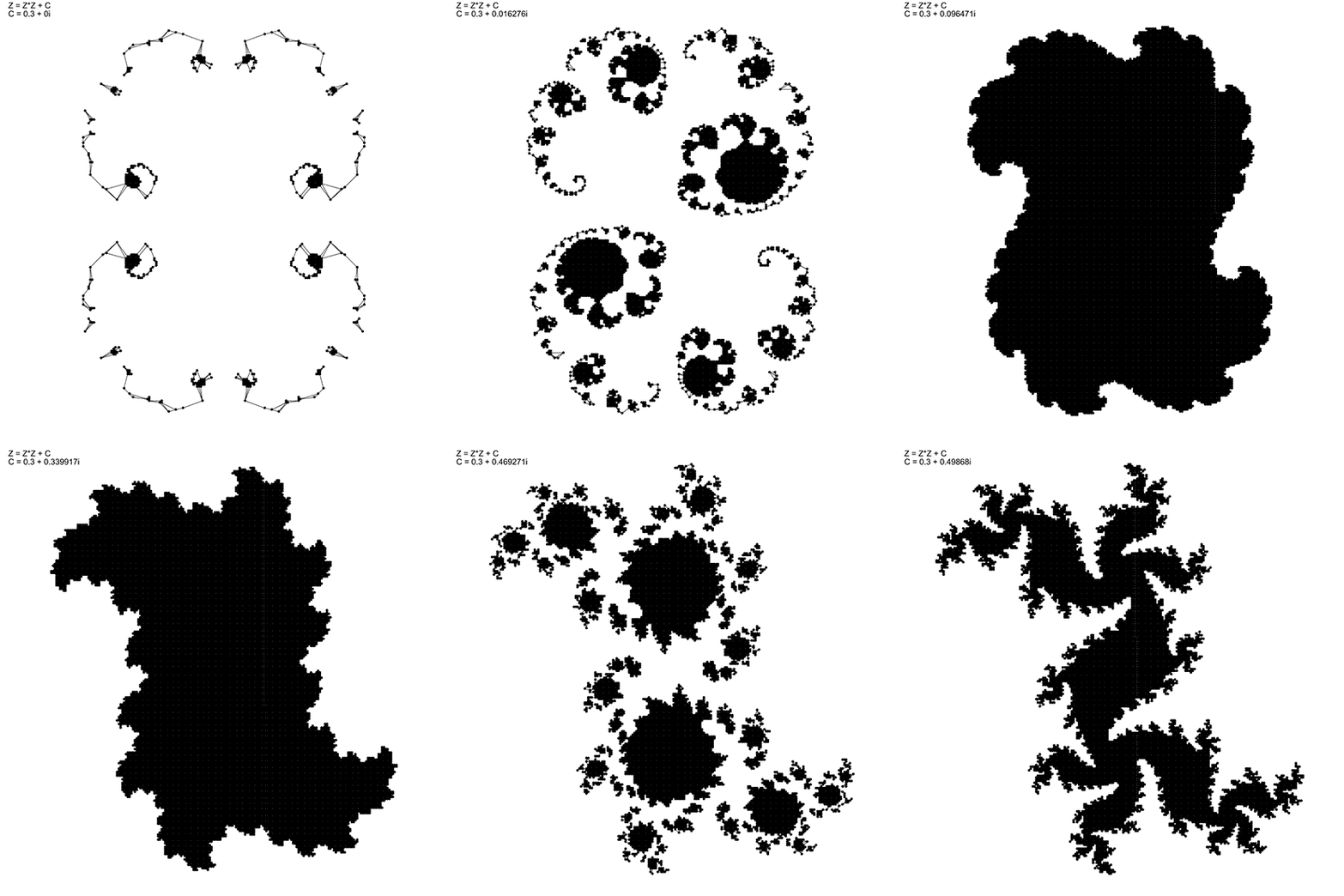
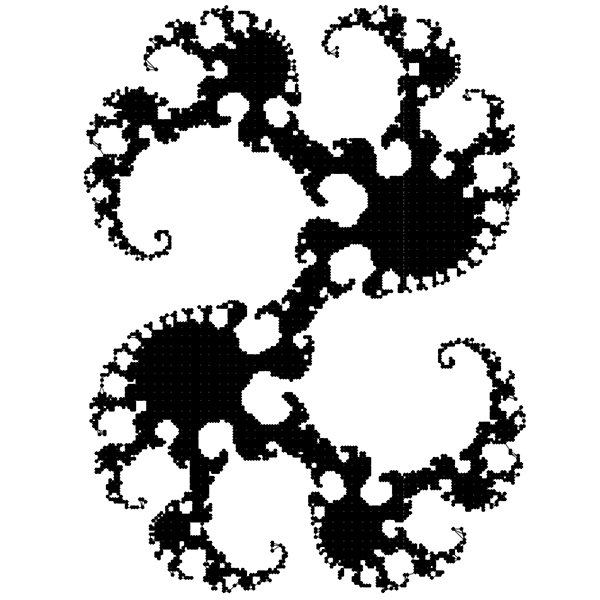
This Grasshopper definition generates the Julia Set fractals with several input parameters. The user can modify the number of iterations, c and d variables, and also the formula itself. You can generate the infinite possibilities of Julia Set. The outputs are point objects. The code does not generate boundary surfaces or curves. I made the definition with the help of native Grasshopper components and a VB.net code. So, you don’t need to install external add-ons to be able to use the definition.

Cite this post
Related Posts
Mandelbrot Set
October 10, 2012
Today’s fractal is the famous Mandelbrot Set. The Mandelbrot set is a well-known and complex mathematical set often associated with fractals and chaos theory. Named after the mathematician Benoît B. Mandelbrot, it’s a set of complex numbers defined by a simple iterative process. The Mandelbrot set is an intricate and self-similar boundary, which reveals increasingly complex patterns at different magnifications. On the other hand, I heard the term “The fingerprint of God” in some sources resembling its aesthetic and philosophical…
Complex Numbers
October 6, 2012
Studying circle packing led me back to my high school days. First, I’ve tried to write a vb.net component so that I would say Grasshopper to place circles and check lots of things iterating again and again. Then I felt that this was not my real interest in circle packing. After finding an old post by Daniel Piker, I’m truly enlightened about an old topic of our high school education: The complex numbers! Then I found this link, explaining the…
Sierpinski Triangle
February 20, 2024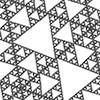
Today’s computational curve is the beautiful Sierpinski Triangle. It is a fractal named after the Polish mathematician Waclaw Sierpinski, who described it in 1915, though it had been previously described by other mathematicians. It is a self-replicating pattern that arises from a simple recursive process. To construct the fractal, you start with an equilateral triangle and then repeatedly remove smaller equilateral triangles from its interior, leaving holes. Each iteration involves dividing each triangle into four smaller triangles and removing the…
Dragon Curve Fractal
December 25, 2023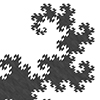
This week’s fractal is the famous Dragon Curve. Dragon Curve exhibits self-similarity, meaning parts of the curve resemble the overall shape, regardless of scale. It’s fascinating because a relatively simple construction process generates a complex and visually captivating fractal pattern. The Dragon Curve is often used to demonstrate fractal properties in mathematics and is popular in recreational mathematics due to its intricate and beautiful patterns. It has applications in computer graphics and is interesting in studying chaos theory, self-similarity, and…
Cesaro Fractal
December 19, 2023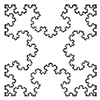
In this study, I explore Cesaro Fractal, generated by Grasshopper. Usually, it is not possible to code recursive algorithms in Grasshopper. With the help of the Anemone add-on, these fractal curves are easy to model. I studied similar fractal algorithms here before. This one is very similar to the Koch’s snowflake. The only difference (as far as I understood) is the side of the spikes. Koch’s Snowflake generates triangular spikes pointing to the outside of the polygon. Cesaro Fractal does…