
Baklava
In Turkish, there is a strange word “baklava” that has many uses. According to Wikipedia:
Baklava is a rich, sweet pastry made of layers of filo pastry filled with chopped nuts and sweetened with syrup or honey. It is characteristic of the cuisines of the former Ottoman Empire and those of Central and Southwest Asia.
However, we should add that 150 gr. of baklava is 413 calories. Here is it (with pistachio):
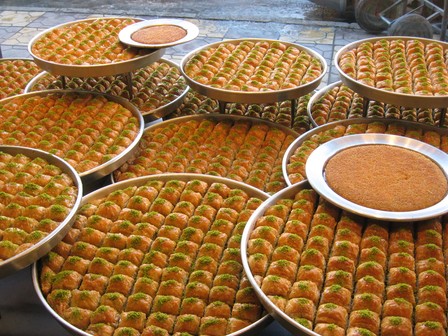
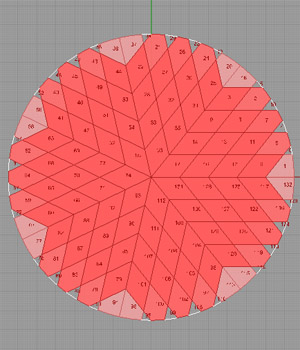
The other use of this word comes from the shape of baklava slices. They are always cut in quadrangles (with a couple of exceptions), forming squares, rectangles, and rhombii. Baklava is a common word used for rhombus in Turkish. Yes, we call “baklava” describing quadrangular forms with a fuzzy meaning of the real shape, as it can be a parallelogram, deltoid, or rhombus (but not square or rectangle). There are other interesting terms for geometric shapes such as “yamuk” (lopsided) used for trapezoids. To some extent, we try to use correct names in geometry classes but sometimes I feel it is an interesting tradition for us to name geometric shapes inspired by food. As baklava trays are usually circular, such quadrangular subdivisions of a circular area have brought an interesting technique, called “star cut”,
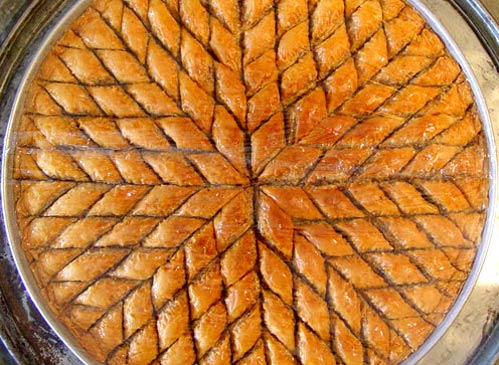
Because of the flow of syrup and the source of fire underneath, the best part of the tray is always the middle. I think the above style of cutting Safranbolu baklava has logic that, the middle part has as many slices as possible, while the flow of the boiling syrup is diffused better into the whole tray because of the canal-shaped cuts, pointing to the middle. Yummy. The photos below show how to cut it;
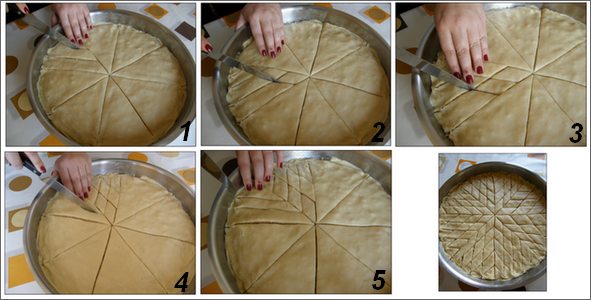
This style of cutting has losses at the perimeter of the tray, but at the same time, it creates many equal and very sharp rhombii. Thus it is easier and more polite to bite it. As it is a polar construction, all subdivisions including the ones at the perimeter are equally distributed. The process is very simple and it depends on the desired size of the rhombii and the radius of the tray.
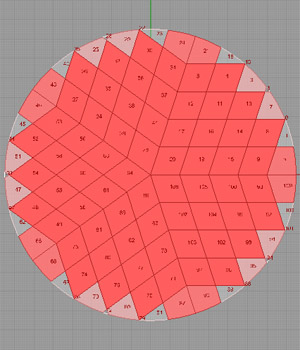
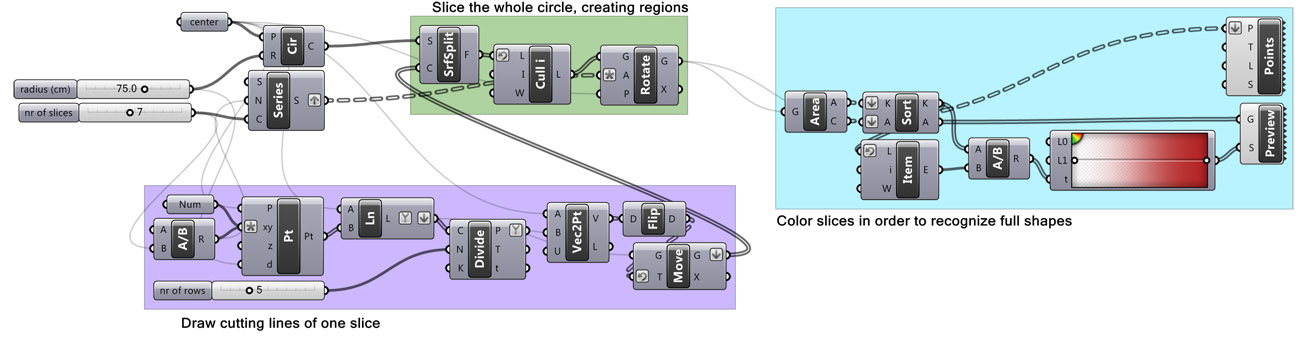
Here is the Grasshopper definition that subdivides any given circle into rhombii, using the star-cut style of baklava, color-coding different-sized slices.
Cite this post
Related Posts
Rhombus Facade
June 4, 2023
This is the continuation of a very old parametric model of a building facade, presented here. I will introduce the basic Grasshopper definitions of several alternative designs. The first one is the rhombus facade. The first part of the algorithm deals with the necessary data collection. We reference a polyline from the Rhino model as the path that the facade will follow. After that, we create vertical lines around the path. Then, we shatter these lines by using a Graph…
Space-filling Rhombic Dodecahedra
February 10, 2024
The rhombic dodecahedron is a polyhedron with twelve rhombus-shaped faces, where each face has four sides of equal length. It is possible to construct the space-filling variant of the rhombic dodecahedron by arranging multiple such rhombic dodecahedra in a regular pattern so that they fill space without leaving any gaps. In his 1611 work on snowflakes titled “Strena seu de Nive Sexangula,” Johannes Kepler observed that honey bees utilize the geometric structure of rhombic dodecahedra to construct honeycombs. These honeycombs…
Rhombille Tiling on Surface
June 13, 2023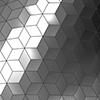
This is an update on my 2012 exercise on rhombille tiling. This reminded me of the old-school subdivisions of surfaces again after 11 years. It was while reading about rhombic dodecahedron (the stackable solid), that I came across this cute tiling. It’s quite simple, just a hexagonal grid with a special reconstruction. I decided to recreate it by using well-known native Grasshopper components. I animated the result with a variation of the Breaststroke surface function (described here). Then I reconstructed…
Dürer Rhombii
November 19, 2013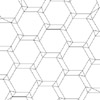
I’ve come across this nice website about the short history of tilings and tessellations. In this post, I am regenerating a tiling of Dürer rhombii. Albrecht Dürer sounds like one of the pioneers of some of the concepts of today’s emerging field of architectural geometry. Here is a phrase from that website about Dürer; “…Like Kepler, regular polygons and polyhedra fascinated Dürer… A large section of the Painter’s Manual is dedicated to practical ways to construct various curves and regular polygons with…
Fermat’s Nightmare
October 14, 2026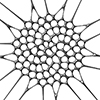
Revisiting a specific mathematical phenomenon that I previously explored twice, here (in 2017) and here (in 2011), from a different angle in 2026 now. This was the final video (from 2023) that I found in my junk folder during the blog’s resurrection. Today, designers mostly know Fermat through the famous 137.5-degree angle of rotation, which is the mathematical formula used to describe the arrangement of sunflower seeds. However, today I will speculate on a nightmare of Fermat’s. Because Fermat, in…