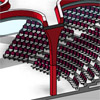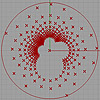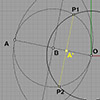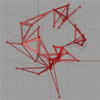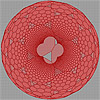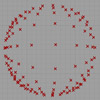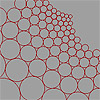
After a couple of days of studying the mysterious Doyle spiral, I’ve decided to test an approach of circle packing from conformal mapping. First, I tried to understand the Poincare disk (earlier at here, here, and here and here). I used it as the hyperbolic representation of space on a two-dimensional plane. Then, I linked a regular hexagonal grid and rebuilt it after the hyperbolic distortion. This led me to find […]

Author Archive
Which keywords are the most popular, regarding contemporary architectural geometry? Above is the wordle.net analysis result for all 155k words of the famous book “Architectural Geometry” by H. Pottmann, A. Asperl, M. Hofer, and A. Kilian. Not many surprises though, this may be a starting point for research on today’s understanding of geometry in architectural design. You can click on the image to see the top 500 words mentioned in […]
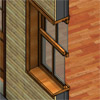
This is a detailed wooden casement window, created for a restoration project last year by Tuşpa Architecture. Revit is used in creating the survey and restitution projects. This component is partially parametric, you can define width and height values. It took about three days to complete the component, way much more than just drawing it in Autocad, but it was very educational for me. You can download and play with […]
I’ve been working on a multi-function building for a design contest. This led me to the custom component designs also. Here is a quick column object with several parameters. You can right-click and download the file here: [RFA: Revit 2012] This was an interestingly easy and quick process of creating a parametric component in Revit. It is somehow similar to Grasshopper3D, with just single revolve command, connected to the variables. […]
Here is the preface of the famous book “Architectural Geometry”. It simply encourages me to learn new things every day even sometimes it seems to become impossible. Geometry lies at the core of the architectural design process. It is omnipresent, from the initial form-finding stages to the actual construction. Modern constructive geometry provides a variety of tools for the efficient design, analysis, and manufacture of complex shapes. This results in […]
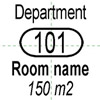
I’ve been carried away by a design competition since 10 days. This is a multi-function building with 20.000 m2 floor area. This is the first time I’m trying to design such a large space completely in Revit Architecture. Below are two small modifications I’ve made to meet Turkish annotation standards. Especially the elevation tag is very different from original Revit component. Room tag is also modified because the multi-function buildings […]
We can create tessellations of outer points in a Poincare Disk, using the manual method explained in the last post (here). But repeating that compass and straightedge process is becoming a little useless after a couple of repeats. If you say “ok. I understood the concept, let’s get faster!” then we can model just the same process in Grasshopper3D to examine varying results in seconds; If we connect any grid of […]
The poincare disk is still an interesting representation of hyperbolic space for me, full of mysteries. I’ve had several attempts to understand it previously (here and here). Finally, I found a resource* explaining basic concepts about it. I tried to repeat some of the constructions in Rhinoceros, (without any logical purpose). The most important part is the conversion of a Euclidean point into a hyperbolic space. There is no clear […]
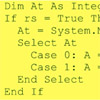
Previous studies on the timer component were based on understanding its use. This time, I tried to implement it in a geometric design task. Moreover, manipulating the timer component to change the regular animation of parameters. Time does not have to be equally divided into sequences. Rather, new possibilities may emerge with different time flows. A simple triangulation system is developed with a potential manipulation, based on a timer. This […]
Joseph Bergin‘s pedagogical patterns for computer science education returned my attention to teaching methods I’ve searching for almost five years. Here is a phrase from a paper submitted to pedagogical pattern language project: Most educators and trainers are not taught how to teach. Rather, they often find themselves teaching by accident. Typically, a person with a skill that is in demand, such as a particular programming language, will be asked to teach […]
We can model a musical composition using native Grasshopper components. After the experiments with the timer component (here and here), I managed to build a definition that allows us to produce outputs in various time intervals. I converted a small part of Bach’s Bouree in E-Minor into Grasshopper as a guitar tablature. I used Guitar Pro 5’s MusicXML export function to convert classical guitar tablature into XML data, then organized […]
[GHX:0.8.0066] Here is today’s improvement on my metronome with the timer component, which started here. It’s straightforward to tell Grasshopper about seconds and organize it according to it. Using an interval smaller than 1 second, this small script catches every second and returns a different value. However, it’s much harder to implement smaller values than seconds. It seemed easy at first sight but getting accurate results smaller than seconds requires working […]
The logical structure of computer-aided architectural design tools is based on object orientation. New design methodologies named Building Information Modeling or Virtual Building aim to improve this structure by synchronizing the digital object classes with real architectural products. Therefore, CAD becomes smart and parametric. But from the design educator’s point of view, most commercial CAD tools are not useful and too complicated to implement basic spatial concepts. This is the […]
This was before Spherical Fantasies, while I was trying to update my surface equation definition. In between designerly intentions and mathematical facts, it’s hard to maintain a process, while keeping the definition yet simple and open to exploration. Grasshopper definition is here: [GHX: 0.8.0066] A little tired of mathematical definitions, I started to give names to the animate surfaces I develop. Like the Spherical one, this is also a trigonometric equation […]
This is about conforming distortions on surfaces and creating imperfect (say ugly) surfaces. I started with planar surfaces, however, I continued with spherical ones. There are interesting results when applying trigonometric functions to spherical surfaces. Example surface equations: W=(sin(x*y)) / 2 and W=(cos(x)+sin(x-y²)) / 2 Please be patient if animations are loading slowly. But they represent a way of creating free-form-looking surfaces, highly mathematical behind the scene. Here is the […]
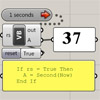
This is probably the most simple definition on this site but I think it’s very useful. The timer is a special component of Grasshopper that is significant in terms of the real-time sketching paradigm. This basic use of a timer includes a 1-second update to a Vb script. Inside the script, the system date’s seconds are returned, so we see a real-time increasing number at output A. Beyond this point, […]
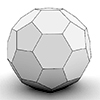
The Truncated Icosahedron (5,6,6) is an Archimedean Solid we often recognize as the iconic soccer ball. This geometric structure, also affectionately known as the “Buckyball” in honor of the visionary architect Buckminster Fuller, has gained significant popularity and recognition both within the realms of mathematics and everyday life. It is composed of twelve regular pentagons and twenty regular hexagons, meticulously arranged to achieve a harmonious balance. This symmetrical nature makes […]
Here is an interesting six-year-old quote from Rivka Oxman, telling us about a potential class of designers. The particular character, type, class or whatever we call could be more sophisticated people than we imagine today. It tells me that, advances in design computing does make high-end techniques available for large communities, and re-define basics of architectural geometry for everyone in digital age, but always there seem to remain a small […]
Truncated hexagonal tessellation (or named 3-12-12) is represented in hyperbolic space (as far as I understood it). The idea is simple if you don’t mix it with complex equations. Below is the 2-dimensional representation of hyperbolic projection. Paper space is defined by the thick line there. Projection is based on a two-sheet hyperboloid surface. Euclidean version of this tessellation is described here. Here is the Grasshopper3D file containing the above […]
[GHX: 0.8.0066] This is my second attempt on getting into non-euclidean representations of space. Althouth it seems easy at first sight, this represents a close point of theory between mathematics and contemporary computational design geometry. As always, architects tend to use mathematical terms such as “non-euclidean geometries” but as far as I saw, most of them have no idea about what it is. So, I’m trying to learn and understand this […]