
Modeling the Buckyball
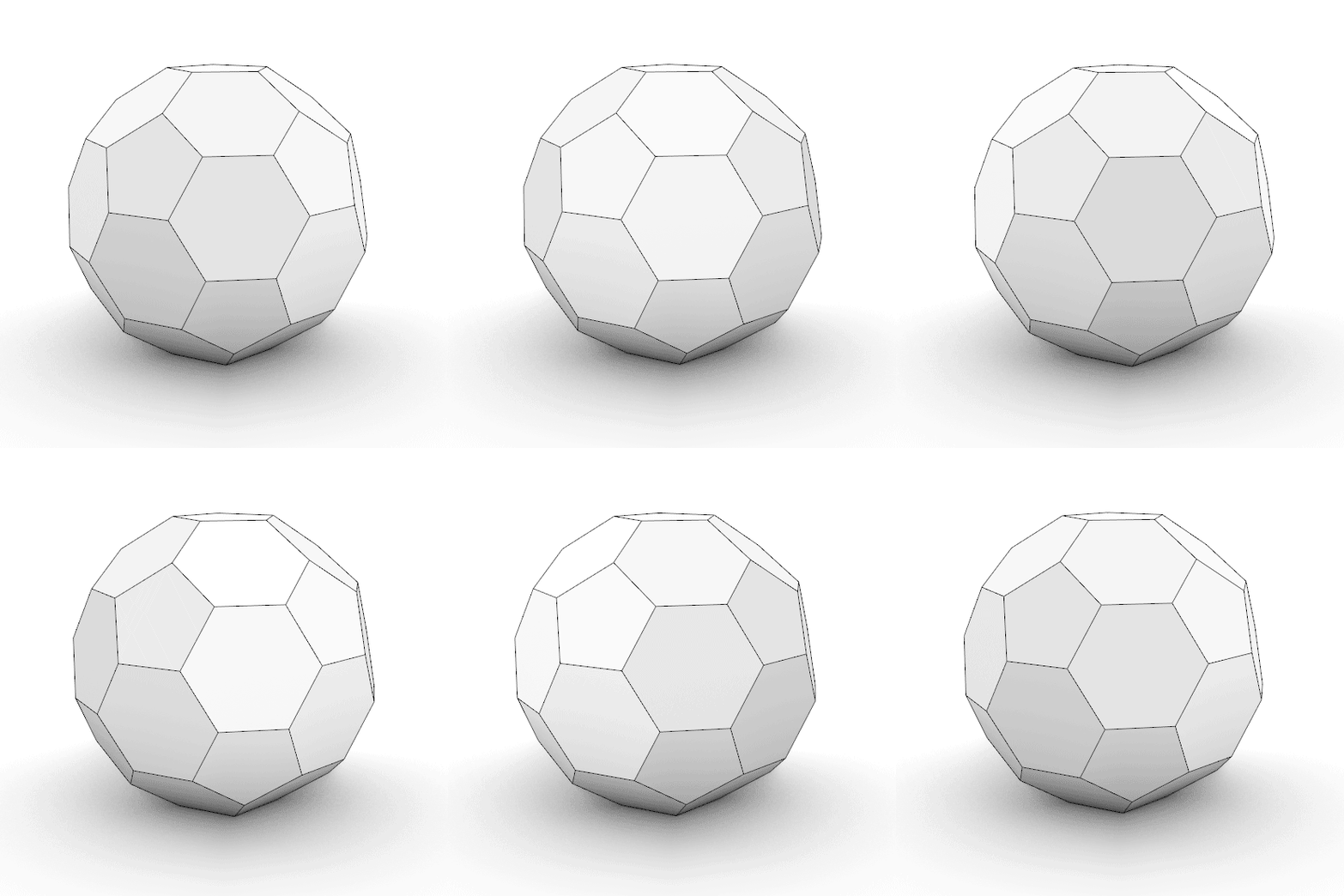
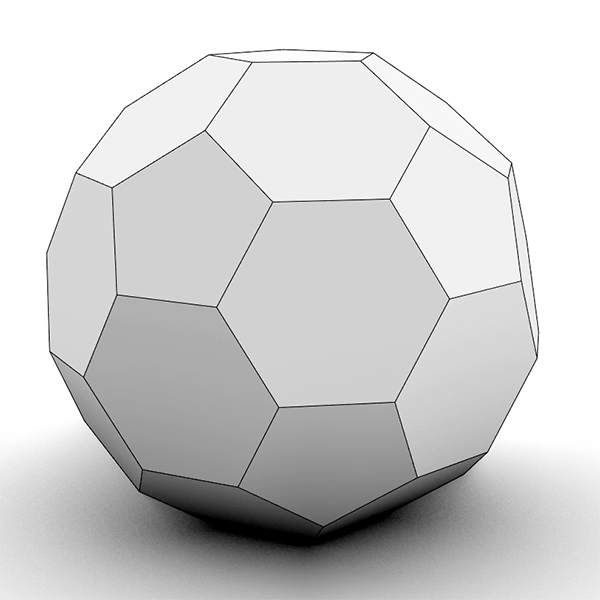
The Truncated Icosahedron (5,6,6) is an Archimedean Solid we often recognize as the iconic soccer ball. This geometric structure, also affectionately known as the “Buckyball” in honor of the visionary architect Buckminster Fuller, has gained significant popularity and recognition both within the realms of mathematics and everyday life. It is composed of twelve regular pentagons and twenty regular hexagons. This symmetrical nature makes it an interesting object of study in geometry and various fields. This is a short Rhinoceros tutorial on modeling the Buckyball.
The Truncated Icosahedron has found practical applications in architectural design, particularly in the geodesic domes pioneered by Buckminster Fuller. Geodesic domes utilize the inherent strength and efficiency of this polyhedral structure to create spacious, self-supporting objects. Its symmetry and mathematical properties have made it a subject of exploration in various scientific disciplines, including crystallography and materials science. We can construct a Truncated Icosahedron by just “truncating” an Icosahedron. This means we should be trimming one-third of each edge of an Icosahedron, (described here). To find 1/3’s of each edge, I used duplicate border, explode, and divide commands. I got the points that construct the pentagons and hexagons. Then, I finished paneling by using planar surface commands on closed polyline edges.
Cite this post
Related Posts
Modeling and Unrolling Buckyball
December 14, 2024
A Buckyball, (or Fullerene), is a molecule of 60 carbon atoms with a structure resembling a soccer ball. It is a specific type of fullerene, often referred to as C60, where the carbon atoms form a series of pentagons and hexagons in a pattern that creates a spherical shape. This structure is similar to the arrangement found in a truncated icosahedron, with 12 pentagonal and 20 hexagonal faces. The buckyball is named after architect Buckminster Fuller, who popularized geodesic domes,…
Modeling and Unrolling Mecon
December 14, 2024
The truncated octahedron is an Archimedean solid, characterized by a mix of hexagonal and square faces, and it has a very symmetrical and regular structure. Buckminster Fuller called this solid “Mecon”. The truncation process includes the cutting the edges of a polyhedron. We do this by dividing every edge of the polyhedron into 1/3s. Then, we carefully re-connect these division points to generate new, planar polygons. In the case of a truncated octahedron, we transform the 8 regular triangular faces…
Modeling and Unrolling Dymaxion
December 14, 2024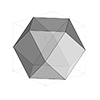
Buckminster Fuller used the term “dymaxion” for a variety of his designs, and one of these was the dymaxion map. It was based on the geometry of a polyhedron. While the dymaxion map is more directly related to the icosahedron, Fuller’s work often involved using other polyhedral shapes. One of them is the cuboctahedron. He used this term for various conceptual and practical designs, particularly in the context of his ideas on efficiency and structure. The cuboctahedron itself is notable…
Modeling Truncated Icosidodecahedron
December 15, 2024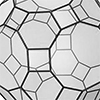
In geometry, a truncated icosidodecahedron, rhombitruncated icosidodecahedron, great rhombicosidodecahedron, omnitruncated dodecahedron, or omnitruncated icosahedron is an Archimedean solid. It is one of thirteen convex, isogonal, non-prismatic solids constructed by two or more types of regular polygon faces. In this short tutorial, I am constructing an irregular truncated icosidodecahedron. It is not the regular Archimedean solid, but a rough approximation of it. I made this model to exercise the exploration of new polyhedra by using rectification and truncation operations. Nevertheless, here…
Modeling Rhombicosidodecahedron
December 15, 2024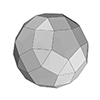
The rhombicosidodecahedron, an Archimedean solid, is one of the 13 convex polyhedra made up of regular polygons. While all its faces are congruent, they consist of various types of regular polygons. I previously explored this fascinating polyhedron and am revisiting it now as part of the Architectural Geometry course. In this short tutorial video, I demonstrate the modeling of a rhombicosidodecahedron. Despite its lengthy and unusual name, this polyhedron is truly a remarkable and beautiful structure. I hope that this…