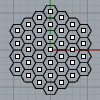
This python code proves how much effort it takes to create a simple hexagonal tessellation. There are, of course, much easier and faster methods than this. But here you see a code that introduces students to Rhino Python. Using this code, a new Rhino command can be generated, and for the first time in Rhino, we can have a command that creates a hexagonal grid. I followed this tutorial to […]
“Grasshopper” çalıştayı İstanbul Bilgi Üniversitesi Eyüp / santralİstanbul Kampüsü’nde, Mimarlık Fakültesi içerisinde 26 ve 27 ekim tarihlerinde 2 gün boyunca saat 10:00 – 16:00 arasında gerçekleştirilecektir. “Grasshopper ile Parametrik Modelleme” kitabının yazarları Tuğrul Yazar ve Serkan Uysal tarafından yürütülecek çalıştayda Grasshopper’a giriş, veri yapıları ve temel geometrik dönüşümler incelenecek ve uygulamalar yapılacaktır. Çalıştay dili Türkçedir. Katılım ücretsizdir. Katılım için önceden kayıt yaptırmak gerekmektedir. Kayıt başvurusu için 24 ekim saat 18:00’e kadar […]
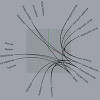
This is done because I needed to represent relationships between different factors and layers of a design process. Although this method of “Chord Diagrams” is a very common technique in information design, it became very hard to find an effective tool for generating those diagrams quickly. There seem to be a solution called “Circos” but however, even installing it on the computer became very boring for me. So I decided to […]
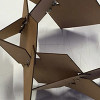
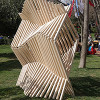
This project started as a study on a geometric method called quadror, but resulted in an amazing self-standing structure with the capability to fold flat. Initially, after Ayza made lots of sketches and models, the project team continued the research and finally, they managed to build one prototype only in two days. Here are some photos of this project but there are much more variations and models on their own […]
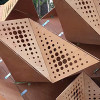
Another well-organized group of students produced this self-standing structure in only a couple of days. This group joined the same 8mm wooden plates into a set of components of 8-sided polyhedra. Then, they joined these components in a fashion that the macro form emerged from the angles of their geometry. Below are some of the pictures of their production phases: The final prototype Some phases of the production Model of […]
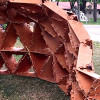
A very hard-working group from this year’s Computation-based Basic Design Studio produced this amazing structure. They joined 8mm cnc-cut wooden plates using puzzle-like cuts and tightened them with strings. A good example of group coordination produced this result in two days. Below are some photos of the prototype and the project phases: Final prototype. Interlocking Structure The joint details and the first experiments. *Students: Aslı Naz Çolakoğlu, Aybike Yılmaz, Bilge Kardelen […]
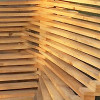
In this final project for İBU Basic Design Studio in 2015, wooden sticks are arranged to produce ruled surfaces for various uses such as sitting, leaning, etc. Here are some photos of the final prototype and its production phases. Final prototype Digital model First sketches. *Students: Dilara Çerçi, Elham Kaya, Gizem Kama, Gül Zorlu, Gülşah Kılıç, Orhan Ünver, Yiğit Altındağ, Sena Ortaç Here is the students’ blog on this project.
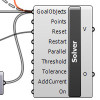
After several readings, I’ve understood the way of working the new and very interesting feature of Kangaroo 2: “Grab”. Now, we can actually grab the Grasshopper objects from Rhino viewport! Also, on one hand, the new Kangaroo has a very special way of working (not common to us, native Grasshopper users) and on the other hand, it is very very easy to use and understand now. I loved that. Here […]
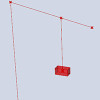
It is a nice exercise to study various components of point-to-curve transformations and vice versa. Tower Crane was our second-week exercise at İstanbul Bilgi University Faculty of Architecture Parametric Modeling class, asking students to design and draw a parametric object that has joints and parts that are moving alongside straight lines. Below is the most “safe-side” solution for me, although there are also very complicated solutions such as Mertcan’s. [GHX: 0.9.0076] here […]
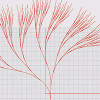
This is a classical method of generating tree-like forms utilizing a simple command “Arc SED”. The idea is simple, as the command draws arcs using an input direction vector, so this could easily be implemented creating a “smooth” composition of curves just by iteration. Actually, this has been a previous study, discussed before here, using Hoopsnake. Now, this time I’m implementing the same algorithm using Anemone and a couple of other […]
Utilizing “Force Field” components of Grasshopper to show my students how it is easy to develop flexible surfaces in design. The classical parametric canopy design is introduced in this video: According to Wikipedia; In vector calculus, a vector field is an assignment of a vector to each point in a subset of space.[1] A vector field in the plane, for instance, can be visualized as a collection of arrows with […]
The A-Chord folding structure was developed and constructed for the World Wood Day 2015 event in İstanbul. The structure had fifty wooden struts of 4 cm X 4cm with changing heights from 200 cm to 230 cm. Two struts joined with a hinge enabled the folding motion of the structure. Thus, the nearby unit is folding in the opposite direction. The Grasshopper model generated all construction details and drawings automatically. As a result, […]
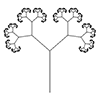
Based on this post, the problem of modeling tree-like fractal shapes is still a good question for the early years of computational design education. Last time, I used Rhino’s macro to study these fractal trees in an “impossibly” limited interface. But this time I used a VB.net script. Here is the code inside of the VB.net component: Here are the inputs. x is the number of iterations. The Crv input is […]
Some facade studies as early sketches of an architectural project; all of them are utilizing a similar Grasshopper approach. My favorite “Graph Mapper” generates the overall gridal deformation, then some of them are drawing geometry for membranes, while others are generated to be realized from sheet metal. Hopefully, one or two of these could be further studied: I hope I’ll be able to improve these sketches and publish their definitions […]
Further studying iteration in Grasshopper, this time, inspired by George Stiny’s “Chinese Ice-Ray Lattice” subdivisions with Aneome, instead of the Hoopsnake add-on I tried in the previous work. As you know, loops add various ways of usage to Grasshopper. In future versions, loops may cease to be just an add-on and become native components of Grasshopper. Until then, loop plugins like Anemone take on this task. In the example here, […]
About to finish the well-defined section of this year’s Parametric Modeling course, here are the mid-term questions I’ve asked; First question checks if the curve < > point conversions are well understood in Grasshopper. Evaluating a parametric curve and generating the closest point from another curve. This also requires a basic understanding of the use of the Grasshopper interface. The second question was testing a basic and classical use of […]
This is a great site, explaining very familiar concepts of dataflow diagrams for designers firsthand. Leveling is an interesting chapter there, I’m not sure if it completely fits with the use of “Clusters” in Grasshopper but it is obvious that the complex systems should be well organized not only to be perceptually “better” ones but also to develop a way to use parts of definitions again and again in different situations. […]