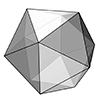
Today’s polyhedra is the beautiful icosahedron. It is one of the five Platonic Solids with twenty equilateral triangular faces. Its dual is the dodecahedron, which has pentagonal faces. Here, I explained the process of modeling an icosahedron. After creating a regular pentagon, you should find the “tip” point of the Icosahedron by intersecting spheres from at least three of the corner points with a radius of the pentagon’s edges. You […]
Posts categorized under Tools and Languages
A truncated tetrahedron is an Archimedean solid, created by slicing a tetrahedron. Its faces are regular hexagons and triangles. Assuming you’ve created a tetrahedron, first join its faces to create a closed polysurface. Now, you may recreate the lines of the tetrahedron’s edges, either by drawing them or generating them (Curve / Curve from Objects / Duplicate Edge). While the edge lines are selected, hit (Curve / Point Object / Divide […]
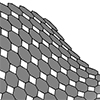
Back in 2011, one of the first posts on designcoding explored how to divide a surface in alternative ways. I called this Grasshopper definition a semi-regular surface tessellation. Although the term isn’t entirely accurate -since the pattern is neither planar nor made of equilateral shapes- it still reflects what I had in mind. Dividing surfaces into fabricable parts remains a key concept in learning parametric modeling, so I decided to […]
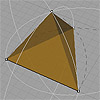
The tetrahedron is a platonic solid with four equal triangular faces (equilateral), six equal edges, and four vertices. In the construction of a tetrahedron, we will look closer at length transfers using compass-like tools in two- and three-dimensional space. To define the edge length of the first triangle, start with any two points in Cartesian space. Using a compass (arc or circle), draw two arches (or circles) using your initial […]
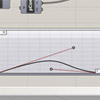
The smooth and continuous nature of the “Sine Surface” has garnered significant popularity among designers and architects alike. This captivating curved surface offers a visually pleasing aesthetic that adds an elegant touch to various design projects. Its flowing contours and gentle undulations create a sense of harmony and organic beauty. Recently, I delved into this with the help of Grasshopper’s Graph Mapping functionality, I began my artistic journey. Although I […]
Design scripting is initially based on secondary syntactic mechanisms that control sequential executions of code. We call this model of computation control flow programming. On the other hand, dataflow represents a widespread alternative to control flow by utilizing concurrent streams of data. Dataflow programming languages are also considered as pedagogical tools in fields where the coders are not expert computer programmers. In the last decade, new parametric modeling tools introduced […]
This is my first post in designcoding, dated 14.11.2011. I revisited the code and decided to re-publish it in 2024. Hello World! This is the Emergent Polygons definition, one of the first Grasshopper studies I made while learning the language. This is a very efficient programming language for designers and architects since it utilizes geometric relationships very intuitively. I think it will be more popular and widely used in the […]