
Trifoliolate
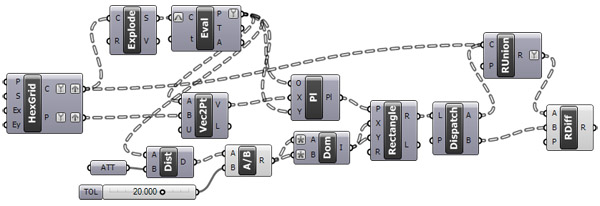
The Parquet Deformation exercise is generally originated with William Huff. Huff conducted it at several schools of architecture since the 1960s. Huff defines the exercise as rooted in two analytical disciplines; monohedral tilings in geometry, and the continuous deformations in biological morphology. This is generally exemplified by D’Arcy Thompson’s and Albrecht Dürer’s studies. One of the student’s works of Huff, Trifoliolate is a single-axis, single-prototile hexagonal parquet deformation. It was designed by Glen Paris at the studio of William Huff in 1966. I tried to analyze it and reconstruct it in several different ways. The Grasshopper code was surprisingly simple. Here is the result:
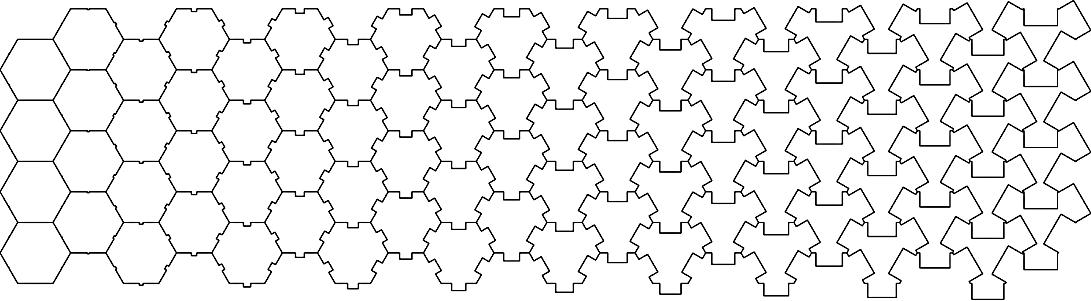
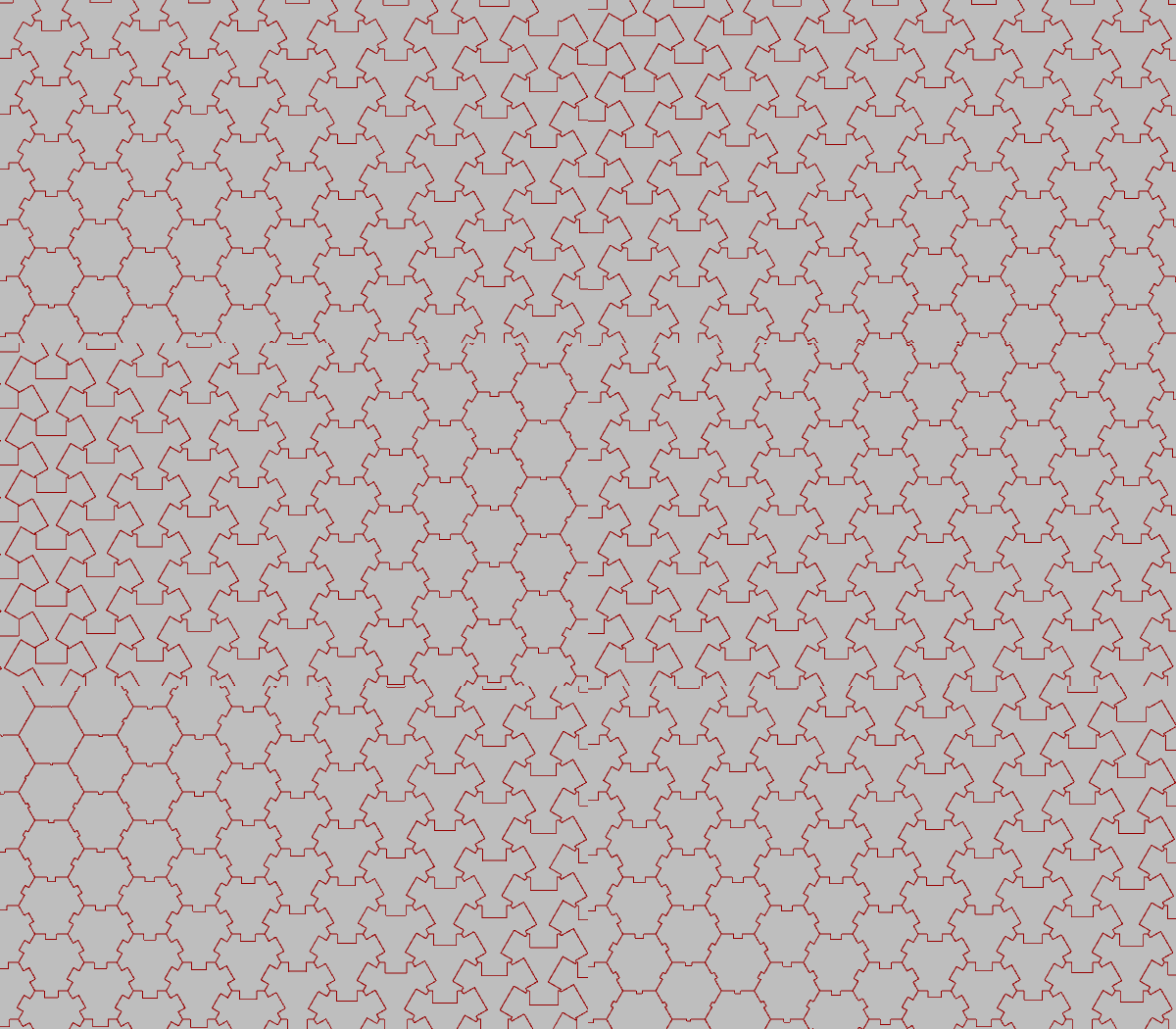
Here is a small phrase from Douglas Hofstadter:
Three of my favorites are “Crazy Cogs”, “Trifoliolate”,and “Arabesque”. They all share the feature of getting more and more intricate as you move rightward. Most of the earlier ones we’ve seen don’t have this extreme quality of irreversibility-that is, theratcheted quality that signals that an evolutionary process is taking place. Is there any way you can back out of that super-tangle except by retrograde motion-that is, retracing your steps? I suspect there is, but I wouldn’t care to try to discover it.
Hofstadter, D., 1983, “Metamagical Themas Questing for the Essence of Mind and Pattern”, Chapter 10.
When you switch the x and y axes of the plane, strange patterns start to emerge:
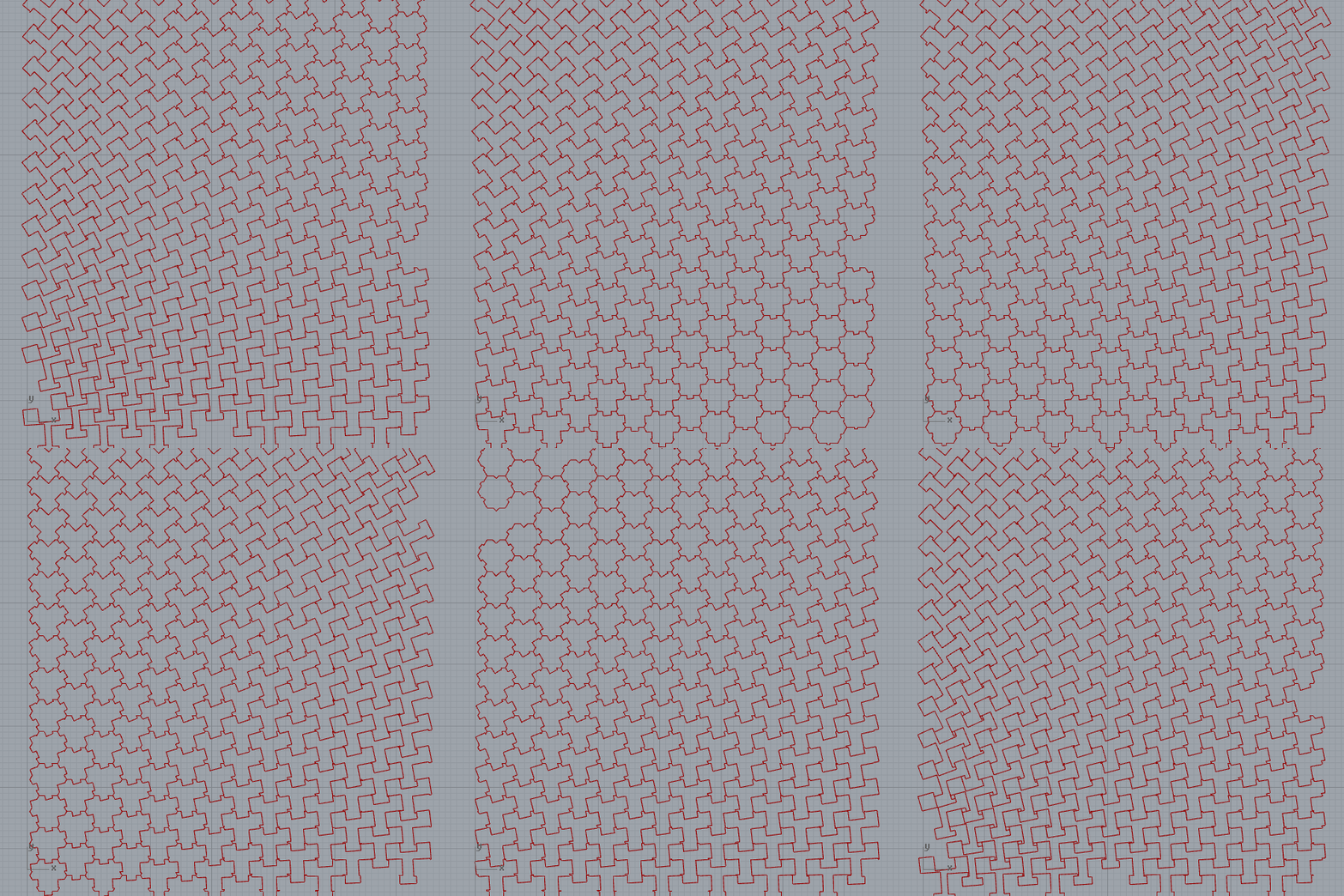
I love the contrast between the simplicity of the code and the rich variations it produces. Here is a journal paper I wrote about parquet deformations. In the paper, there are three reconstructions of classical parquet deformations with Grasshopper. I developed the below definition in 2013. But it still works without any problem in 2021.
Cite this post
Related Posts
Deformation of Islamic Patterns
March 2, 2024
This is the new version of my previous study on the deformation of Islamic Patterns. I love the purity and simplicity of the geometric construction processes of these patterns. It is possible to observe them in many places in many different forms. By continuing this work, I aimed to highlight the pattern deformations that map out all the variation possibilities of these patterns. Unlike previous versions, this time I aimed to achieve results ready for laser-cutting production. As you will…
Wiry Wonder
January 8, 2023
The Parquet Deformation named “Wiry Wonder” was designed by Michael Cuttita in William Huff’s studio at the State University of New York in 1989. The below figure shows the original drawing made by the student. Similar to the previous one, this composition is based on a hexagonal lattice. In this composition there are three significant prototiles, marking the three key moments in the shape-shifting process. There is also one invisible prototile. It accommodates the transition between the last two prototiles….
I at the Center
September 30, 2013
I at the Center is a multiple-axes vertex deformation based on a quadrangular hyperframe, designed by David Oleson at the studio of William Huff in 1964. Below, you see the original drawing and my Grasshopper animation based on a single-point attractor, creating the “I” wherever it is. It was a pleasure to read and repeat this deformation, which is a nice exercise in data tree operations and also one of the first examples I see about point attractor algorithms in design…
Parquet Deformation Handmade
October 31, 2012
This is not to explain the method of the Parquet Deformation but to see the potential. After we’ve studied regular, semi-regular, dual, and truncated tessellations with students, the Architectural Geometry course expects them to develop a Parquet Deformation handmade such as those shown below. I call them Parquet Deformation handmade. Because they are manually designed but drawn using traditional CAD. The samples you see below are from this website. It is a good source for other topics of tessellation as well….
Metamorphosis
November 28, 2014
Here are some of the student works from this year’s Computation-based Basic Design Studio, centered around the captivating theme of Metamorphosis. Throughout the course, we tasked the students with pushing the boundaries of their creativity and innovation and encouraged them to construct designs that transcend conventional limitations and embody the essence of shapeshifting systematic wholes. The metamorphosis concept catalyzed their artistic exploration. Then, urged them to delve deep into the realm of design possibilities. A pivotal aspect of this studio…