
Voronoi Kündekâri
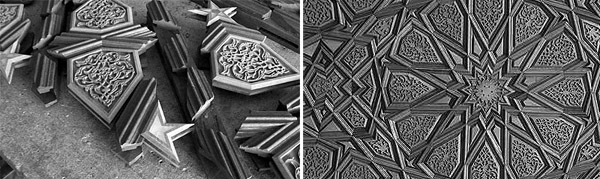
Kündekâri is an old woodworking technique, composed of interlocking parts without any glue or nail. It is primarily used in wooden doors and minbers inside Mosques. The interlocking system makes the whole structure very durable. I tried to model this technique using the Voronoi pattern, naming it Voronoi Kündekâri. Below you see a typical example of Kündekâri pieces and the resulting pattern.
The interesting part of the Grasshopper model is to define the tongue-and-groove detail. It is similar to a puzzle. Although it is very easy in Rhino to create it, I found it challenging to implement this detail with a non-regular subdivision such as Voronoi. In a regular subdivision such as hexagons, it was way much easier, such as the Trifoliolate (explained here). You have to tell Grasshopper which edge is tongue and which edge is groove one by one. In the real world, it is a very simple decision, but it is a mess for a dataflow algorithm. Because you should consider a random Voronoi subdivision, with cells composed of 3, 4, 5, or 6 edges. So, as you can see in the diagram below, I tried many tricks to solve this problem.
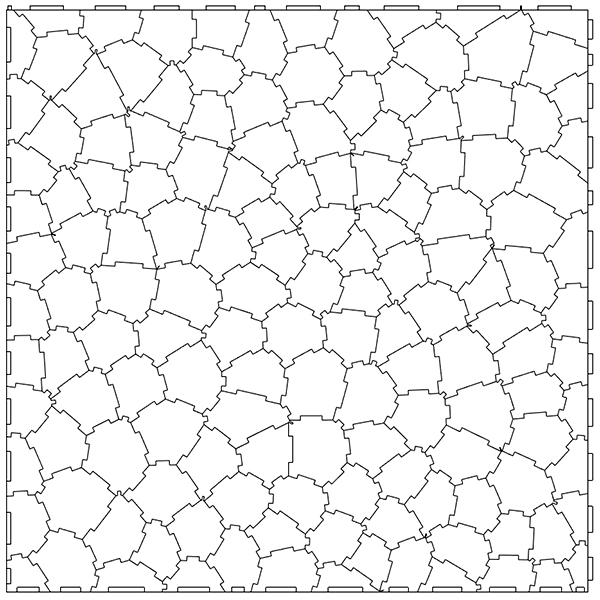
You can click on the diagram to see it larger. My process was simply splitting the edges, offsetting, and connecting the ends.
Cite this post
Related Posts
Voronoi Puzzle
April 5, 2023
In this Voronoi puzzle exercise, we derive two-dimensional puzzles by using Voronoi diagrams. This is similar to my previous studies here, and here. Part 1: The Random Voronoi Diagram In section 1 of the below image, I use a rectangular region to generate random points. Then, I create a standard Voronoi diagram by using those points. Finally, I explode the Voronoi cells. Part 2: The Voronoi Puzzle Details In the second part, we draw an arc on the edges of…
3D Voronoi Puzzle
May 3, 2023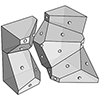
Here, our aim is to generate a 3D Voronoi puzzle ready for 3D printing. Below is the step-by-step explanation of this Grasshopper algorithm: The 3D Voronoi Puzzle Step number one is the application we saw earlier in the Voronoi diagrams. We obtain random polyhedra within a given volume quickly. The basic features we need for the puzzle are: (1) When we solve the puzzle the final volume should be a cube. (2) We should control the dimensions of the total…
Puzzling
March 21, 2012
Nowadays, I found myself back into traditional hand sketching. Several failed attempts on Grasshopper led me back there. NURBS (and Grasshopper) somehow limits our conception of surfaces to four-cornered (or two-directional) manifolds. Although it sounds like limiting our designs, having four-cornered component spaces has still lots of experimental fields for designers. Escher is a cult person, who transforms the euclidean coordinate system to meet his design intentions. There are lots of interesting research about him, and he shows us how…
Voronoi Cage
June 26, 2023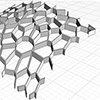
I have created a straightforward Grasshopper code that generates a Voronoi diagram on a surface. Then, it adds thickness to form a structure called a “Voronoi Cage.” In the initial step, I project a surface onto the ground plane (Z=0). The projected frame serves as the boundary for two operations: generating random points using the Populate 2D (Pop2D) function and calculating the Voronoi diagram based on these points. The resulting Voronoi cells are then slightly offset inwards. Moving on to…
Image Sampler Revisited
March 17, 2015
Image Sampler of Grasshopper saves life if used responsibly. While explaining the component to this year’s ARCH362 students, I used this simple example that generates numbers from a beautiful picture of “metal foam” and uses it to generate lots of circles: Metal foams are lightweight but strong materials, that are typically produced by injecting gas into the liquid metal. Of course, it becomes easier to teach something when you manage to attract the attention of students.